The Hidden Battle: Black Soldiers' Vietnam War Experience
At a pivotal moment when Black military history faces revision under certain political administrations, Wil Haygood's groundbreaking new book, The War Within a War: The Black Struggle in Vietnam and at Home, emerges as a crucial historical document. The tenth publication from the acclaimed author, this work meticulously chronicles the often-overlooked narratives of Black Americans who served during the Vietnam War era, from the mid-1960s to the mid-1970s.
A Chilling Discovery
During a Washington DC meeting to discuss his research, Haygood carefully produced a fragile, yellowed leaflet from a protective Ziploc bag. The document, distributed by North Vietnamese forces, contained a powerful message in both Vietnamese and English aimed directly at Black soldiers. It declared: "Colored GIs! The South Vietnamese people, who are struggling for their independence and freedom, are friends with the American colored people being victim of barbarous racial discrimination at home. Your battlefield is right in the USA! Your enemy is the war lords in the White House and the Pentagon!"
Haygood recounted how Dr. Elbert Nelson, one of the many soldiers interviewed for the book, discovered this propaganda leaflet attached to trees and walls throughout Vietnam. "He was so touched that I tracked him down," Haygood explained. "He said, 'I want you to have this.' It just gave me chills."

James Baldwin's Enduring Truth
The author, who met James Baldwin early in his journalism career, opens his book with a powerful 1967 quote from the legendary writer. Haygood read Baldwin's words with steady conviction: "Long before the Americans decided to liberate the south-east Asians, they decided to liberate me. My ancestors carried these scars to the grave, and so will I. A racist society can't but fight a racist war – this is the bitter truth. The assumptions acted on at home are also acted on abroad, and every American Negro knows this for he … was the first Viet Cong victim. We were bombed first."
"I came across that quote early in writing," Haygood revealed, "and I said to myself, 'I've got to use that at the beginning of the book, because it says everything.' It synthesizes so much of what the feelings were among so many of those soldiers."
Stark Statistics and Systemic Inequality
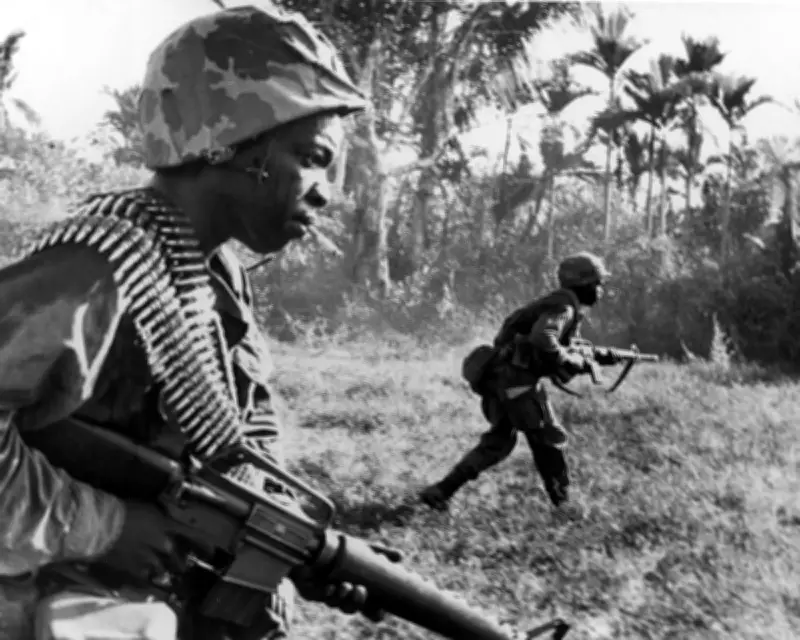
Library of Congress figures paint a disturbing picture of disproportionate Black participation and sacrifice. Approximately 300,000 African Americans served in Vietnam, with Black soldiers comprising 31% of ground combat battalions in 1965 despite representing only 12% of the general population. These soldiers saw combat at higher percentages and suffered casualties at elevated rates, leading Dr. Martin Luther King Jr. to famously describe the conflict as "a white man's war, a Black man's fight."
Haygood emphasized Vietnam's unique position as America's first desegregated war, where Black and white soldiers theoretically had to depend on each other. "The Civil Rights Act of 1964, in spirit, told us to do that, to respect your fellow man or woman," he noted. "But so often, that didn't happen."
Personal Connections and Collective Memory
The book's origins trace back to Haygood's childhood in Columbus, Ohio, where he witnessed neighborhood friends like Skip Dunn depart for Vietnam. The 1968 assassination of Martin Luther King Jr. created watershed moments both domestically and for Black soldiers overseas, coinciding with the devastating Tet Offensive that signaled the war's unwinnable nature.
Despite extensive Vietnam War scholarship, Haygood identified a significant gap in Black soldier narratives. "Americans are still pretty confused by that war," he observed, "and it's a scary war to talk about because it lasted so long." His research led him to reconnect with five other Black veterans from his neighborhood, providing personal foundation for broader national interviews.

Remarkable Individuals and Cultural Impact
The book features diverse perspectives including West Point graduate Joseph B. Anderson, subject of the Oscar-winning documentary The Anderson Platoon; heroic Ia Drang battle participant George Forrest; captured pilot Fred Cherry; and journalist Wallace Terry, author of the seminal oral history Bloods.
Haygood also examines cultural responses to the war, including Motown's spoken-word albums opposing the conflict and Marvin Gaye's masterpiece What's Going On, partially inspired by his brother Frankie's psychological trauma. The narrative includes nurse Dorothy Harris's bond with Captain Riley Leroy Pitts and his widow, and the tragic story of mixed-race pianist Philippa Schuyler, who died in a helicopter crash while attempting to rescue Vietnamese orphans.
Political Consciousness and Historical Revisionism
The book documents evolving political awareness among Black soldiers, expressed through gestures like "dapping" for solidarity and manifested in events like the lethal Long Binh Jail uprising where Black soldiers were disproportionately represented.
Haygood's publication arrives amid contemporary battles over military history. The book highlights General Art Gregg, who rose from lieutenant colonel in 1966 to become the Army's first Black three-star general by 1982. In 2023, Fort Lee's renaming to Fort Gregg-Adams honored Gregg and Lt. Col. Charity Adams, only for the Trump administration to revoke this recognition in 2025 as part of broader base renaming reversals.
"It's unbelievable that a nation as big as ours, steeped in the history of slavery and in the savagery of Jim Crow, would come to a point when it would try to rewrite history," Haygood asserted. "This is the book the literary gods at this point in life wanted me to write, because I do firmly think that writers and film-makers will step up in this moment, amid this effort to whitewash history. As long as I have a pen in my hand, I will fight the good fight."