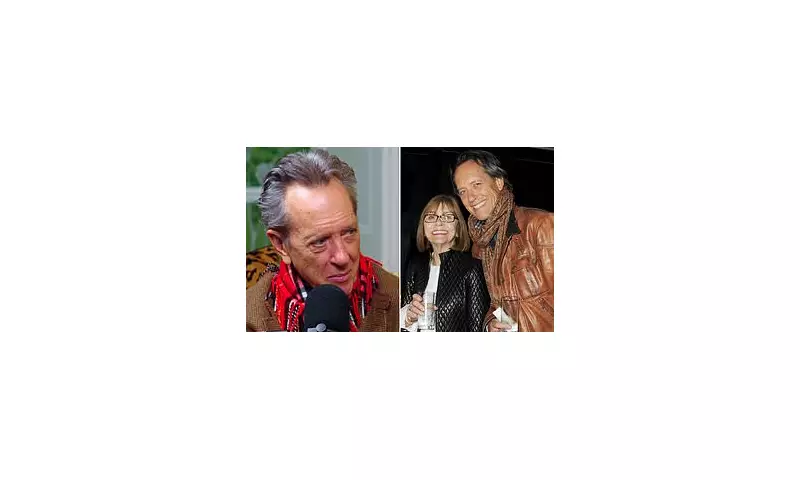
In a deeply emotional and candid interview, acclaimed actor Richard E. Grant has shared the raw reality of his ongoing grief, four years after the tragic loss of his beloved wife, Joan Washington. The 68-year-old star fought back tears while speaking on Paloma Faith's Mad Sad Bad podcast, offering a poignant insight into a bereavement that his mind still struggles to comprehend.
A Love Story Cut Short
Grant first met dialect coach Joan Washington in 1982, with the couple marrying four years later in 1986. Their union lasted 38 years and brought them a daughter, Olivia, now 34. This enduring partnership was devastatingly cut short in September 2021 when Joan passed away at the age of 74. Her death came just eight months after she received a diagnosis of stage four lung cancer, leaving a void that Grant describes as impossible to fill.
The Daily Struggle with Loss
Speaking openly about the fourth anniversary of her passing, Grant explained the profound disconnect between rational understanding and emotional reality. 'I understand it rationally, that I will never see, touch, talk to her ever again,' he stated. 'But, emotionally, my brain cannot compute that she's gone.' This cognitive dissonance led him to develop a unique and intimate coping mechanism: writing to his late wife every single night.

He revealed that this nightly ritual began instinctively and has become a crucial part of his grieving process, though he admits 'that is the hardest bit to get used to.' The act of writing, he suggests, creates a tangible, ongoing conversation that helps bridge the immense gap left by her physical absence.
Memory as a Survival Mechanism
Grant spoke movingly about how his memory has reconfigured itself in the years since Joan's death, focusing almost exclusively on the positive times. 'The trick of memory is so extraordinary,' he reflected. His mind now primarily recalls Joan in full health, rather than during the eight months of her illness—a period that represented just a fraction of their nearly four-decade life together.
He noted that encountering a photograph from her final months can be 'a real shock,' as it conflicts with this protective mental editing. 'I suppose that is what you do,' he mused, 'your survival instinct to only remember the good bits.' With 38 years of shared joy, this selective remembrance allows him to cherish their life together.
Navigating a World of Grief
The actor was strikingly honest about the daily impact of his loss, confessing that he cries every day. These tears are not solely from sorrow; they also spring from moments of joy or even reactions to the news. When asked about recovery from such a profound loss, Grant offered a nuanced perspective that challenges common platitudes.
'I don't think of it like that,' he said regarding 'getting over' grief. 'I think that it's something that you navigate your way round it, and you don't get over it.' He expressed a degree of resistance to well-meaning phrases like 'time will heal,' explaining that he has not wanted to 'get over' Joan's death, as that would feel like relegating her life to the past.
An Irreplaceable Bond
In previous interviews, Grant has elaborated on the irreplaceable nature of his connection with Joan. He has spoken of how he 'can't imagine falling in love again' and that, despite friends setting him up on blind dates, 'nobody else has even come near' to matching what they shared. He described feeling 'truly seen and understood by another human being' in a way that remains unique to her.
His nightly letters serve as a physical anchor for this ongoing bond. 'I find that it feels like I have a physical, tangible, ongoing conversation with her that's written down,' he told The Telegraph. 'I've found that really, really helpful.' These writings cover everything from daily events to mundane thoughts, keeping her presence actively woven into the fabric of his life.

Richard E. Grant's heartfelt disclosures provide a powerful, unvarnished look at long-term grief, love, and the human capacity to adapt to unimaginable loss while honouring a memory that continues to shape every day.