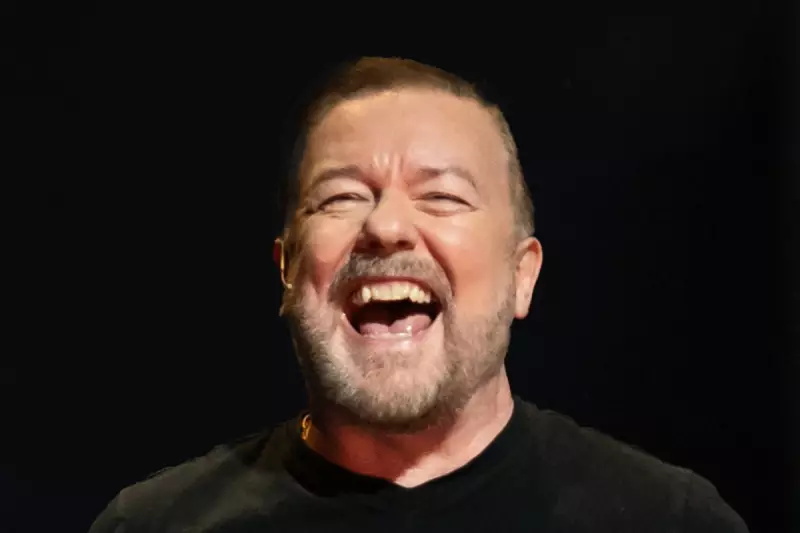
Ricky Gervais's latest Netflix stand-up special, released in late December 2025 and titled 'Mortality', promised a deep dive into life's ultimate question but delivered little more than a parade of the comedian's everyday annoyances and well-worn provocations.
A Weighty Title, A Mundane Reality
Given the profound subject matter tackled by comedy greats like George Carlin and Norm Macdonald, and Gervais's own exploration of grief in After Life, expectations were high. The reality, however, is a show where death is 'barely an afterthought', as Gervais himself admits near the end of the hour-long set. Instead, the 64-year-old multi-award-winning comedian focuses on settling petty scores and constructing straw-man critics, allowing him to posture as a noble defender of free speech against a supposedly silencing elite.
Playing the Victim Amidst Global Acclaim
Gervais opens the special by highlighting how complaints and calls to ban his work have only propelled his shows to the top of Netflix, a tactic also used in his 2022 special Armageddon. This narrative of being persecuted by 'elitists' continues, despite Gervais's immense success: Armageddon won a Golden Globe, Mortality is already nominated for awards, and Gervais recently received a star on the Hollywood Walk of Fame. This persistent focus on cancel culture rings hollow, resembling the victim-playing he claims to despise.

Notably, the special avoids the trans-related material that drew significant criticism for his 2022 show SuperNature, which was labelled 'dangerous, anti-trans rants' by an LGBTQ+ charity. However, the controversy he courts feels dated. A routine attempting to reclaim 'gammon' as a white equivalent to a deeply offensive racial slur lacks nuance and ignores painful historical context for the sake of an awkward laugh.
Glimmers of Brilliance Amidst the Grumbling
The special is not without its moments. Gervais's physical comedy, a relic of his iconic David Brent performance, remains sharp. A bit about Stephen Hawking on Epstein's island is pointed, and there are flashes of the dark, absurd humour that made him famous. He also offers a behind-the-scenes anecdote from hosting the Golden Globes, involving a stand-off with lawyers over the word 'minge'.
Yet, for a show billed as his 'most honest and confessional', there is a striking lack of self-reflection. Brief mentions of wanting his body fed to London Zoo's lions and the pains of ageing offer little substantive contemplation of mortality. Ultimately, the show circles back to Gervais's stated philosophy on legacy, first voiced in Armageddon: 'F*** my legacy. You can't plan your legacy.' Judging by the content of Mortality, which even finds time for a plug for his vodka brand, he seems intent on proving that point.
In its most earnest moment, Gervais asserts that 'free speech is still a really good thing'. He has undoubtedly benefited from it, achieving wealth, critical acclaim, and a global platform. But Mortality leaves viewers with a nagging question: what is the value of that freedom if you have nothing new or meaningful to say?