Jonathan Anderson's Avant-Garde Vision Transforms Dior Haute Couture
Jonathan Anderson's highly anticipated debut as creative director of Dior's haute couture line has finally arrived, marking a significant moment in the fashion industry's calendar. The Irish designer presented his first formal collection at the historic Musee Rodin in Paris, signalling a bold new direction for one of fashion's most prestigious houses.
From Tradition to Experimental Innovation
Anderson's approach represents a fundamental shift from reverence to curiosity, replacing traditional couture conventions with experimental artistry. Late last year, the designer declared his intention to "change couture at Dior," and his debut collection demonstrates precisely how he plans to achieve this ambitious goal. Rather than discarding established codes, Anderson has reimagined what couture can represent in the modern era.
In an interview with i-D magazine last September, Anderson revealed that his first couture collection would be "completely abstract" and serve as a laboratory for "newness within form." He emphasised that couture should prioritise experimentation, artistic expression, volume exploration, and conceptual ideas above all else.

Nature as Primary Muse and Structural Foundation
The collection drew profound inspiration from natural forms and materials, with clay serving as a central conceptual starting point. Before the show began streaming to global audiences, a ceramicist provided context, explaining how ceramics fundamentally depend on the human form for their existence. This tension between flesh and form became the collection's animating principle.
Dresses appeared moulded rather than sewn, with skirts flaring like bell-shaped vessels and bodices rising from torsos as if sculpted by hand. The overall effect transformed couture into wearable sculpture, with raw materials serving as Anderson's primary muse. References ranged from iron meteorites to cyclamen flowers, from seashells to sweeping grasslands.
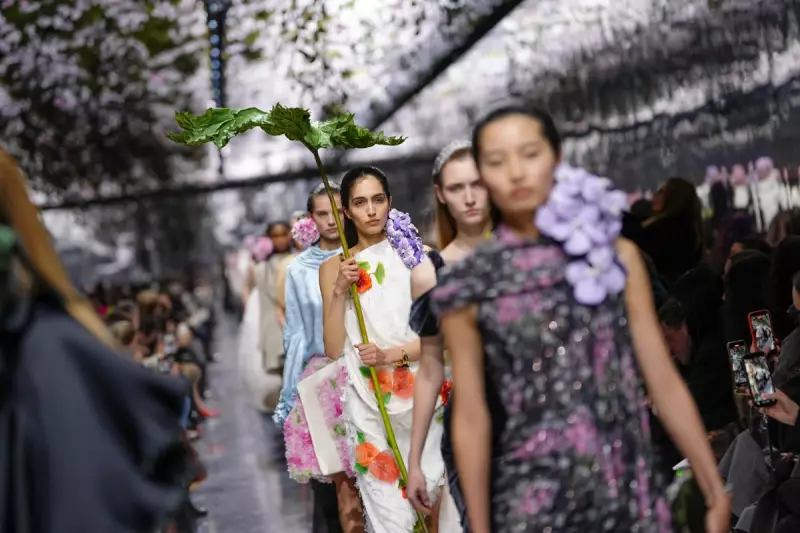
Nature's inherent logic—its precision, oddness, and refusal of symmetry—was meticulously translated into fabric. Feathered skirts fell like plumage mid-moult, while flecked capes echoed scattered petals and ruffled hems mimicked the torn edges of blooms. Conical clutches resembled shells, and bags sprouted cascades of green as though overgrown from dress roots.
Reinterpreting Dior's Floral Heritage
Flowers have been Dior's enduring heritage motif since Christian Dior's revolutionary 1947 debut, carried through John Galliano's romantic theatrics and Maria Grazia Chiuri's feminist florals. Anderson honoured this lineage while simultaneously turning it on its head. His blooms became structural rather than decorative elements, built into silhouettes, erupting from seams, and hovering around bodies like living organisms.
Hydrangea earrings brushed shoulders, and bustles fanned out like peacock tails, reaffirming that Dior could once again embrace "pretty" aesthetics without sacrificing innovation. The colour palette extended the bold hues from Anderson's September 2025 ready-to-wear collection, featuring lime, lilac, fiery orange-red, and powder blue alongside Dior's signature soft pinks.
Redefining Couture Conventions
Anderson challenged traditional couture norms across multiple categories. Footwear moved away from expected high heels toward metallic flats, sneakers, and loafers, suggesting that couture need not teeter on stilettos to maintain glamour. Knitwear appeared in deconstructed wools and generous, tactile fabrics—materials typically considered unorthodox in haute couture but here elevated to sophisticated new heights.
The designer suggested that feathers and silk hold no inherent superiority over sheep's wool; true value lies in imaginative application rather than material pedigree. Closing looks featured sky-blue silk gowns emblazoned with flowers, demonstrating tonal restraint alongside exceptional tailoring. The bridal dress—crafted from silk and chiffon, backless, with feathers fluttering down the bodice into a pluming skirt—appeared both romantic and otherworldly, as if grown rather than manufactured.

Star-Studded Front Row Attendance
The historic occasion attracted fashion royalty to its front row, including former Dior creative director John Galliano, who led the maison from 1996 and introduced several legendary designs including the iconic Saddle bag. Brand ambassador Jennifer Lawrence embodied Anderson's ethos of combining casual and couture elements, attending in jeans and a vest paired with a structured wool coat and fur stole.
Alexa Chung and actor Josh O'Connor also occupied front-row seats, channelling sophistication through Dior capes and deconstructed knitwear while maintaining casual foundations. As Vivaldi's Spring filled the mirrored exhibition space, the collection's closing message became clear: couture is no longer about preserving beauty based solely on heritage but about allowing it to grow, evolve, and transform.
Anderson's debut represents more than just another fashion collection; it signals a philosophical shift for one of fashion's most storied houses. By blending natural inspiration with avant-garde execution while honouring historical motifs through contemporary lenses, the Irish designer has established a compelling new direction for Dior's future.