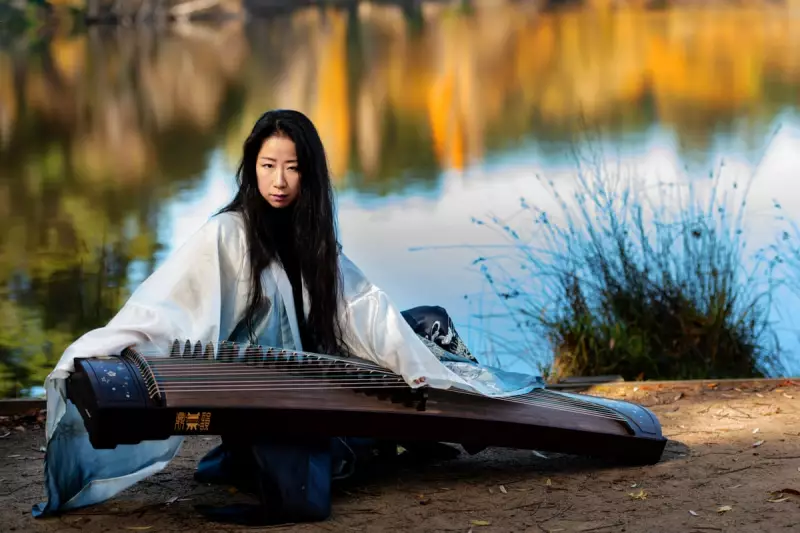
An Australian-based musician is channelling the profound disorientation of personal grief into a groundbreaking theatrical production, set to captivate audiences in Sydney and Melbourne. Mindy Meng Wang, a virtuoso of the ancient Chinese guzheng, has created Opera for the Dead 祭歌, a contemporary cyber-opera directly inspired by the elaborate, three-day funeral of her father in 2015.
From Cultural Shock to Artistic Innovation
When Wang's father passed away, she returned to her home city in north-west China to organise the traditional ceremony. The experience, filled with prescribed rites like burning paper effigies and ritualised crying, left her feeling "completely shocking and disorienting." She recalls the conflict between genuine sorrow and performative expectations, stating, "People criticised my crying... I was meant to do a performative cry – really loud and a big gesture – but it was like, 'I'm actually feeling really sad, I can't do this!'"
A decade later, this potent mix of emotion and ritual forms the core of her most ambitious work. Opera for the Dead 祭歌 opens this week at Sydney Festival, with an encore season in Melbourne where it debuted. The one-hour immersive show blends live guzheng music and singing with 3D-mapped projections and vivid animations. Audiences walk through an environment featuring six moving stages, video screens, and five performers, including a countertenor and a cellist.

A Fusion of Tradition and Modernity
Co-created with Malaysian-born Chinese Australian composer Monica Lim, the opera sprang from conversations about funeral rituals across the Chinese diaspora. The duo were fascinated by the contradiction between spirituality and materialism in modern ceremonies. Wang observes the evolution of symbolic offerings: "In the past you would burn the yellow round paper, symbolic of money... Now they burn paper iPhones, Mercedes, servants, American Express."
She also noted adaptations for convenience, such as the use of pre-recorded chanting machines, which she encountered at her father's funeral. This blending of ancient practice with contemporary reality is central to the opera's theme. Despite its specific cultural roots, Wang emphasises the show's universal accessibility: "Most people will find it quite emotional in parts... You don't need certain knowledge to be able to enjoy the show."
A Prodigy's Path to Pioneering Art
Wang's journey to this point is remarkable. She began learning the 2,500-year-old guzheng at age six in Lanzhou, Gansu province, under a strict regime of up to eight hours of daily practice. A prodigy, she received offers from China's top conservatoriums by 16. Her path shifted when her father suggested a UK exchange program. At 16, she travelled alone to London, eventually enrolling in a musicology degree which "broadened my knowledge about western music" and changed her creative approach.
Her career flourished in Europe with the top-tier Silk String Quartet, leading to a pivotal role in Monkey: Journey to the West, the pop opera co-created by Gorillaz's Damon Albarn and Jamie Hewlett. This experience revealed new musical possibilities. A visit to Melbourne in 2010 led to a lasting connection with the city's music scene. After her father's death, she moved to Australia permanently, where she has continually pushed the boundaries of her instrument.
"I always want to do something that hasn't been done before," Wang asserts, a philosophy that fully manifests in Opera for the Dead 祭歌. The production represents the culmination of a four-decade journey from child prodigy in China to an innovative artist performing on the world's most prestigious stages, now using cutting-edge technology to explore timeless themes of loss, ritual, and memory.