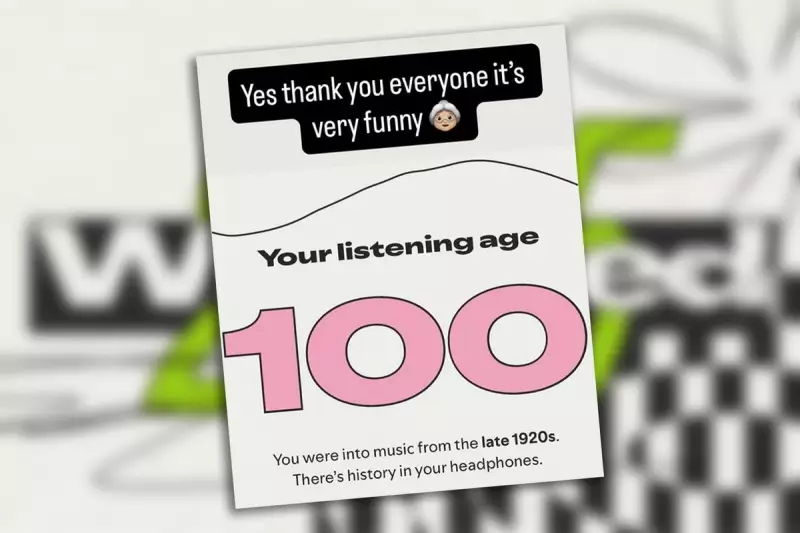
In a digital assessment that left her feeling more baffled than flattered, a millennial journalist discovered her Spotify 'listening age' to be a staggering 100 years old. Claire Cohen's annual Wrapped summary, released on Thursday 04 December 2025, placed her musical tastes firmly in the centenarian bracket, a verdict she finds more embarrassing for the streaming giant than for herself.
How Spotify Calculates Your Musical Age
The feature, a clever annual marketing ploy from Spotify, analyses users' most-played songs and artists over the past 12 months. It then assigns a 'listening age' based on the concept of the 'reminiscence bump'. The algorithm examines the release dates of your most-streamed music, identifies the five-year period you engage with most, and hypothesises that you were between 16 and 21 years old during that time. For Cohen, this logic suggested she was a teenager in 1941, a conclusion that left her reaching for the metaphorical wireless.
Cohen's year included deep dives into Britpop, heavy rotation of Lily Allen's new album, and the soundtrack to summer barbecues and a first birthday party. Despite this mix, her top genres were listed as indie, soul, alternative pop, Britpop and electronica. "I thought I was quite current?" she questioned, noting her enjoyment of podcasts unrelated to the Boer War and a shared account with a mother-in-law who prefers Slipknot and house music.

The Social Media Humblebrag and Silent Shame
The feature has flooded social media feeds, tapping into a universal desire to be seen as culturally relevant. Users proudly post youthful listening ages, like 17, accompanied by Spotify's flattering note: "Since you listen to mostly new music. Your taste is trending." Others benefit from shared accounts, like one friend bestowed with a listening age of 29 thanks to her husband's Taylor Swift and Avril Lavigne sessions.
However, Cohen noted a distinct lack of people sharing listening ages in the forties, fifties, and sixties. A friend in media confessed to a listening age of 46, heavy on "peak midlife dad" French electronica, but refused to share it publicly. The trend reveals a cultural anxiety about being perceived as middle-aged and musically middle-of-the-road.
Why Musical Taste Defies Simple Age Boxes
Cohen and other 'geriatric' listeners argue that Spotify's age-based categorisation fails to reflect modern listening habits. In an era of algorithmic discovery, tastes are more eclectic than ever. Gen Z embraces Nineties and Noughties fashion and music, aligning them with listeners decades older. Meanwhile, older millennials and Gen Xers often retain a soft spot for the Sixties and Seventies music of their parents' generation.
"Putting us in musical boxes, according to age, fails to recognise the reality of how we listen," Cohen writes. Her own playlist highlights this range: alongside Lily Allen, she streamed Carole King, The Drifters, and Edith Piaf (the latter on her caesarean playlist). Furthermore, children's music, like her son's 1920s music hall version of "Teddy Bear's Picnic," skews the data without exemption.
Ultimately, the humorous outrage sparked by a listening age of 100 underscores a deeper truth: musical identity is a complex, personal mash-up, resistant to the neat labels of an algorithm. As Cohen concludes, her diverse taste is simply "called having range" – a reality streaming platforms help create but sometimes struggle to define.