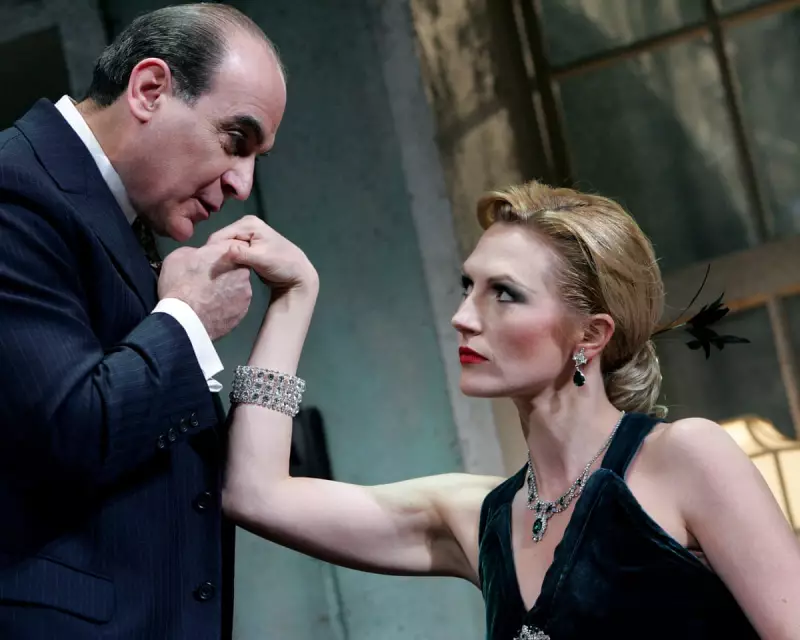
A major revival of a rarely performed Terence Rattigan play is set to shed new light on the playwright's personal struggles and prescient commentary. 'Man and Boy' opens at the National Theatre's Dorfman theatre on 30 January, running until 14 March.
A Play of Personal and Professional Urgency
First written in 1954, 'Man and Boy' was of immense importance to Rattigan. With his reputation challenged by the emerging 'Angry Young Men' of the Royal Court, he saw it as a final opportunity to prove his serious dramatic credentials. The plot was inspired by the real-life Swedish financier Ivar Kreuger, whose empire collapsed during the Great Depression.
Rattigan transferred this story to 1934, centring on Gregor Antonescu, a Romanian financier on the brink of ruin. In a desperate bid to secure a merger, he hides in the Greenwich Village apartment of his estranged son, Basil. The play's shocking core lies in Gregor's ruthless exploitation of his son's sexual allure to manipulate the chairman of American Electric.

Rattigan's Uncompromising Vision and Personal Demons
Typically diplomatic, Rattigan was uncharacteristically stubborn about this work. He described his protagonist as "as evil as Iago" and refused to soften the text when requested by intended star Rex Harrison and director Glen Byam Shaw. He even dug his heels in when Laurence Olivier rejected it for the inaugural Chichester Festival season.
This intensity stemmed from deep personal roots. The play is fundamentally a father-son drama, a theme crucial to Rattigan's own life. His father, Frank, a diplomat forced to resign after an affair, cast a long shadow. Biographers note Rattigan inherited a talent for pretence and masked emotion from him, while his work repeatedly explored their complex dynamic.
Rattigan used his plays to dissect this relationship:
- In 'Adventure Story', Alexander the Great's drive is fuelled by love for his father.
- 'Who Is Sylvia?' (1950) features a thinly disguised portrait of the philandering Frank.
- 'Man and Boy' presents the most tangled iteration, full of social antagonism and painful interdependence.
Discreet Explorations of Sexuality and Contemporary Resonance
Another thread is Rattigan's discreet but persistent exploration of homosexuality. While a deeply private man, themes of hidden sexuality permeate his work, from the manipulative Crocker-Harris in 'The Browning Version' to the metaphor for cottaging in 'Separate Tables'.
While Gregor Antonescu's sins differ in scale, modern audiences will find his story chillingly familiar. The play evokes more recent financial and moral scandals, inevitably bringing to mind figures like Robert Maxwell, the disgraced media mogul, and the subsequent notoriety of his daughter, Ghislaine, and her association with Jeffrey Epstein.
Despite his heartless exploitation, Gregor possesses a theatrical dynamism that makes him compelling. Rattigan understood the dramatic paradox that monsters fascinate us when they embody a fierce, Blakean energy. This revival promises to reintroduce a powerful, neglected work that reveals much about its author and continues to resonate with themes of family, finance, and fraud.
'Man and Boy' runs at the National Theatre, London, from 30 January to 14 March.