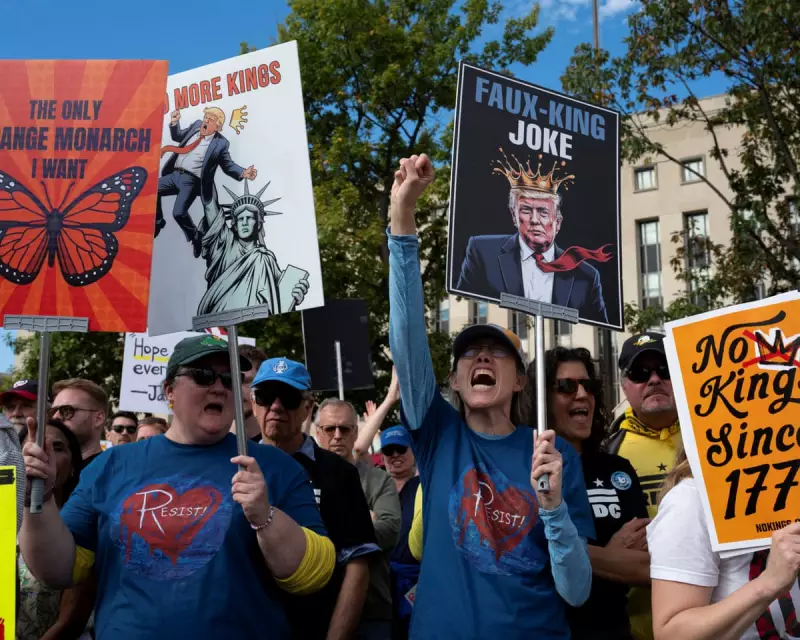
Political unrest across the United States has intensified dramatically since Donald Trump returned to the White House, with new data revealing a staggering increase in public demonstrations compared to his first term.
A Nationwide Surge in Dissent
According to figures compiled by the Crowd Counting Consortium, a collaborative project between Harvard University’s Kennedy School and the University of Connecticut, more than 10,700 protests took place in 2025. This marks a sharp 133% rise from the 4,588 recorded in 2017, the inaugural year of Trump's first administration.
The research indicates that protest activity has become remarkably widespread. An overwhelming majority of US counties have witnessed at least one demonstration since Trump's re-inauguration, including 42% of counties that voted for him.

"It is a very historic time, in the sense that people are mobilising where they live in ways that I don’t think I have seen before in my lifetime," said Erica Chenoweth, a political scientist at Harvard Kennedy School and co-director of the Crowd Counting Consortium.
From Localised to Diffused: A New Protest Landscape
The scope of demonstrations has broadened significantly. Historically, major protests were often confined to large metropolitan centres or focused on marches in Washington DC. The current wave, however, is far more dispersed.
"We’re seeing very diffused protest mobilisation all around the country," Chenoweth noted. This geographical diversity is evident in rallies held in traditionally conservative and rural areas such as Cut Bank, Montana, and Sparta, North Carolina.
"It definitely cuts against the narrative that protest is confined to major cities, to the coasts, and to predominantly liberal areas where it doesn’t change anybody’s mind," Chenoweth added.
The causes driving people to the streets have been varied throughout 2025 and into 2026. They range from demonstrations supporting trans youth healthcare and protesting US policy in Gaza, to so-called "Tesla takedowns" targeting Elon Musk, and sustained anti-ICE protests responding to federal immigration raids.
Sustained Momentum and a Potential Inflection Point
This pattern of widespread, nonviolent protest has continued into 2026. A key catalyst was the killing of Renee Good during an ICE interaction in Minneapolis on 7 January. This event prompted a rapid, grassroots-organised "weekend of action" with over 1,000 participating protests across the nation.
"What’s really notable now is how much grassroots, improvised and then organised response there is to ICE operations," Chenoweth observed. She described the public outrage as a reaction to policies deemed "unbearable and intolerable."
Chenoweth's own seminal research, which analysed over 300 nonviolent movements from 1900 to 2006, found that governments rarely withstand a movement involving 3.5% of the population. While not suggesting the US has reached that specific threshold, Chenoweth identifies a significant shift.
When asked if America is at a similar tipping point, they reframed it as an "inflection point," highlighting measurable changes in public opinion. Most crucially, Chenoweth emphasises that growing protest movements can restore a "sense of agency" and hope to those who feel powerless against the administration's agenda.