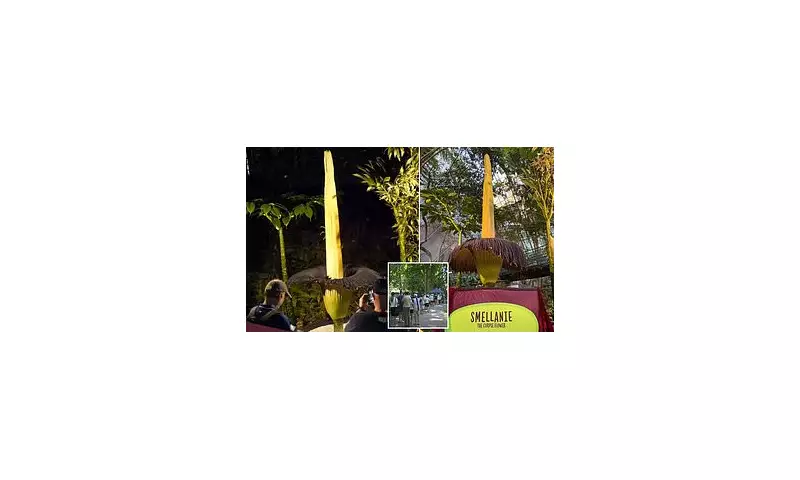
In a remarkable botanical event drawing unprecedented public interest, crowds have been forming lengthy queues at the Adelaide Botanic Garden for a chance to witness a rare and pungent phenomenon. The centre of attention is a giant flowering plant known as the Titan Arum, which has been affectionately nicknamed 'Smellanie' by garden staff. This extraordinary bloom, which emits a powerful odour reminiscent of rotting flesh, officially began when the gardens opened early on Saturday morning.
A Conservation Triumph Two Decades in the Making
The flowering of 'Smellanie' represents the culmination of a dedicated twenty-year conservation effort by horticultural experts at the garden. Staff have meticulously recreated the ideal environmental conditions required for this notoriously difficult plant to bloom. Matt Coulter, Horticultural Curator at the Botanic Gardens and State Herbarium of South Australia, emphasised the significance of this achievement. 'We received a donation of three seeds in 2006,' he explained, 'and from that small starting point have grown a collection of around 250 Titan Arum plants.'
This particular specimen, which has bloomed for the second time following a previous flowering in 2021, originated from a tuber generated by one of those original seeds. The collection has been expanded through both leaf cuttings and careful cross-pollination, showcasing a major success in plant propagation and preservation.

The Science Behind the Stench
The Titan Arum, native to the rainforests of Sumatra in Indonesia, is one of the world's largest flowering structures, capable of growing up to three metres in height. Its infamous smell, however, is its most talked-about feature. Described as a pungent aroma combining notes of strong cheese, fermented cabbage, and even roadkill, the scent serves a vital biological purpose.
Botanic experts note that the powerful odour is the plant's evolutionary strategy to attract specific pollinators, namely carrion beetles and flesh flies, which are drawn to the scent of decay. The aroma, composed of approximately seventy different chemical compounds, is expelled in pulses every thirty to sixty seconds. The intensity of the smell is expected to peak within twelve to twenty-four hours of the initial bloom.
A Fleeting Spectacle with Global Significance
The public response has been overwhelming, with thousands of visitors lining up over the weekend for designated 'smell sessions'. The garden offered viewing slots from opening until midday and again in the evening on Saturday, with further opportunities available on Sunday. This level of interest underscores the plant's rarity and the unique nature of the event.
It is a spectacle of fleeting beauty and odour. The Titan Arum flowers only once every two to five years, and each bloom lasts a mere forty-eight hours. Roughly two days after its rapid emergence, the plant's giant central spadix will begin to collapse, marking the end of the cycle.
This event also highlights a sobering conservation reality. The Titan Arum is classified as an endangered species, with estimates suggesting fewer than one thousand individuals remain in their natural wild habitat. The successful cultivation and flowering of 'Smellanie' in Adelaide therefore represents not just a local attraction, but a vital contribution to the global understanding and preservation of one of the plant kingdom's most extraordinary specimens.