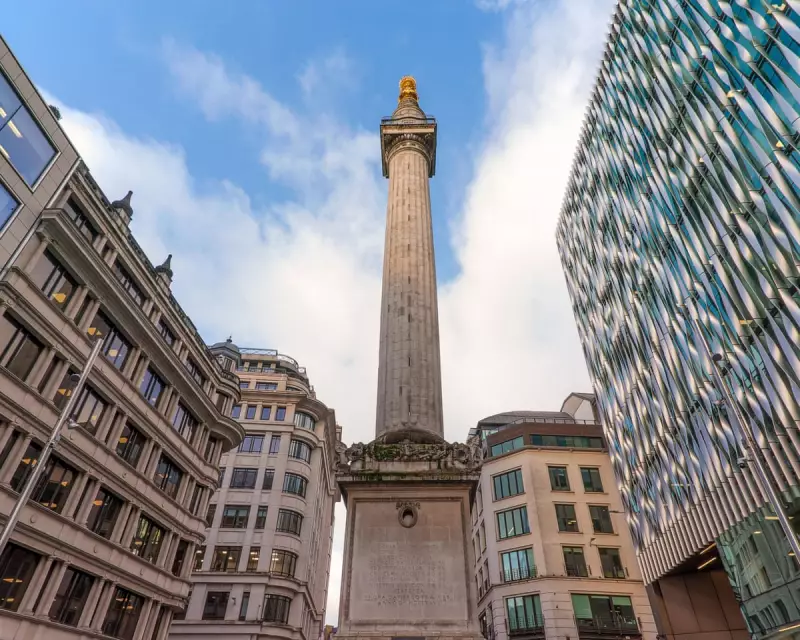
The iconic Monument column in the City of London, commemorating the Great Fire of 1666, stands as more than just a historical marker. Constructed from Portland stone, this towering structure contains a remarkable secret within its fabric: countless Jurassic oyster shells and prehistoric shrimp burrows, preserved for millions of years and now forming part of the capital's urban landscape.
Rock Up to London: Discovering Global Stones and Fossils on Urban Geology Tours
London's architecture serves as an extraordinary journey through both time and continents, incorporating materials ranging from slabs of the Italian Alps to meteorite-impact rocks from southern Africa dating back two billion years. In the bustling heart of the Square Mile, between the windows of a tapas restaurant on Plantation Lane, a 150-million-year-old ammonite fossil stares mutely at passersby, embedded within a limestone wall alongside ancient nautiloids and squid-like belemnites.
This mineralised aquarium hides in plain sight, offering snapshots of deep geological time that most Londoners walk past without a second glance. It creates a transtemporal space where modern dining meets prehistoric cephalopods, raising fascinating questions about how often we consider the stones that form our urban environments.

The Passionate Geologist Revealing London's Hidden Stories
For Dr Ruth Siddall, a distinguished geologist and urban geology enthusiast, the answer to that question is constantly. Her passion for street-level geology began in Athens during the early 1990s, where she catalogued rocks from Greek ruins after completing her PhD. "It was essentially a big pile of rubble," she recalls with a smile, "but it became an absolutely fascinating project that got me completely hooked."
Inspired by her former colleague Eric Robinson, a pioneer of urban geology, Dr Siddall now sees her adopted home of London in an entirely new light. For her, the city's walkways, shop facades, and statue plinths aren't merely civic structures but repositories of epic stories about both social history and material origins. "London is huge, but unlike some cities it has no local building stones of its own," she explains. "The city sits basically in a basin of clay, so all the stones you see around us have had to be imported from elsewhere."
A Walking Tour Through Geological Time
Dr Siddall's guided walks, offered through the longstanding tour company London Walks, reveal sedimentary, igneous, and metamorphic rocks from locations as disparate as Australia, Brazil, and China. Each stone type has been carefully selected by architects for its aesthetic value, creating what amounts to an open-air geological museum throughout central London.
During a typical two-hour tour, participants might encounter serpentinite from the Italian Alps outside a travel agency, smooth 290-million-year-old larvikite from Norway forming a pub pillar, or the remarkable York stone paving slabs beneath their feet. "York stone is a fine-grained sandstone, around 310 million years old, quarried in the Peak District," Dr Siddall points out during a walk along Eastcheap. "It was once a prehistoric riverbed – you can still see the ripples in the surface – although to picture the world back then you need to imagine Sheffield looking like the Brahmaputra river."
Extraordinary Discoveries in Ordinary Places
Perhaps most astonishing are the rare finds that emerge when examining seemingly ordinary buildings with geological expertise. Near St Paul's Cathedral, the limestone exterior of a wine bar displays a small vertebrate bone from 150 million years ago. "Possibly a pterosaur," Dr Siddall explains, "but we might never know for certain." The cathedral steps themselves contain 30-centimetre-long fossilised orthocones, which she describes as looking "a bit like swimming carrots."
Even more remarkable is a co-working space on Houndsditch, its exterior constructed of gneiss from a meteorite impact crater in South Africa. Approximately 6,000 miles from its place of origin, the stone's surface still displays crack-like veins of black impact glass containing traces of the meteorite's extraterrestrial minerals. This material crashed to Earth a staggering two billion years ago, offering perspective when modern January days seem to drag.

Creating Access to Urban Geology
About ten years ago, in partnership with fellow geologist Dave Wallis, Dr Siddall helped establish London Pavement Geology – a website and app providing free comprehensive listings of geological interest sites around the capital and increasingly in other UK towns and cities. The resource allows enthusiasts to explore independently, with highlights including lobe-finned fish suspended in Edinburgh's Caithness flagstones.
Her guided walks, running on a roughly monthly basis starting in spring, attract curious looks from passersby. "It transpires that if you peer at something usually considered unremarkable, people stare at you," she notes. But when you're hurdling geological epochs at every corner, such attention becomes secondary to the wonder of discovery.
The Monument itself represents a pivotal moment in London's architectural history, as the Great Fire of 1666 accelerated the use of stone construction throughout the capital. While the Romans first imported stone building blocks to London, it wasn't until the city's restructuring in the late 1660s that natural, hard-wearing materials became commonplace. Today, these materials continue to tell stories that span continents and epochs, transforming ordinary urban exploration into extraordinary journeys through deep time.