In the pastoral landscapes of the Kent Weald, a timeless agricultural practice continues against the chill of winter. While modern wire netting and barbed fences now demarcate many ancient pastures, the original, living boundary – the hedgerow – requires a skilled and strenuous human touch to survive. This is the ancient craft of hedge laying, a practice that transforms leggy, gapped hedges into dense, livestock-proof barriers and vital wildlife habitats.
The Human-Made Fabric of the Countryside
To many, the crisscrossing hedgerows of Britain appear as a natural, permanent feature of the land. In reality, they are a human invention, planted primarily for the practical purpose of enclosure over hundreds of years. However, left unmanaged, a hedge fails in its duty. Young trees mature, their lower trunks become bare, and gaps appear that animals can easily penetrate. Hedge laying was developed not as an act of creation, like bricklaying, but as one of essential maintenance, ensuring these living fences endure for generations.
Across the UK, distinct regional styles evolved to suit local conditions and livestock. In Devon, hedges are laid low upon earth banks, while the robust "Midland style" produces a high, thick barrier designed to withstand cattle. In the South-East, including Kent, practitioners follow their own traditional method, which is simple to learn in principle but demands years of practice to master proficiently.

A Morning of Harsh, Physical Labour
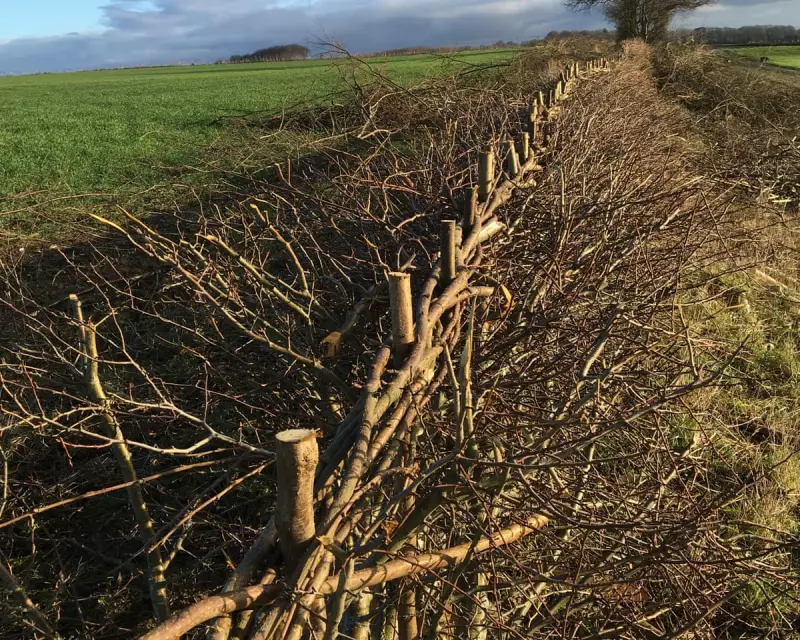
The process begins early, on a cold morning in Cranbrook, Kent. The task is a stretch of overgrown hawthorn. First, the undergrowth and lower branches are cleared. Then, starting at one end, the hedge layer isolates the first tree. With a carefully angled swing of an axe, they cut almost – but not completely – through the base of the trunk. This partially severed stem, known as a pleacher, is then bent over horizontally.
Crucially, it remains attached to its roots by a slender "tongue" of living wood and bark. This pleacher is laid down along the line of the hedge. The process is repeated along the entire length, creating a continuous, interwoven barrier of still-living wood. This technique ensures the hedge will regrow vigorously from the laid stems.
Staking a Claim for the Future
This newly laid hedge is still vulnerable. To secure it against wind and animals, sturdy wooden stakes are driven into the ground along its centre. Then, a flexible, rope-like binding, traditionally made from pliable hazel wands, is woven along the top. This holds everything firm until new shoots grow and knit the structure into an impenetrable, living wall. A well-laid and subsequently maintained hedge can last for decades, and when it eventually becomes leggy again, the cycle simply restarts; it can be relaid.
For many modern projects, the primary goal is no longer holding livestock. The aim is ecological revival. A laid hedge becomes a dense, thorny home for birds, insects, and mammals, and a safe corridor for them to travel through the landscape. It stands as a vital environmental asset, reinstated through ancient skill.
To an observer, the sight of a craftsperson repairing the living arteries of the land with simple tools can seem deeply romantic. The ground truth is one of harsh, physical labour undertaken in all weathers. Yet, it is beyond this hardship that the true satisfaction lies. The profound pleasure comes from looking back, cold and exhausted, at a completed section of hedge – a piece of living history and a legacy for the future, meticulously restored by hand.