Mass Evacuations Ordered as Victoria Bushfires Intensify Amid Extreme Heat
More than 1,000 families across Victoria have been instructed to evacuate their homes as dangerous bushfires rage through the state, coinciding with a severe heatwave pushing temperatures in parts of southeast Australia towards a scorching 50°C. Emergency services are engaged in a critical battle against the flames, with conditions expected to deteriorate further.
Otways Fire Breaches Containment Lines
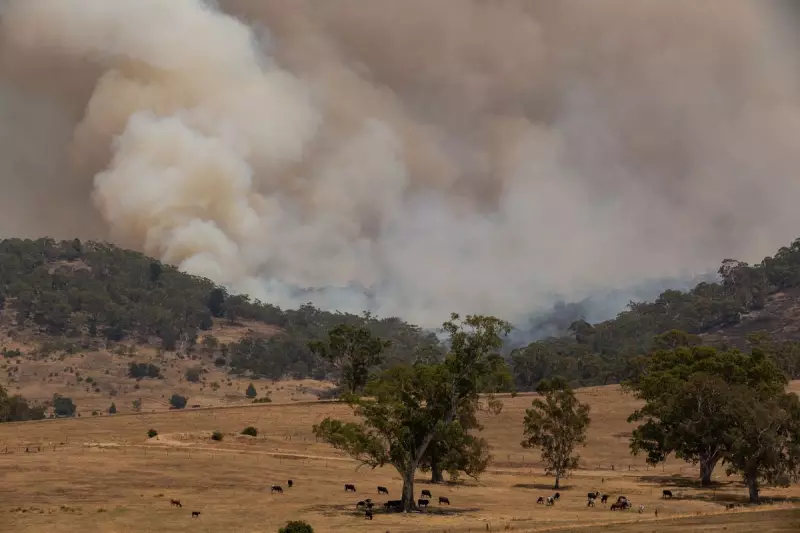
Emergency authorities reported that a fast-moving bushfire in the heavily forested Otways region, approximately 200 kilometres southwest of Melbourne, has breached established containment lines. This development poses a significant threat to several communities, including Gellibrand, Kawarren, Beech Forest, Forrest, Barongarook, and the coastal town of Lorne. The blaze has already consumed an estimated 10,000 hectares of land.
On Monday, police and state emergency service crews conducted extensive door-knocking operations across the Greater Otways area, strongly advising residents to leave before sunset. Officials confirmed that around 1,100 homes were visited, and text alerts were dispatched to 10,000 mobile phones, urging immediate evacuation for safety.

Firefighters Battle Against Forecast Deterioration
Reegan Key, a spokesperson for Victoria’s State Control Centre, stated that over 300 firefighters and six aircraft are actively combating the Otways fire. However, she issued a stark warning that forecast weather conditions for Tuesday would make containment efforts extremely difficult.
"We have got very strong winds and very warm temperatures coming again tomorrow, and we have extreme fire danger in that area of the south-west," Key explained. "We’re really concerned about the potential of that fire to take a big run and impact communities."
In response to the escalating threat, a statewide total fire ban has been declared in Victoria. All visitor sites within the Great Otway National Park and surrounding state forests have been closed until further notice to protect public safety.
Record-Breaking Heatwave Grips Southeast Australia
The bushfire emergency unfolds alongside an intensifying major heatwave across southeast Australia. Meteorologists forecast temperatures well above historical averages for several consecutive days. The Bureau of Meteorology indicated that Melbourne could reach 45°C on Tuesday, marking its hottest day in nearly 17 years.
Inland regions of Victoria, South Australia, and New South Wales are expected to experience temperatures in the high 40s. Notably, Ouyen in Victoria's northwest, situated about 440km from Melbourne, was forecast to reach 49°C. This threatens to surpass the state’s previous record of 48.8°C, set during the devastating Black Saturday fires in February 2009. By Tuesday afternoon, Ouyen had already exceeded 48°C.
The Bureau emphasised that this heatwave is notable not only for its intensity but also its prolonged duration. Parts of inland southeast Australia are on track for seven to eight consecutive days above 40°C, representing the longest such stretch since the 1930s in some areas.
Meteorological Drivers and Fire Danger Warnings
Meteorologists attribute the extreme heat to a stationary high-pressure system sitting several kilometres above the surface. This system forces air downward, compressing it and creating what experts describe as a "heat dome." The slow movement of this system has allowed heat to accumulate progressively over multiple days.
Country Fire Authority chief officer Jason Heffernan warned that a wind change forecast for late Tuesday afternoon could dramatically worsen fire behaviour. "It’s the change that’s going to come through about 5pm with some really punchy winds that is likely to do most of the damage and drive that fire further," Mr Heffernan told ABC News.

Fire conditions are forecast to be extreme across large parts of Victoria, including the Central, Mallee, North Central, South West, and Wimmera districts. The fire danger rating in some areas is approaching catastrophic levels. Emergency Management Commissioner Tim Wiebusch noted that Victoria had not experienced heat of this intensity for almost two decades, urging residents to enact their bushfire plans and leave early if advised.
Multiple Blazes and Widespread Disruption
Several major fires are burning across Victoria, including near Walwa in the northeast and in the Alpine National Park, where a blaze is moving towards Dargo. Residents in parts of the Nariel Valley near the Murray River have also been ordered to evacuate.
The ongoing heatwave has caused significant disruption to major events and daily life. Organisers of the Australian Open tennis tournament in Melbourne adjusted match schedules ahead of the quarterfinals, implementing measures such as:
- Advancing start times
- Closing roofs on main courts
- Triggering the tournament’s extreme heat protocol
Wheelchair matches were postponed to Wednesday, with additional protective measures introduced for players, staff, and ball kids. Over the weekend, play was suspended and roofs closed during Jannik Sinner’s match as temperatures exceeded 40°C.
Relief Efforts and Broader Climate Context
Several relief centres have been opened for evacuees, including in Colac, about two hours southwest of Melbourne. Authorities cautioned that risks from smoke, falling embers, and rapidly changing conditions could extend even outside immediate fire zones.
This crisis occurs within a broader climatic trend. Australia recorded its fourth-warmest year on record in 2025, with average temperatures 1.23°C above the long-term norm, according to the Bureau of Meteorology. Scientists consistently warn that rising global temperatures are increasing the frequency and severity of heatwaves and bushfires across the country, placing growing pressure on emergency services and communities.