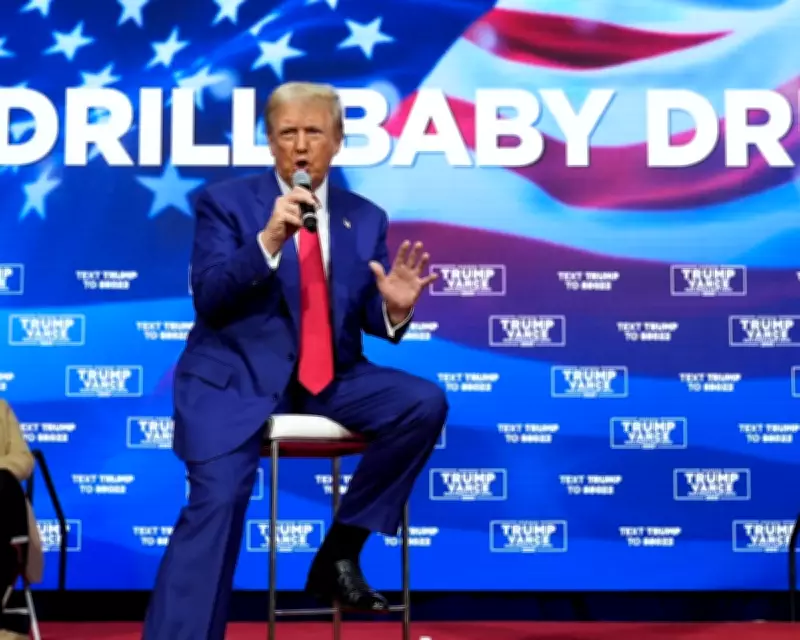
Donald Trump's long-professed position that climate change constitutes a "hoax" has drawn severe criticism from a former senior legal figure, who describes the policy as both perverse and potentially catastrophic for the planet. The critique comes amidst the former president's repeated withdrawal of the United States from the landmark Paris climate accord.
A Judicial Perspective on Climate Denial
In a detailed analysis, retired Supreme Court Justice Robert Carnwath, now a visiting fellow at the London School of Economics' Grantham Institute, has highlighted the profound dangers of Trump's environmental agenda. Carnwath points to the systematic dismantling of climate measures and the active encouragement of unfettered oil industry development as hallmarks of an administration fundamentally at odds with scientific consensus.
The Abdication of Global Responsibility
Echoing the assessment of Jeremy Wallace, a professor of China studies at Johns Hopkins University, Carnwath characterises Trump's most recent exit from the Paris Agreement as a clear "abdication" of international responsibility. This move, he argues, is entirely consistent with a worldview that dismisses the overwhelming evidence of anthropogenic global warming.

Notably, Carnwath draws upon his extensive observation of climate litigation in courts across the United States and worldwide. He states that in numerous cases involving both governments and major oil corporations, there has been "no serious challenge to the relevant science or the consequences of failure to act." This legal reality underscores the settled nature of climate science within judicial proceedings.
The Telling Silence in Court: The Juliana Case
A pivotal example cited is the 2019 case of Juliana v United States, heard during Trump's first term. Carnwath notes that the government's legal team made no attempt to dispute the plaintiffs' scientific evidence regarding climate change. The majority judgment in that case recorded a "largely undisputed" factual record demonstrating that the federal government had long promoted fossil fuel use despite full awareness of the catastrophic risks.
The court's language was stark, noting the government's actions may "hasten an environmental apocalypse." Even a dissenting judge in the case conceded the point, observing that the government "accepts as fact that the United States has reached a tipping point crying out for a concerted response – yet presses ahead toward calamity."
A Constitutional Impasse and a Perverse Legacy
Despite this judicial acknowledgement of the crisis, the majority in the Juliana case felt constrained by their constitutional role from ordering the sweeping policy changes sought. Carnwath laments this legal impasse, which allowed the administration's course to continue unchecked.
Against this backdrop, Carnwath concludes that Trump's climate policy stands out as the most remarkably perverse and dangerously catastrophic of all his initiatives. It represents a conscious choice to ignore judicial findings and scientific evidence, prioritising short-term industrial interests over the long-term health of the planet and future generations. The former justice's intervention adds a powerful, legally-informed voice to the chorus of experts warning of the dire consequences of climate inaction and denial at the highest levels of government.