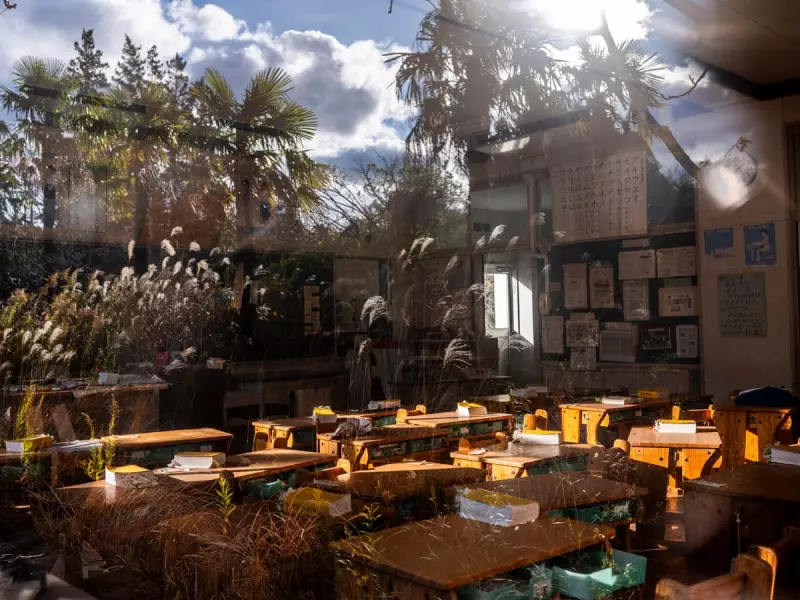
Fifteen years after a catastrophic tsunami triggered the Fukushima nuclear accident, a classroom in Kumamachi elementary school, adjacent to the power plant, stands frozen in time. Textbooks lie open on desks, pencil cases are scattered across the floor, and empty bento boxes remain where children left them in haste. The scene is a poignant reminder of the day when pupils fled, some still in their indoor plimsolls, as a magnitude-9 earthquake rocked the town on 11 March 2011, leading to the world's worst nuclear disaster since Chornobyl.
A Landscape Transformed by Nature
Outside the school, the once-pristine playground is now a tangle of weeds and susuki wild grass, with rusting bicycles nestled in the undergrowth. A monitor at the site indicates that atmospheric radiation, while safe for short visits, remains too high for former residents to return permanently. The relentless march of nature is evident everywhere in Okuma and other communities near the Fukushima Daiichi nuclear power station, where wild boar, raccoons, and black bears now roam freely through streets long devoid of human activity.
Personal Loss and Lingering Hopes
Among the 330 children who evacuated that afternoon was Yuna, the seven-year-old daughter of Norio Kimura, a former pig farmer. Yuna perished in the tsunami along with her mother and grandmother, leaving Kimura to grapple with grief and a desire to return to his coastal home. He regularly visits a clearing near the coast, marked by flowers, where fragments of Yuna's remains were found years later. Kimura advocates for preserving Kumamachi primary school as a historical warning about the dangers of tsunamis and nuclear power, suggesting it could become an "eco-museum" to educate future generations.

Scientific Insights and Environmental Challenges
Experts like Prof Kenji Nanba from Fukushima University are studying the impact of radiation on local ecosystems, noting that trees circulate radiocaesium, a radioactive isotope, through forest environments. Despite the contamination, animal populations such as wild boar and bears have increased, leading to debates about coexistence. Thomas Hinton, a retired professor, argues that while nature thrives in human absence, controlling prolific species like wild boar is essential to prevent damage if people return.
The Struggle for Resettlement
Authorities in Fukushima are still wrestling with how to encourage residents to return, with evacuation orders lifted in some areas but others, like Sanjiro Sanpei's home, remaining in "difficult-to-return zones" due to high radiation levels. Sanpei, a 77-year-old former cattle farmer, hopes to repair his damaged house once decontamination is complete, but acknowledges the uncertainty of long-term resettlement. Many evacuees have built new lives elsewhere, with only 17% of the pre-disaster population having returned to evacuated towns and villages as of March 2025.
Future Prospects and Conservation Debates
As decommissioning of the nuclear plant continues, discussions are ongoing about whether to designate parts of the area as nature conservation zones after interim storage of contaminated soil ends in 2045. Kimura and others propose that the region could serve as a reminder of the disaster, promoting a return to nature and highlighting human impacts on the environment. However, priorities often lean towards human resettlement, raising questions about the balance between ecological recovery and community rebuilding.
Ultimately, the story of Fukushima is one of loss, resilience, and complex choices. From the abandoned school to the thriving wildlife, it underscores the enduring legacy of nuclear disasters and the ongoing quest for healing in affected communities.