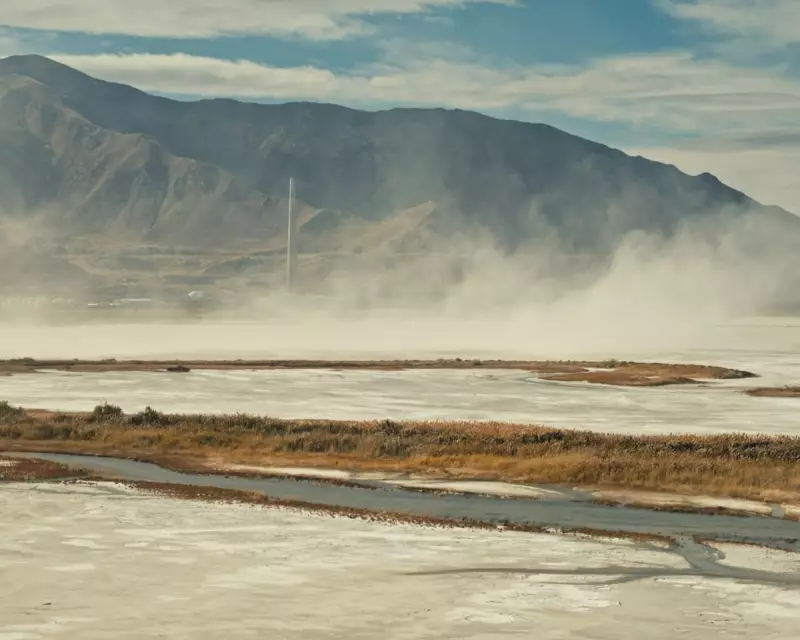
The Sundance Film Festival's 2026 edition, marking its final year in Park City, Utah, before relocating to Colorado, has opened with a stark environmental warning. The festival premiere of The Lake, directed by Abby Ellis and executive produced by Leonardo DiCaprio, presents a chilling examination of the rapid disappearance of the Great Salt Lake, described in the film as an "environmental nuclear bomb" threatening the entire region.
A Looming Catastrophe for Utah
The documentary meticulously charts the lake's precipitous decline, which scientists warn could see it vanish completely within years. Having lost 73% of its water and 60% of its surface area, primarily due to agricultural diversion, the lake hit a record low in 2022. This poses an existential threat to the health of Utah's 2.8 million residents, who face exposure to toxic dust clouds laden with arsenic, mercury, and selenium from the exposed lakebed.
Economic and Ecological Fallout
The consequences of inaction are framed as catastrophic. The film outlines a domino effect of devastation: public health crises in a region where air quality already rivals Los Angeles, the complete collapse of birdlife and recreation, and billions in economic damage. This would imperil mineral extraction industries and even threaten the famous ski conditions at nearby resorts, including those in Park City itself.

Ecologist Ben Abbott, featured prominently, states with grave urgency: "I don't think people realize how close to the edge we are." He and over 30 fellow scientists co-authored a report three years ago predicting the 11,000-year-old lake's demise within five years without major intervention.
Historical Precedents and a Daunting Challenge
The Lake draws sobering parallels to other ecological disasters, presenting them as cautionary tales for Utah. It references the dust-choked fate of California's Owens Lake, the rapid degradation of Iran's Lake Urmia, and, most ominously, the utter destruction of the Aral Sea due to Soviet irrigation projects. The film underscores that no saline lake on Earth has ever been successfully restored from such structural decline, making the proposed rescue effort unprecedented.
The Political and Social Divide
The documentary delves into the complex battle to save the lake, tracing the starkly different approaches to governance and advocacy. On one side, scientists like Abbott and microbiologist Bonnie Baxter call for a radical overhaul of Utah's water use, where over 80% of the lake's inflow is diverted, mainly to grow water-intensive crops like alfalfa.
On the other, state officials like Great Salt Lake Commissioner Brian Steed pursue a more moderate path, seeking compromise with farmers in the nation's second-driest state. This tension highlights the immense challenge: the scale of change required is massive, and as Abbott warns Steed, "winning slowly is losing."
A Glimmer of Hope Amidst the Crisis
Despite the dire prognosis, the film captures recent efforts that offer a fragile hope. It includes footage from a September 2025 roundtable convened by Governor Spencer Cox, which publicly prioritised the lake's restoration and dedicated $200 million in philanthropic funds. A new charter has set 2034—coinciding with Salt Lake City hosting the Winter Olympics—as a target for achieving healthier lake levels.
As the Sundance festival prepares to leave Utah, The Lake leaves audiences with a cautiously optimistic call to action. Commissioner Steed concludes: "Saving the Great Salt Lake is not an impossible order... We have an opportunity in front of us." The documentary serves as both a dire warning and a rallying cry, urging immediate and decisive action to avert an environmental catastrophe in the heart of the American West.