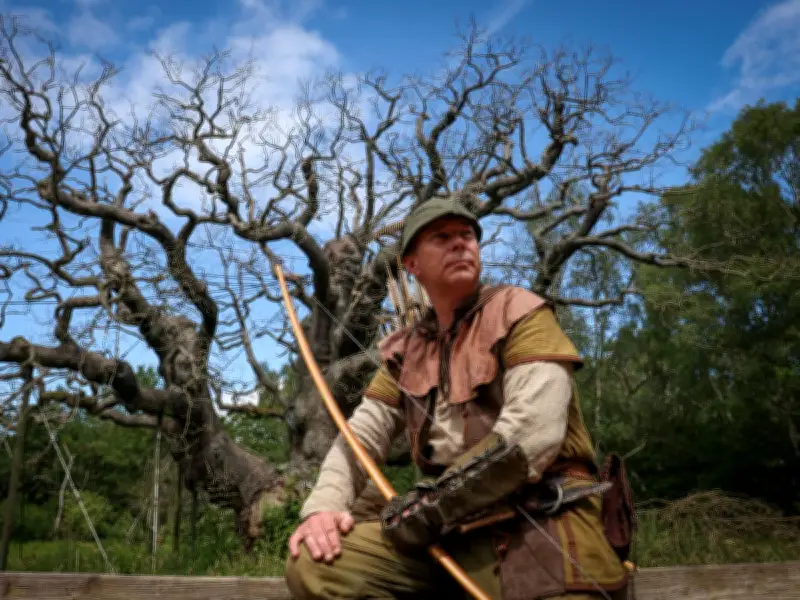
The world-famous Major Oak, the ancient Nottinghamshire tree at the heart of the Robin Hood legend, has officially been declared dead after an estimated 1,200 years. Experts concluded that the beloved tree, the folkloric shelter home of Robin Hood and his Merry Men, produced its final burst of leaves in 2025. Major Oak has been noticeably bare in 2026, and conservationists from the RSPB, which manages Sherwood Forest, were devastated to confirm today that the tree met its end after dedicating 100 years to its care and having to dispel rumours it had died much earlier.
They have said they were "gutted" to confirm the death, which was concluded to be at least partly due to climate change and heavy, persistent footfall from its legions of visitors. Legendary outlaw Robin Hood was said to have used Major Oak as a hideout from the Sheriff of Nottingham, a significant pull for visitors, who arrived in their thousands every year. The sheer amount of tourism has been cited as a principal factor behind its death, as footfall compacted the soil around its roots until it was fenced off by the local council in the 1970s.
The iconic tree, which is believed to be older than the Tower of London and the concept of zero, has been in decline for some time, the RSPB said. But they added it is not possible to determine whether there was one exact cause of its death, which was likely down to a "complex combination of issues." Among causes, they said, was the ongoing massive human activity, which included both tourism and well-intentioned structural intervention.

Simon Parfey, Managing Director of soil microbiology testing specialists SoilBioLab, who has helped care for Major Oak since 2021, said the soil was "under far greater stress than anyone initially realised." He added: "The soil around the Major Oak was under far greater stress than anyone initially realised. Our early surveys revealed a root system that had been quietly struggling for a long time due to naturally poor soil and heavy ground compaction. While the Major Oak team worked tirelessly to revive the environment around this iconic tree — and saw encouraging signs of life in some areas — the damage, it now seems, was already too deeply entrenched to fully reverse."
Other factors, the organisation added, would have included climate change and recent prolonged droughts which have hit the UK, and "compounded the challenges it would naturally be facing at its great age." Leading tree and soil health experts had tried over the years to improve its health and prolong its life, but the organisation has now decided the tree will stand as a "natural monument" for visitors and wildlife.
Chloe Ryder, the RSPB's estate operations manager at Sherwood Forest, said: "It is a moment of great sadness for me in the job that I have, but also as a visitor to Sherwood Forest. I'm really gutted that the death of the Major Oak has happened in my lifetime." The tree's death has led experts to call for greater tree protections, which have been put forward since the illegal felling of Northumberland's Sycamore Gap in 2023. Dr Ed Pyne, Senior Conservation Adviser at the Woodland Trust, said the legal protections should now be applied to dead trees as well.
He said the tree would continue to contribute to the ecosystem by "providing a home for hundreds of different species", some of which "are amongst the rarest and most threatened in Europe." Organisations including the RSPB and the Woodland Trust say the lessons learnt from the Major Oak will prove invaluable when it comes to safeguarding other ancient oaks throughout the country.
Beyond this aspect of the tree's enduring legacy, numerous saplings have been cultivated from it over the years, with one being planted in the garden of the US Ambassador's London residence in 2023. The tree itself is expected to remain standing for potentially hundreds of years to come as a "living museum", and the legend of Robin Hood will continue to attract visitors in their droves.

Among recent visitors to the tree are Cheryl and Dennis Swan, who told the Nottingham Post they travelled from Blackpool to see the Major Oak on the very day its death was confirmed, with the couple spending a week exploring the Sherwood Forest area. Mrs Swan, 69, said: "Dennis had said when we were approaching it that it looked a bit dead, so it's a good job that we've had our picture taken with it now." Mr Swan, 63, added: "Coming to see the Major Oak was probably the top of our list of things to do when we came here."
The RSPB's Chloe Ryder added: "What we'd like to see is that people value and respect these amazing natural wonders. Even in its death, I think that the Major Oak remains one of the most beautiful trees that you can see. We'll be periodically assessing the tree, as we do with our other ancients, and making sure that it remains this visible icon in the landscape for as long as it's possible." She added: "My wish for the Major Oak is that in my lifetime it still remains in this form and that we don't have to take any steps to reduce it for stability or safety. It could be decades, even centuries, before it fades away into its next existence of feeding the forest fauna."