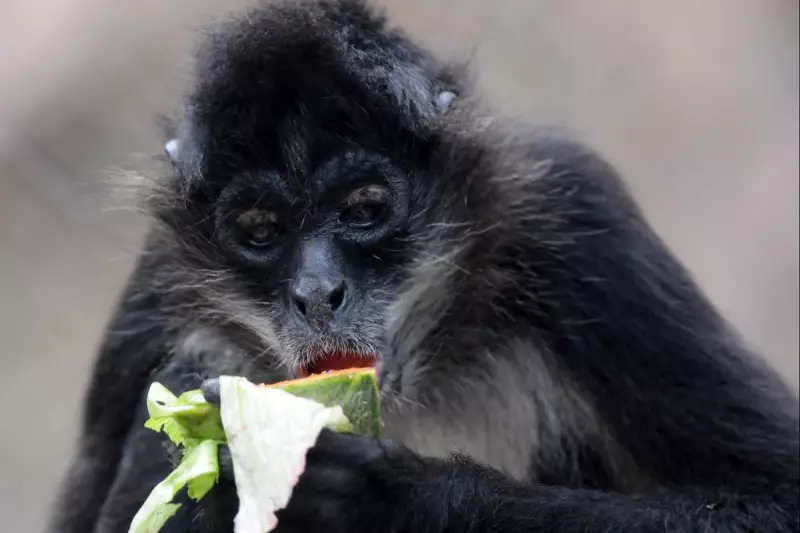
Groundbreaking research has uncovered that spider monkeys operate a remarkably sophisticated social system, sharing crucial "insider knowledge" about the best fruit trees in their forest environments rather than foraging randomly. The study reveals these primates constantly alter their social subgroups, a dynamic behavioural pattern that facilitates the exchange of vital information regarding food sources.
Seven Years of Field Observations in Mexico
The comprehensive study, a collaboration involving scientists from Heriot-Watt University, the University of Edinburgh, and the National Autonomous University of Mexico, was based on seven years of intensive field observations in Mexico's Yucatan Peninsula. Researchers utilised this extensive dataset to explore a key aspect of Geoffroy spider monkey social behaviour, which involves group members frequently splitting into smaller subgroups before rejoining in different combinations.
Remarkably, the same subgroup might never forage together twice, creating a constantly evolving social network designed for optimal information sharing.

A Clever System for Sharing Forest Knowledge
Dr Matthew Silk, an ecologist from the University of Edinburgh, explained the significance of these findings: "It isn't random social mingling; it's a clever system for sharing insider knowledge about where the best fruit trees are located across their forest home. By constantly changing their subgroups, monkeys who know different parts of the forest can share information about where fruit is available."
The research team tracked individual monkeys' movements and mapped out their core ranges, identifying the specific areas each monkey knows particularly well. Some forest sections are known by multiple monkeys, comparable to a town's most popular restaurant, while others are known by only one or two monkeys, similar to hidden culinary gems.
Optimal Balance Between Exploration and Information Sharing
Ross Walker, a PhD student at Heriot-Watt University, developed an innovative analytical method based on abstract mathematical theory rather than traditional ecological models that typically analyse pair relationships. He revealed: "We've shown that there's an optimal middle ground between the monkeys sticking together and spreading out too far. It's not helpful if every monkey knows exactly the same thing, and it's not helpful if no-one ever meets. It's best when individuals explore different areas, but still reconnect often enough to pool what they've learned."
Spider monkeys typically travel in subgroups of three or more individuals, with their ranges overlapping in sets of three or more, creating sufficient overlap for information exchange while maintaining enough separation for effective scouting of different forest areas.
Collective Intelligence in Natural Conditions
Professor Gabriel Ramos-Fernandez from the National Autonomous University of Mexico emphasised the broader implications: "We have demonstrated that the fluid social dynamics of spider monkeys has an important consequence for their foraging success: by exploring their environment in a distributed fashion and then coming together to share their uniquely obtained information, the group as a whole can know the forest better than a single individual could independently."
He described this foraging strategy as "a compelling example of collective intelligence operating under natural conditions," noting that future research aims to apply similar mathematical techniques to explore other interactions involving more than two individuals, which remain common yet understudied phenomena in animal behaviour research.
The research team utilised data collected from a group of Geoffroy's spider monkeys by experienced observers between January 2012 and December 2017. This endangered species, also known as the Central American spider monkey or black-handed spider monkey, demonstrates how sophisticated social structures can enhance survival in challenging environments.
These significant findings, published in the prestigious journal npj Complexity, provide new insights into how animal societies develop sophisticated information-sharing mechanisms that maximise collective benefits while minimising individual effort.