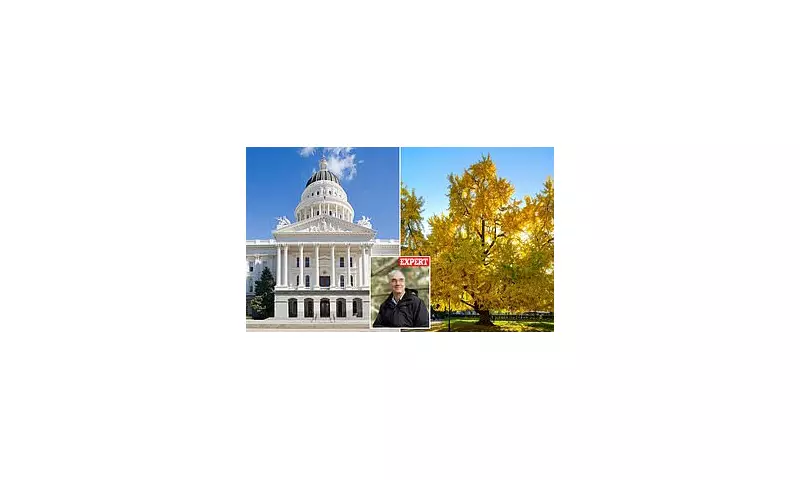
A picturesque park in California's capital has become the scene of an olfactory assault this autumn, as two mature Ginkgo trees release what visitors describe as a 'rancid butter and vomit' scent that's disrupting the perfect foliage backdrop.
The Unpleasant Surprise at State Capitol Park
State Capitol Park in Sacramento, normally celebrated for its stunning autumn displays, is currently home to an unexpected nuisance. Two 75-year-old Ginkgo trees have begun shedding their leaves and seeds, creating beautiful golden scenery for photographs but accompanying it with a truly offensive odour that's driving visitors away.
The problem stems specifically from the female Ginkgo trees, which reach maturity at around 30 years old and begin producing seeds and fruit. When this fruit falls to the ground in autumn, it breaks open to reveal what can only be described as a sickening smell that ruins the otherwise perfect atmosphere.
The Science Behind the Stench
According to experts at Harvard University's Arnold Arboretum, the offensive odour comes from butyric acid, the same chemical compound that dominates the smell of vomit. This pungent substance is found in the coating of the Ginkgo seeds and becomes particularly potent when the fruit smashes upon impact with the ground.
Ned Friedman, director of Harvard's Arnold Arboretum which houses over 16,000 trees including Ginkgoes, told Daily Mail: 'These seeds, these beautiful orangish seeds are quite odiferous.' The arboretum has extensive experience with these ancient trees and their distinctive characteristics.
Official Response and Safety Measures
The situation has become so problematic that Sacramento's Department of General Services has taken action. Officials have installed metal barriers around the trees secured with zip-ties and posted laminated signs reading 'NO PICKING THE GINKO FRUIT' to keep the public at a distance.
Jennifer Iida, spokesperson for the department, explained to SFGate that 'Groundskeepers will keep the fences up and continue to rake up the dropped fruit as needed.' The barriers have become a seasonal necessity, installed depending on the fruit yield each year and the volume of complaints from park visitors.
The issue extends beyond mere unpleasant smells. The falling fruit creates a genuine safety hazard as Iida noted to the Sacramento Bee: 'The trees were leaving the slippery flesh of the fruit on the sidewalk, lawn and the roadway creating an unpleasant smell and a potential safety hazard.' The gooey insides can stick to shoe bottoms and create slip risks throughout the park.
Historical Context and Purpose
These particular Ginkgo trees have a significant history in the park. They were planted in 1954 by former California Governor Goodwin Knight as part of his effort to enhance the park's foliage. Now, nearly seventy years later, they've become both an attraction and a nuisance.
Despite the offensive smell, Friedman defends the trees, noting their beauty: 'I mean they're beautiful trees. Have you seen them in the fall? So incredible. Gold colors. The leaves are this lovely fan shape.'
The stench actually serves an important biological purpose. Friedman explained: 'The smelly part on the outside is really meant to attract an animal that likes smelly, rotting stuff to eat them.' This evolutionary adaptation helps distribute the seeds through animal consumption and subsequent excretion.
Culinary Uses and Cultural Significance
Remarkably, some people brave the horrible stench to collect the seeds for various purposes. The nuts inside the fruit are used in cooking, traditional medicine, and even for growing bonsai trees. They feature in classic Asian dishes, where chefs carefully remove the foul-smelling outer flesh to access the edible nuts inside.
Friedman described the culinary appeal: 'On the inside is a hard shell and inside of that is what we refer to as the Ginkgo nut. If you go to Japan or China or Korea, you will see dishes with Ginkgo nuts, which are quite tasty.' He characterized the nuts as starchy with a mild flavour once properly prepared.
Broader Implications and Tree Management
The situation in Sacramento reflects a wider issue with female Ginkgo trees in urban environments. Some cities have taken more drastic measures, banning female Ginkgoes altogether and actively encouraging their removal to prevent the annual odour problem.
Ginkgo trees represent one of the oldest living tree species in the world, with fossils dating back an astonishing 270 million years. They originate from China and grow slowly but can live for hundreds, sometimes even thousands of years. Scientists speculate that the same rotten smell that repels humans today might have attracted dinosaurs to eat and redistribute the seeds in prehistoric times.
The Sacramento Department of General Services has received multiple inquiries from concerned park visitors about the odorous trees. The department continues to monitor the situation and implement seasonal measures to balance the trees' preservation with public comfort and safety.