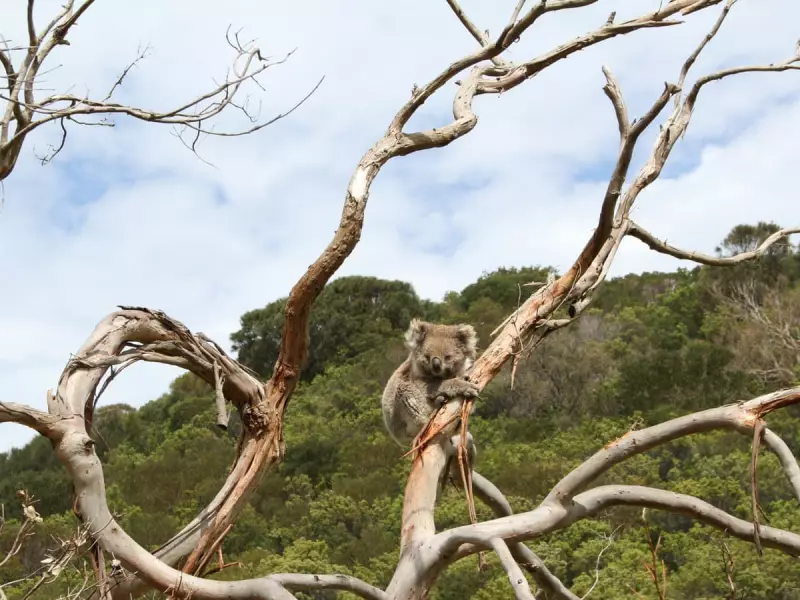
Australia's iconic koala is facing a starkly contrasting crisis across the continent, with some regions grappling with unsustainable overabundance while others battle the spectre of local extinction. This paradoxical situation presents a profound and complex challenge for conservationists.
The Southern Plight: Too Many Koalas, Too Few Trees
In parts of Victoria and South Australia, koala populations have boomed to such an extent that they are now eating themselves out of house and home. On French Island in Victoria's Western Port Bay, a population established in the 1880s has thrived in the absence of predators and disease. The result is severe defoliation of eucalypts, with local reports of koalas found starving, dead, or falling from trees.
The problem extends to the mainland. In South Australia's Mount Lofty Ranges, home to roughly 10% of Australia's total koala population, the situation is similarly dire. A recent study published in Ecology and Evolution, co-authored by Dr Frédérik Saltré from the University of Technology Sydney, projects this population will grow by 17% to 25% over the next 25 years, further threatening its own survival through overbrowsing.

"We might think it's a good thing having a lot of individuals, but it causes a lot of ecological problems down the track," Dr Saltré warns. "They're going to have massive issues feeding themselves." The issue, identified as a potential problem as early as 1996, is exacerbated by the prevalence of manna gum and commercial blue gum plantations—highly preferred food sources that support abnormally dense koala populations.
The Northern Threat: Habitat Loss and Decline
In stark contrast, koala populations in Queensland, New South Wales, and the Australian Capital Territory are in steep decline. Listed as endangered by the Australian government since 2022, these northern koalas face a different suite of threats.
Professor Mathew Crowther from the University of Sydney identifies habitat loss as the paramount issue, driven by land-clearing and urban development. This is compounded by disease, vehicle strikes, dog attacks, and the increasing impacts of climate change, including drought and more frequent fires.
Analysis has revealed that nearly 2 million hectares of forests suitable for koalas have been destroyed since the species was declared threatened in 2011, with 81% of that clearing occurring in Queensland. Assoc Prof Desley Whisson from Deakin University notes that the visible crisis of overabundance in the south often overshadows the quieter disappearance of koalas in the north. "I'm actually a bit concerned that we might be losing some of our populations," she says.
No Easy Fixes for a National Icon
Addressing the dual crisis has no simple solutions. Culling is banned and politically unthinkable for the beloved marsupial. Translocation—moving koalas from overpopulated areas—is expensive, logistically challenging, and has a mixed record, including notable recent bungles in NSW.
Fertility control through sterilisation is another avenue. Dr Saltré's new modelling suggests sterilising approximately 22% of adult females annually in high-density areas of the Mount Lofty Ranges could stabilise populations, at an estimated cost of $34 million over 25 years. However, with koalas living up to 15 years, this is a long-term strategy that struggles to align with political timelines.
Ultimately, experts point to landscape-scale habitat restoration as a crucial part of the answer. In the north, initiatives like the newly announced Great Koala National Park in NSW are vital. In the south, creating larger expanses of mixed forest that naturally support lower koala densities is key.
"With climates changing, the predictions are that the southern states of Australia will be the stronghold for koalas," says Assoc Prof Whisson. The goal, as Dr Saltré puts it, is to "find a sweet spot where the species can be sustainable over a long time," balancing a national icon's survival against the ecological limits of its environment.