In a remarkable stroke of paleontological luck, workers expanding a car park at a famous US monument have stumbled upon the remains of one of the longest creatures ever to walk the Earth.
A Colossal Discovery Beneath the Tarmac
While conducting construction work at the Dinosaur National Monument's Utah parking lot in September 2025, crews made an unexpected and historic find. They uncovered the first significant fossils to be discovered at the site in more than a hundred years. Experts from the National Park Service (NPS) believe the bones belong to a gigantic, long-necked dinosaur, most likely a Diplodocus.
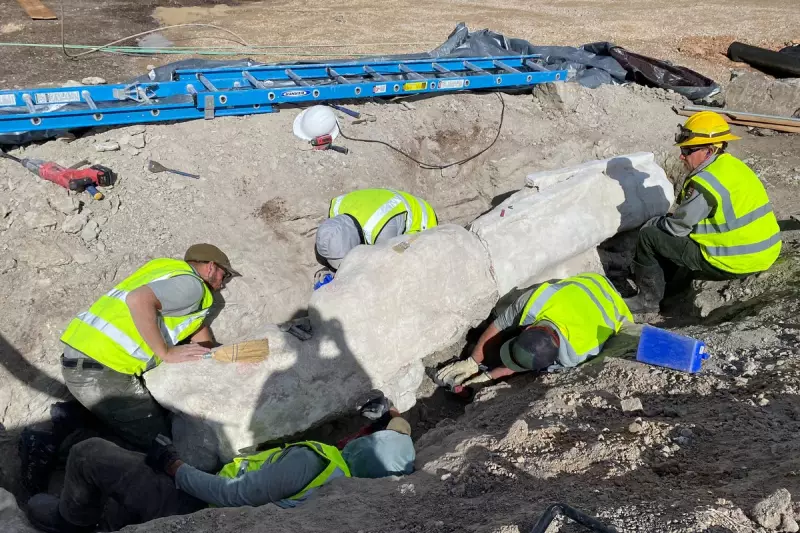
This sauropod species was common in the region during the Late Jurassic period, approximately 150 million years ago. Following the initial discovery, a collaborative team comprising construction workers, paleontologists, volunteers, and the Utah Conservation Corps worked tirelessly to extract the fragile remains from the surrounding sandstone.

"Roughly 3,000 pounds of fossils and rock were removed during the new excavation between mid-September to mid-October," the NPS confirmed in an official statement. This monumental effort has yielded a treasure trove for scientists.
Unearthing History at a Legendary Site
The find is particularly significant because the area had not been subject to a major fossil excavation since 1924, when the University of Utah led historic digs. The Dinosaur National Monument itself was established in 1915 and now spans an impressive 210,000 acres across Utah and Colorado.
Previous major excavations were conducted by prestigious institutions like the Carnegie Museum and the Smithsonian National Museum of Natural History. Today, the monument's Quarry Exhibit Hall, often called the "Wall of Bones," allows visitors to view over 1,500 dinosaur fossils embedded in a cliff face, including Allosaurus, Apatosaurus, and Stegosaurus.
Work is now underway to clean and study the newly recovered fossils at the Utah Field House of Natural History State Park Museum in Vernal. However, some specimens are already on public display at both that museum and the monument's Quarry Exhibit Hall, located conveniently near the very parking lot where they were found.
The Diplodocus: A Prehistoric Giant
The probable identity of the dinosaur, the Diplodocus, points to a truly colossal discovery. The Diplodocus longus species is known to be an extremely long dinosaur, with the Park Service noting it was the longest found in the famed Carnegie Quarry within the monument.
These gentle giants could grow up to 92 feet in length and possessed pencil-like teeth perfect for stripping leaves from low-growing plants. Its name, meaning "double beam" in Greek, refers to the distinctive double projections on the bottom of its tail vertebrae. Remarkably, of its roughly 300 bones, nearly a third were located in its whip-like tail.
This new find adds to the site's rich legacy, as the Carnegie Quarry already houses three of the most complete Diplodocus skeletons ever discovered. The painstaking analysis of the 3,000-pound haul may now reveal a fourth, offering fresh insights into the lives of these majestic Jurassic inhabitants.