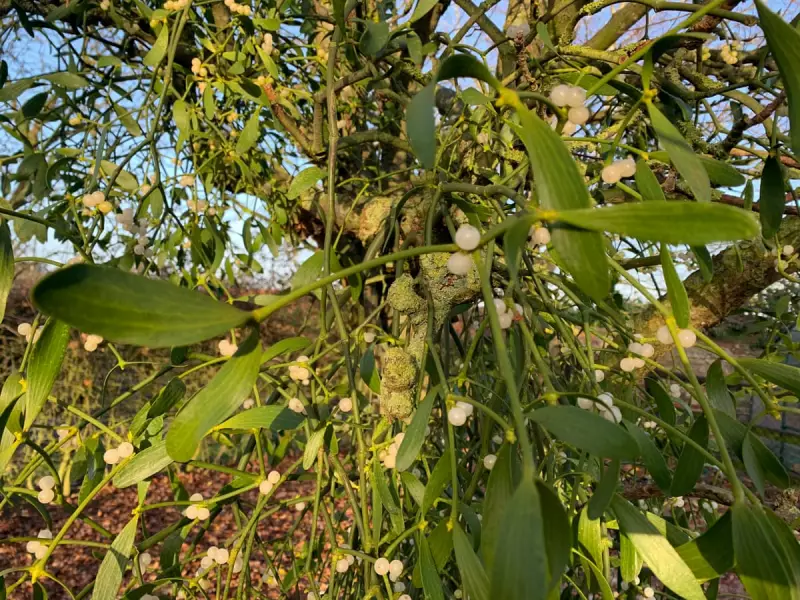
In the stark winter landscape of Caistor St Edmund, Norfolk, the true character of the woodland is laid bare. With leaves gone, the intricate architecture of the trees is revealed, from ivy-clad trunks offering shelter to wrens and robins, to the precarious sway of rook nests. Among this scene, the great, spherical clusters of mistletoe hang suspended in the bare branches, their evergreen presence a year-round fixture that only becomes a festive icon in December.
A Parasite Steeped in Myth and Modern Tradition
For a plant that siphons life from its host, mistletoe holds a uniquely cherished place in human culture. Its lore stretches from ancient Greek myths, where it was considered a gateway to the underworld, to the Druids who linked it to ceremonies of fertility. This ancient association is the likely seed for our modern tradition of stealing a kiss beneath its boughs during the Christmas season.
Botanically, mistletoe is a hemiparasite. It employs root-like structures called haustoria to penetrate a tree's bark and extract water and nutrients. Yet it also contributes to its own sustenance through photosynthesis, using its distinctive pairs of curved, leathery leaves. This dual strategy does not negate its burden on the host, however, and an infestation can often stunt a tree's growth.

The Keystone Species: Why Mistletoe Matters for Biodiversity
Despite its parasitic nature, mistletoe's ecological value is immense and disproportionate to its size. Conservationists classify it as a keystone species, meaning its presence supports a wide web of life. The direct beneficiaries are specialists like the mistle thrush bird and the mistletoe marble moth.
The impact of its loss, however, is devastatingly broad. One scientific study found that removing mistletoe from woodlands led to a 20% fall in overall species richness, with a quarter of all woodland bird species disappearing from the area. This underscores its critical role in providing food, shelter, and nesting sites for a vast array of creatures.
Spreading the Parasite: A Lesson in Patience from the Mistle Thrush
On a low-growing apple tree, the pearly white berries of mistletoe gleam, almost translucent against the green leaves. This is the plant's vehicle for propagation, typically spread by birds. After eating the fleshy berries, birds either wipe the sticky seed residue from their beaks onto a branch or excrete the intact seed. The viscous coating acts as a natural glue.
Emulating the mistle thrush, one can attempt to spread the plant. By squishing a berry to extract the seed and rubbing the gluey substance firmly onto the bark of a suitable host tree—like a mature apple—you mimic nature's process. The key ingredient thereafter is patience, as germination can take many months. It's a unique form of gardening: while others spread festive cheer, you might just be spreading a beneficial parasite.
Under the Changing Skies: The Best of the Guardian’s Country Diary, 2018-2024 is published by Guardian Faber and is available with a 15% discount from guardianbookshop.com.