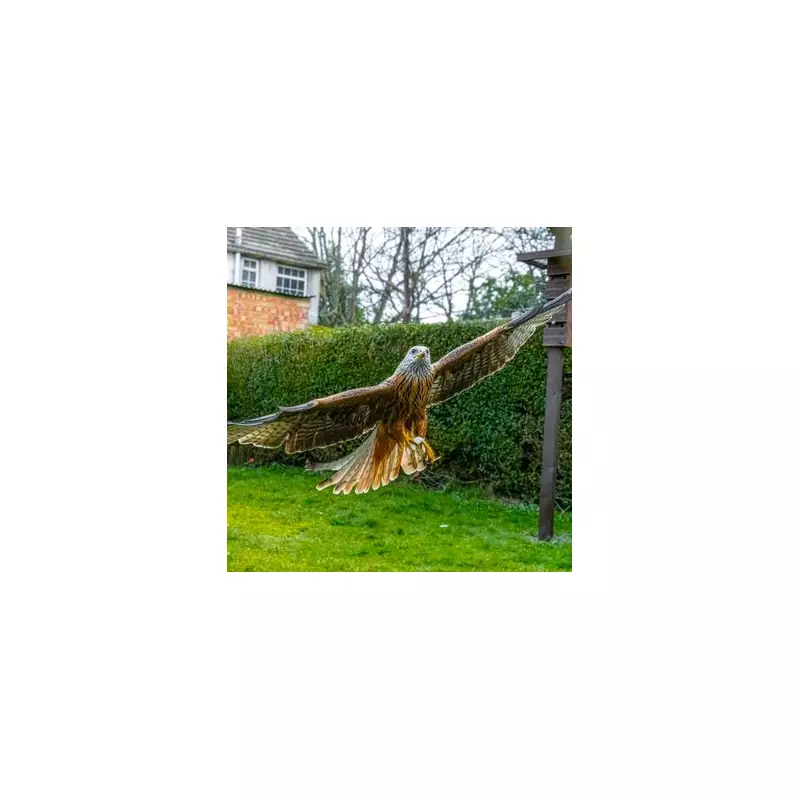
A dedicated wildlife photographer from Portsmouth has revealed the extraordinary lengths he went to capture stunning close-up photographs of Red Kites in his own back garden, including disguising himself as a bush for weeks.
The Patient Pursuit
Charlie Blake, 41, from Portsmouth, Hampshire, devoted weeks to preparation before finally achieving his goal of photographing the magnificent birds of prey at close range. The wildlife enthusiast adopted full camouflage clothing and concealed himself beneath a specially designed net for sessions lasting up to four hours at a time.
His determination was rewarded when he captured the extraordinary split-second moment a Red Kite landed in his garden. Charlie explained his technique: "I kept the camera focused on the ground where I thought it would swoop. When it entered the frame, I just clicked and hoped."

Weeks of Preparation
The photographic project began when Charlie first noticed a group of the distinctive birds flying over his Portsmouth home. Initially, they remained too high for quality photographs, but he noticed their flight patterns changed after he began leaving scraps for local foxes.
The breakthrough moment came in March this year when Charlie spotted one land in his garden while he was in his kitchen. Sadly, that opportunity passed too quickly for him to capture any images. "It was over in a flash — I couldn't believe it," he admitted.
This near-miss inspired Charlie to develop his elaborate camouflage strategy. For two weeks, he spent up to four hours at a time hidden under foliage-style netting, peering through a small hole with his trusty Canon 90D camera at the ready.
Conservation Success Story
The Red Kites in Charlie's photographs represent one of Britain's most remarkable conservation success stories. These impressive birds of prey were once hunted to near extinction in the UK, with none seen in England and Scotland during the post-war decades.
By the early 1960s, the UK Red Kite population had dwindled to just 20 pairs confined to remote areas of Wales, having reached as low as two pairs in the 1930s. Their decline began in the Middle Ages when they started being considered vermin in towns and threats to game birds on country estates.
Conservation efforts began in earnest at the start of the 20th century, culminating in the 1980s and 1990s when chicks from Spain and Sweden were released in the Chilterns. These birds began breeding in 1992, and populations increased rapidly due to earlier breeding ages and greater prey availability.
Today, Britain is home to approximately 6,000 mating pairs of Red Kites, representing around 15% of the world's total population. The conservation strategy has proven so successful that it's now being repeated in reverse, with over 120 chicks taken from Northamptonshire to Extremadura in western Spain since 2022.
Speaking about his remarkable photographs, Charlie added: "Wildlife is usually seen from a distance. If my photos help people appreciate what we have right on our doorstep, then the hours of waiting are worth it."