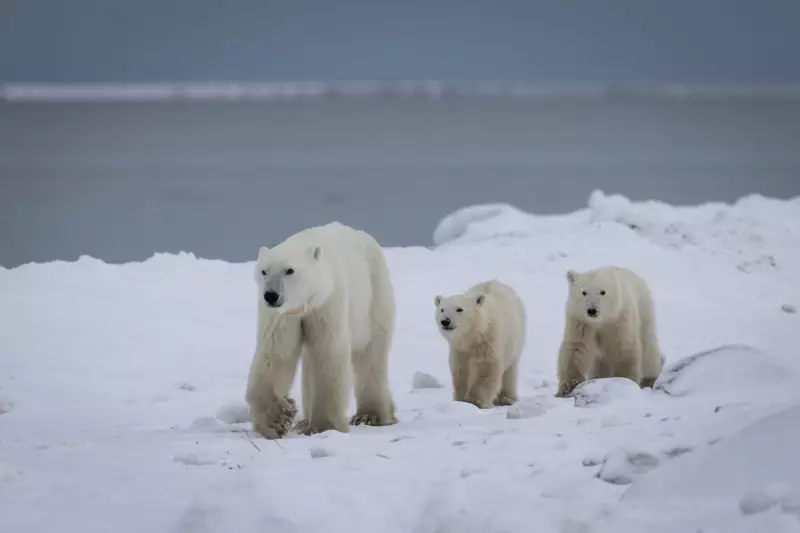
In a heartening display of maternal instinct, a wild polar bear in Canada has been filmed adopting an unrelated cub—an event scientists describe as extraordinarily rare. This remarkable behaviour, captured on video in Manitoba, provides a poignant note of hope for a species facing a dire future due to human-caused climate change.
A Rare Act of Kinship on the Tundra
The adoptive mother, a five-year-old bear identified by researchers as "bear X33991," was originally tagged in the spring in northeastern Manitoba alongside her own 10-to-11-month-old cub. When scientists observed her again in the autumn, they made a surprising discovery: her family had grown. She was now accompanied by a second, untagged cub, seemingly taken in through adoption.
This event marks only the 13th documented case of adoption in the Western Hudson Bay polar bear population, which has seen over 4,600 bears tracked across the last 45 years. "It is unusual," confirmed Alyssa McCall, a staff scientist at Polar Bears International. "We don't really know why it happens or how often - but we know it doesn't happen often at all."

Dr. Evan Richardson, a polar bear research scientist at Environment and Climate Change Canada, noted that such adoptions are not exclusive to Canada, having also been observed in Norway and the High Arctic. "We've seen females take on whole litters of cubs, two or three cubs that aren't even their own," he said. The cubs may be orphans, but sometimes their biological mothers are still alive. The driving force, Richardson suggests, is profound maternal instinct: "They just can't leave a cub crying on the tundra so they pick them up and take them along with them."
A Lifeline for the Cub and a Mystery Unsolved
For the newly adopted cub, this act dramatically improves its prospects. The chance of survival for a polar bear cub to adulthood is roughly 50% with a mother's care, as she teaches essential hunting and survival skills for about 2.5 years. Alone, a cub has almost no chance.
Adoption helps to increase the cub's chance of survival to adulthood, and within the Western Hudson Bay population, three of the 13 adopted cubs have survived. The fate of this cub's biological mother, however, remains unknown. Even with genetic analysis of samples from the cub, researchers may never solve the mystery. "There's a small chance we could find out, but there's a good chance we'll never know," McCall explained.
A Beacon of Hope Against a Grim Backdrop
This tender moment unfolds against a stark warning for the species' future. Polar bears are increasingly threatened by the rapid loss of their sea ice habitat due to global warming, which hampers their ability to hunt. The crisis is so severe it is even forcing changes in polar bear DNA, according to recent studies.
Researchers from the University of East Anglia have predicted that more than two-thirds of polar bears could be extinct by 2050. In this context, the adoption observed near Churchill, Manitoba, feels especially significant. "It's just nice to know that the bears are looking out for each other," said Dr. Richardson, highlighting how such natural compassion offers a glimmer of resilience. While not a solution to the existential threat of climate change, this rare event "gives you a lot of hope" for the enduring spirit of the Arctic's most iconic inhabitants.