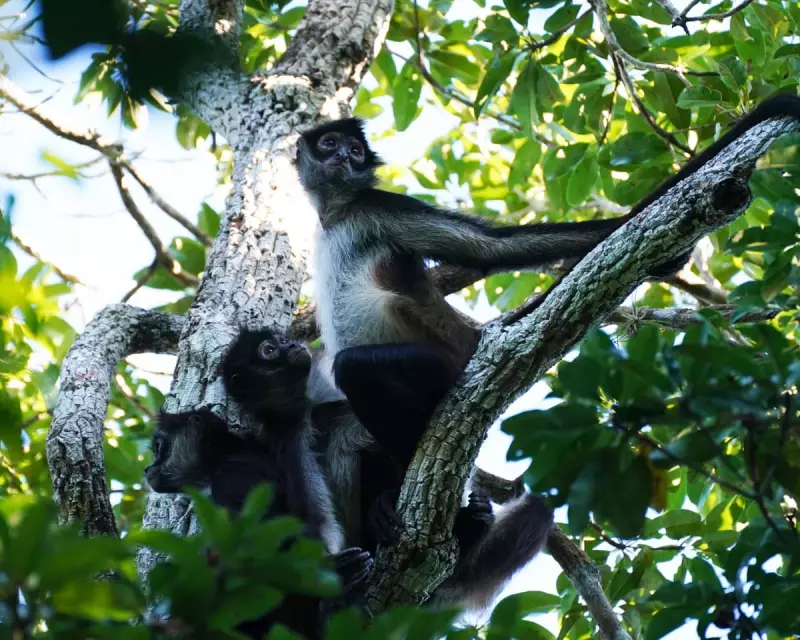
In a groundbreaking study, researchers have uncovered that Geoffroy's spider monkeys employ a sophisticated social strategy to share insider knowledge, helping their groups locate the best food sources in their forest habitats. This behaviour, observed over seven years in Mexico's Yucatán peninsula, reveals how these primates combine information to produce new knowledge, enhancing their foraging success.
Social Dynamics and Information Exchange
The research, published in the journal njp Complexity, involved scientists from Heriot-Watt University, the University of Edinburgh, and the National Autonomous University of Mexico. They found that spider monkeys frequently switch subgroups of three or more individuals, a behaviour that facilitates the sharing of critical information about fruit tree locations and the timing of when fruits ripen. This fluid social system allows monkeys to complement each other's knowledge and synergistically combine details, such as one subset contributing location data and another providing timing information.
Mathematical Modelling and Optimal Strategies
Ross Walker, a PhD student at Heriot-Watt University, developed mathematical models to analyse the benefits of these social relationships. The analysis showed that there is an optimal balance between monkeys sticking together and spreading out too far. By exploring different areas individually and reconnecting often, the monkeys can pool their learned information effectively, maximising the group's collective coverage of feeding spots.

Dr Matthew Silk, an ecologist from the University of Edinburgh, emphasised that this is not random social mingling. Instead, it is a clever system where monkeys who know different parts of the forest share tips about where fruit is available. The study tracked individual movements and mapped core ranges, revealing that some forest areas are known by multiple monkeys, while others are known by only one or two, creating a network of shared and unique knowledge.
Implications for Collective Intelligence
The evidence from this research provides a compelling example of collective intelligence in natural conditions. Prof Gabriel Ramos-Fernandez from the National Autonomous University of Mexico noted that by exploring their environment in a distributed fashion and then coming together to share uniquely obtained information, the group as a whole can know the forest better than any single individual could alone. This strategy is particularly crucial for the endangered Geoffroy's spider monkey, also known as the Central American or black-handed spider monkey, as it aids in their survival by optimising food foraging.
The study's findings highlight the importance of social flexibility in animal behaviour, offering insights into how complex information-sharing systems can evolve in wildlife. This research not only advances our understanding of primate societies but also underscores the value of interdisciplinary approaches, combining field observations with mathematical analysis to uncover the mechanisms behind collective intelligence.