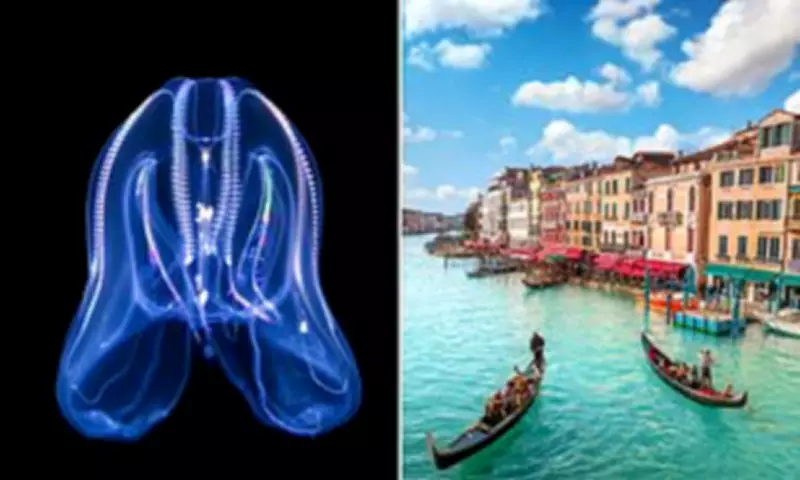
Venice is confronting an extraordinary and alarming invasion of a bizarre, cannibalistic jellyfish species that marine scientists warn is severely threatening local fish stocks and wreaking widespread havoc across the city's fragile lagoon ecosystem. The peculiar marine creature, commonly known as the warty comb jelly or sea walnut, has experienced a dramatic population explosion throughout the Venetian lagoon, creating significant operational challenges for fishermen and devouring the fundamental building blocks of marine life.
An Alien Species Colonising Venetian Waters
Originally native to the western Atlantic Ocean, the gelatinous animal is believed to have reached the Adriatic Sea after inadvertently hitching a ride in the ballast water of international cargo ships. From this initial introduction, the species has rapidly colonised large swathes of the lagoon, establishing a formidable and disruptive presence. Researchers indicate that its successful proliferation has been substantially fuelled by ongoing climate change, with warmer water temperatures and ideal salinity levels creating perfect environmental conditions for the species to thrive and multiply.
The Disturbing Biology of the Warty Comb Jelly
The jellyfish, whose Latin name is Mnemiopsis leidyi, is infamous for its unsettling and unusual biological traits. Its anus appears only temporarily during defecation before vanishing again, a peculiar characteristic that fascinates and disturbs researchers. Furthermore, the species is known to exhibit cannibalistic behaviour, consuming its own offspring under certain conditions, which adds another layer of ecological concern.

Scientific monitoring has recorded a sharp and concerning surge in the number of these creatures within Venice's lagoon, leading to what experts describe as 'serious issues' for the local fishing community. Fishermen, who are already struggling to protect their livelihoods amid various economic and environmental pressures, find their nets clogged by the squishy, pervasive jellyfish. More critically, these invaders are voracious predators that feast extensively on fish eggs, fish larvae, and plankton – all essential elements that form the base of the lagoon's intricate food web and support commercial fish populations.
A Recognised Global Threat
This species is formally listed among the world's 100 most harmful invasive alien species, highlighting its significant potential for ecological damage. It is now reported to be widespread throughout the entire Venetian lagoon, according to comprehensive findings from a rigorous two-year study conducted by scientists from the University of Padua and Italy's National Institute of Oceanography and Applied Geophysics. Their critical research, which details the scale and impact of the invasion, was recently published in the esteemed scientific journal Estuarine, Coastal and Shelf Science.
Broader Implications for the Adriatic Region
The ongoing invasion poses a growing and substantial threat to the wider Adriatic fishing industry, an economic sector worth billions of euros annually and particularly renowned for its high-quality production of clams and mussels. The scientific team issued a stark warning in their publication, stating: 'Ongoing climate change could create increasingly favourable environmental conditions for this ctenophore, potentially boosting its presence in large aggregations and, consequently, increasing the risk of impacts on the entire lagoon ecosystem.'
Notably, the warty comb jelly is not the only invasive species currently causing ecological and economic chaos in the Adriatic region. The area is simultaneously battling a dramatic explosion in populations of blue crabs – another Atlantic interloper also believed to have arrived via ship ballast water. Named for their vivid blue claws, these aggressive crabs tear into clams, mussels, prawns, and other valuable seafood, while also ripping apart fishing nets and causing millions of euros in cumulative damage to fishing infrastructure and catches.

In a novel approach to this dual crisis, Italy is now attempting to mitigate the blue crab problem by promoting them as a culinary resource. Blue crabs are increasingly appearing on supermarket shelves and restaurant menus across the country, as officials and industry stakeholders scramble to curb their numbers through human consumption, turning an ecological threat into a potential gastronomic opportunity.