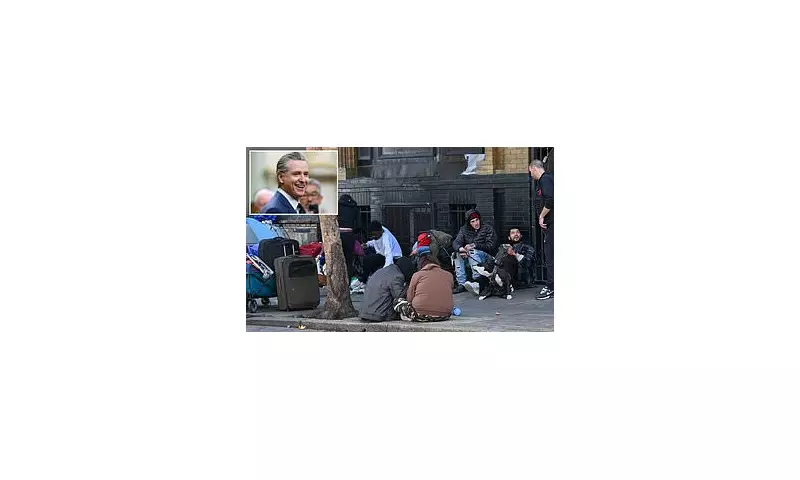
When Governor Gavin Newsom announced the CARE Court programme with considerable fanfare in March 2022, he pledged a revolutionary approach to tackling California's severe mental health crisis. The initiative was presented as a "completely new paradigm" designed to compassionately compel individuals with serious mental illnesses off the streets and into structured treatment through judicial orders. Initial state estimates suggested the programme could assist up to 12,000 vulnerable Californians, with a subsequent Assembly analysis indicating eligibility could extend to approximately 50,000 people.
A Promise of Paradigm Shift Meets Harsh Reality
However, an exclusive investigation reveals the programme has dramatically underperformed following an expenditure of $236 million in taxpayer funds. Critics are now labelling the initiative a potential fraud, with only 22 individuals successfully court-ordered into treatment to date. Statewide data up to October shows roughly 3,000 petitions were filed, of which 706 received approval. Crucially, 684 of these approved cases resulted in voluntary agreements, fundamentally contradicting the programme's core objective of mandated care for those too ill to seek help voluntarily.
Families Left in Despair as System Fails Again
The human cost of this failure is embodied by families like that of Ronda Deplazes from Concord. For two decades, Deplazes and her husband felt like prisoners in their own home following their son's schizophrenia diagnosis in his late teens. Initially attributing his struggles to addiction, they watched his condition deteriorate, leading to violent outbursts, homelessness, and approximately 200 brief incarcerations mostly for misdemeanours.

"He never slept. He was destructive in our home," Deplazes recounted, describing scenes where police had to physically remove her son. She found him barefoot and nearly naked in freezing conditions, or screaming through neighbourhoods at night. "They left him out on our street picking imagined bugs off his body. It was terrible."
For Deplazes, CARE Court appeared to be the long-awaited solution—a mechanism allowing a judge to mandate life-saving treatment. Yet, after navigating a complex, red-tape-heavy petition process familiar from years within California's bloated, multi-billion dollar homelessness and mental health labyrinth, a judge rejected her case. The judge stated her son's needs "are higher than we provide for," a rationale Deplazes calls a lie, given the programme's explicit criteria including frequent incarceration.
Billions Spent, Questions of Fraud and Mismanagement
The failure of CARE Court occurs against a backdrop of colossal state spending. California has allocated between $24 and $37 billion towards homelessness since Governor Newsom took office in 2019, with results remaining dubious despite recent preliminary statistics citing a nine percent decrease in unsheltered homelessness. The state's homeless population consistently hovers between 170,000 and 180,000, with an estimated 30 to 60 percent suffering from serious mental illness, often compounded by substance abuse.
Deplazes, who communicates with a network of mothers in similar situations, now alleges CARE Court has morphed into a revenue-generating system that maintains open cases without delivering substantive care. "There are all these teams, public defenders, administrators, care teams, judges, bailiffs, sitting in court every week," she observed. "They're having meetings and memorials, but are they actually helping people? No! They're getting paid—a lot." She accuses senior administrators of earning six-figure salaries while families wait months for action, stating, "I saw it was just a money maker for the court and everyone involved."
Systemic Failures and a Culture of Complacency
Political activist and longtime Newsom critic Kevin Dalton echoed these concerns, branding the programme "another gigantic missed opportunity." He questioned the return on investment: "$236 million and all you have to show for it is 22 people?" Dalton agrees the situation enables profiteering, comparing it to "a diet company not really wanting you to lose weight."

This perspective finds support from former Los Angeles County District Attorney Steve Cooley, who argues fraud is embedded across numerous California government programmes. Cooley contends that lawmakers and agencies consistently fail to integrate basic preventative measures into systems distributing billions of public dollars. "Almost all government programmes where there's money involved, there's going to be fraud, and there's going to be people who take advantage of it," Cooley stated. He highlighted a recurring failure by local authorities to address this, recalling a welfare official's admission: "Our job isn't to detect fraud, it's to give the money out."
A Legacy of Inadequate Solutions
The current crisis has deep roots. For sixty years, since the bipartisan Lanterman-Petris-Short Act was signed by then-Governor Ronald Reagan—effectively ending widespread involuntary confinement in state mental hospitals—lawmakers and advocates have struggled to find effective solutions for the chronically mentally ill. Celebrity parents, like the late Rob and Michele Reiner, allegedly murdered by their troubled son, or the parents of former child star Tylor Chase, have faced the same insurmountable challenges as ordinary families like the Deplazes.
Governor Newsom's initial empathy resonated with many. "I've got four kids," he said at the programme's launch. "I can't imagine how hard this is. It breaks your heart... you watch a system that consistently lets you down and lets them down." For families like Deplazes's, that is precisely what has transpired. "I was devastated. Completely out of hope," she said of the rejection. "It felt like just another round of hope and defeat."
Demanding Accountability and Change
Determined to expose the truth, Deplazes has filed public records requests seeking detailed information on outcomes and funding, though she reports agencies have been slow or unresponsive. "That's our money," she asserts. "They're taking it, and families are being destroyed." While she fears it may be too late for her own son, currently jailed but soon due for release, Deplazes continues to advocate for others. "We're not going to let the government just tell us, 'We're not helping you anymore.' We're not doing it."
Calls to Governor Newsom's office for comment on these allegations were not returned. The CARE Court programme, heralded as a beacon of hope, now stands as a stark symbol of systemic failure, financial waste, and profound human suffering amidst California's ongoing mental health and homelessness catastrophe.