Cuba's Youth Seek Refuge in Church and State Amid Synthetic Drug Crisis
Cuba is confronting a rapidly escalating wave of synthetic drug use that is severely impacting its young population. This phenomenon, once nearly unheard of in the country, has emerged as a critical public health issue in recent years.
The Rise of 'Químico' and Its Devastating Impact
In Havana and other urban areas across the island, it has become increasingly common to witness young individuals in public parks sleeping, struggling to walk, or lying unconscious. Authorities identify the primary threat as "químico," a potent mix of synthetic cannabinoids and dangerous additives. Known on the streets as "papelitos" or "little papers," this drug is absorbed into sheets of paper, cut into small doses, and smoked. At approximately 250 Cuban pesos per hit (equivalent to 50 cents), it is cheaper than basic staples like bread or soda, making it widely accessible.
"It's very cheap...and it's everywhere," remarked David Morales, a 25-year-old in recovery who received assistance at government-funded health centers and is now undergoing rehabilitation therapy at the Alcance Victoria Cuba evangelical Baptist church.

Government Response and Zero-Tolerance Policy
In response to the surge in consumption, Cuba's Ministry of Health and various state agencies established a National Drug Observatory in July. This initiative aims to research, monitor, and mitigate the effects of illegal drugs on the island. While the government does not officially track the number of drug users, Dr. Tania Adriana Peón, head of mental health and addictions at the General Directorate of Health, cited emergency room data as an indicator of the trend. In 2024, 467 people sought help or were registered in emergency rooms in Havana, a figure that nearly doubled to 886 by 2025.
Cuba maintains a zero-tolerance policy on drugs, with drug trafficking punishable by up to life imprisonment. Although not a drug-producing nation, authorities acknowledge vulnerability to drug use. Sporadic seizures occur, such as packages of cocaine abandoned by traffickers and washed ashore, known as "recalos" or washups. Drugs are also smuggled in via imported goods, and domestic marijuana plantations have been detected to a lesser extent.
"The primary challenge Cuba faces today is related to new psychoactive drugs or synthetic cannabinoids, which originate mainly from the United States," stated Col. Juan Carlos Poey Guerra of Cuba's Interior Ministry. He noted that police laboratories identified 46 new synthetic formulations in the past year, including mixtures with substances like the anticonvulsant carbamazepine, formaldehyde, and fentanyl. Between 2024 and 2025, authorities thwarted 72 smuggling attempts from 11 different origins, with the U.S. being the primary source of precursor substances for químico.
State-Run Healthcare and Rehabilitation Efforts
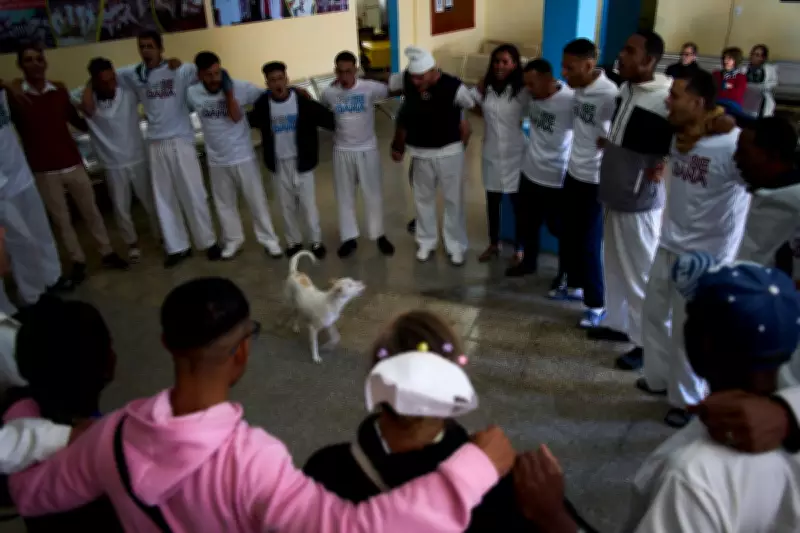
Healthcare in Cuba is state-run and free, with neighborhood family clinics often serving as the first line of detection for drug use signs. Patients with more severe conditions are referred for intensive hospital stays. The Associated Press recently visited a 40-bed men's ward at the Havana Psychiatric Hospital, where patients aged 20 to 30 undergo a 90-day detox before rehabilitation. The ward features two-bed cubicles decorated with family photos, a reading area, dining room, and recreation space. Patients wear white T-shirts with the slogan "We win against drugs" and take daily responsibility for cleaning their surroundings.
"I was incredibly depressed...living on the streets; I just couldn't take it anymore," shared 23-year-old Daniel Fulleda, admitted in January. He expressed enthusiasm about plans to marry and start a family by year-end, adding, "Next year, I'll start my own business."

Church Involvement and Community Support
For decades, the highly centralized state handled treatment for drug and alcohol users, but the scale of the current crisis has opened doors for other actors, such as churches. Pastor Abel Pérez of the Alcance Victoria Cuba church described neighborhoods as "infested" with drug use, stating, "As a pastor, I'm not called to sit idly by." Last year, the church provided therapy to about 50 young people and their families, with over a dozen regularly attending sessions today.
Alejandro Morales, a 57-year-old oceanographic engineer who accompanies his son David to church meetings, reflected on the rapid growth of the problem: "In my youth, talking about drugs was extraordinary... The problem has grown so rapidly and in such a short time that, to some extent, it has overwhelmed the country's capacity to address it."
In the same church setting, 64-year-old Vilma Arias sought help with her 36-year-old daughter, while her 26-year-old son struggles with drug use but refuses treatment. "We have to pray a lot," she said. "My daughter is a wonderful teacher and my son is a graduate in automotive mechanics. I don't even know how they fell into this."
The combination of economic hardship, shortages of basic goods, and the influx of low-cost synthetic drugs has created a perfect storm, driving young Cubans toward addiction. As both state institutions and religious organizations step up their efforts, the battle against this epidemic continues to unfold across the island.