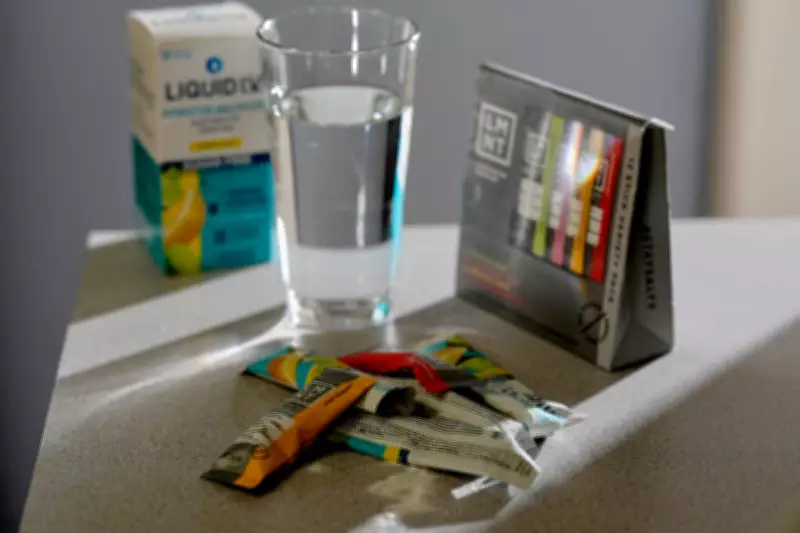
Electrolyte supplements have become ubiquitous in today's health and fitness landscape, but medical professionals are increasingly questioning whether most consumers actually need these products or if they're simply falling for clever marketing tactics.
The Science Behind Electrolytes
According to Julia Zumpano, a registered dietitian at the prestigious Cleveland Clinic, electrolytes are electrically charged substances that play a crucial role in regulating the body's chemical reactions. These minerals, primarily sodium chloride (common table salt), maintain fluid balance both inside and outside cells, making them essential for proper hydration.
"Electrolytes are lost through perspiration during physical activity," Zumpano explains. "When people engage in intense sweating and consume excessive amounts of plain water, they can further dilute their body's salt levels, disrupting this delicate balance."

Who Actually Needs Electrolyte Supplements?
Hunter Huston, a nephrologist at Vanderbilt University who consults for a UK-based company providing electrolyte replacement plans for endurance athletes, offers a clear perspective: "In general, the kidneys in a healthy person do an excellent job of keeping our electrolytes in balance. Taking an electrolyte-enriched drink, just for health purposes, probably isn't doing much."
Huston provides a practical guideline: "A good rule of thumb is that if you are exercising for less than two hours, plain water is probably fine. The average healthy person can tolerate losing around 2% of their body weight in sweat before they really start to feel it. That's increased thirst, it's fatigue, it's cramping."
However, individual variations exist. Some people sweat more heavily or have sweat that contains higher salt concentrations. In extreme sports like ultramarathons, athletes often undergo professional testing to determine their sweat composition and receive tailored nutrition plans.
The Gatorade Origin Story
The modern electrolyte supplement industry traces its roots back to 1965 at the University of Florida. Assistant football coach Dwayne Douglas approached kidney researcher Robert Cade with a puzzling question: "Doctor, why don't football players wee-wee after a game?"
"That question changed our lives," Cade later recalled. His research team discovered that football players could lose up to 18 pounds (8.16 kilograms) during a game, not just water but also sodium, chloride, plasma volume, and blood volume. These losses significantly impacted their strength and stamina.
Cade developed a briny solution to replace what players were losing, adding sugar to help the gut absorb sodium. The initial formulation made him vomit, but with some lemon juice added for taste, the team's performance improvement became undeniable—particularly during the second half of games when opponents wilted in Florida's heat and humidity.
Cade, who passed away in 2007, admitted he never imagined Gatorade would become a consumer product purchased by regular people.
The Marketing Evolution
Darren Rovell, author of "First in Thirst: How Gatorade Turned the Science of Sweat Into a Cultural Phenomenon" and an investor in the sports drink Bodyarmor, has witnessed the industry's transformation firsthand.
"When I was a runner in high school, we were given Gatorade to drink and told the reason it tasted bad was because it was good for you," Rovell recalls. "Then at some point in the nineties, it got to be sugary."
After PepsiCo purchased the brand in 2001, Rovell notes, "That really became the first time where you see Gatorade everywhere in front of your face including in a pizza place, and it starts to be, 'OK. Is this just a different type of soda?'"
Rovell observes that electrolyte brands market the idea that drinking their products will either make consumers feel like athletes or provide a performance edge for actual athletes. "It all starts in the aspiration of being better, but you know we do have to check ourselves," he cautions.

Modern Supplement Concerns
Patrick Burns, who practices emergency medicine at Stanford Health Care and occasionally runs ultramarathons, highlights significant variations in today's electrolyte products. "The supplements out today have an incredibly wide variety of electrolyte concentrations," he notes, pointing out that some contain five times the sodium of others.
Burns warns consumers against assuming all supplements are equal and cautions about potassium supplementation, which can be dangerous in excessive amounts. He also identifies a contradiction in many modern products: "Many brands now offer zero sugar varieties, even though the glucose in sugar is what allows for rapid absorption of the sodium. They're not internally consistent, at all, with what they're trying to sell you. For optimal absorption, you need some sugar in with your salt."
Expert Recommendations
Mark Segal, a professor of nephrology at the University of Florida College of Medicine, provides straightforward advice: "For a healthy person who is not sweating intensely, the beverages probably won't hurt you, but they won't help you either. You're getting extra sugar, and there's no reason for rapid absorption of sodium because you're not sodium depleted."
Segal emphasizes that most people obtain all necessary salt and potassium from their regular diet without needing supplements.
Regarding homemade electrolyte solutions, experts express caution. "How do you know how much you need?" Zumpano questions. "There's a large margin of error there. I'd probably just avoid it," she advises, particularly warning against following recipes from social media influencers without proper understanding of individual needs.
Zumpano summarizes the consensus view: "Electrolytes can help, especially with heavy sweating or exercise, but for most people, they're not something you need every single day, and you definitely don't need large amounts of it."