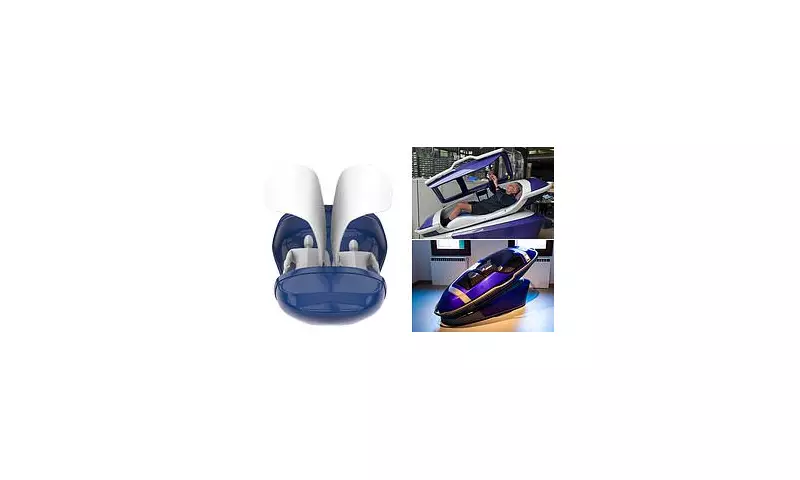
In a landmark and controversial event, a 64-year-old woman has become the first person to end her life using a futuristic 3D-printed device known as the Sarco pod. The incident occurred in September 2024 within a forest in Switzerland's Schaffhausen region.
The woman, who suffered from a severe immune-compromising condition, entered the capsule and initiated the process herself. The pod then flooded with nitrogen, leading to her loss of consciousness and death within minutes. This pioneering use, however, triggered an immediate and forceful response from Swiss authorities.
Police Seizure and Legal Fallout
Following the death, police arrived at the scene, confiscated the Sarco pod, and detained all those present. This included the late Dr Florian Willet, co-president of the assisted suicide organisation The Last Resort, his lawyers, and a photographer. Although an initial homicide investigation was swiftly ruled out and all were released, the authorities retained the device.

The police are now examining whether the act constituted an illegal assisted suicide motivated by 'selfish reasons', such as reputational gain—a claim inventor Philip Nitschke finds 'bizarre' and legally unconvincing. The ongoing investigation has left Nitschke, the Australian-born pro-euthanasia activist, in a state of legal limbo, unable to proceed with his work in Switzerland for the time being.
The aftermath took a tragic personal toll on Dr Willet. After 70 days in pre-trial detention, he was diagnosed with a stress-induced acute polymorphic disorder. He later died by assisted suicide in Germany in May 2025, a death Nitschke directly links to the trauma of his arrest and the false allegations.
The Next Generation: AI and the 'Double Dutch' Pod
Despite the setback, Nitschke, director of Exit International, is forging ahead with new developments. His primary focus is the 'Double Dutch' Sarco pod, a device specifically designed for couples who wish to die together.
This new model is twice the size of the original and features two buttons that must be pressed simultaneously for activation. 'If they both want to die, they have to die together, [and] they have to both press the buttons at the same time,' Nitschke explained.
A key technological advancement is the integration of artificial intelligence to assess mental capacity. Instead of a traditional psychiatric evaluation, future users will interact with an AI avatar. Passing this digital test will activate the pod for a 24-hour window. Nitschke states most parts have already been 3D-printed and assembly is expected within months.
Expanding the Arsenal: The Kairos Kollar and Dementia 'Kill Switch'
Beyond the Sarco, Nitschke is developing other DIY end-of-life devices to circumvent legal restrictions. One is the Kairos Kollar, a collar that induces death by cutting off blood flow to the brain, based on controversial WWII-era research. It is designed to be assembled at home and activated via a mobile app, linked to the same AI capacity test.
Another provocative project is a subdermal 'kill switch' implant for dementia sufferers. The implant would be programmed to release a lethal substance if the user, due to advanced cognitive decline, fails to respond to a daily warning signal. Nitschke believes this could solve the 'dementia dilemma' surrounding mental capacity and consent.
Nitschke vigorously defends his work against critics like Care Not Killing, which has labelled the Sarco a 'personalised gas chamber'. He argues that for elderly individuals seeking control and a guaranteed peaceful exit, these devices provide vital agency and peace of mind. 'We've found that elderly people live longer, paradoxically, by having access to what is a reliable, lethal process,' he claims.
While Switzerland remains the only viable launchpad for the Double Dutch due to its non-medical criteria for assisted suicide, its future—and that of Nitschke's broader campaign—now hinges on the conclusion of the Swiss police investigation.