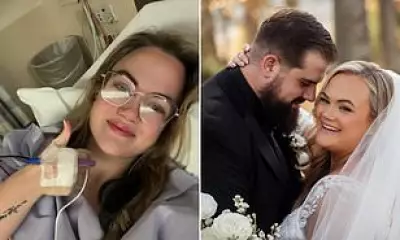
Kate Lawler has offered a candid look into her recent hospital experience for what she termed 'breast replacement surgery,' following her revelation that she needed the procedure to address a leaking implant. The 45-year-old television personality, who rose to fame after winning the third series of Big Brother in 2002, posted a series of photographs reflecting on her January, which included the surgical intervention earlier this month.
From Hospital Gown to Humorous Gifts
In her social media gallery, Kate shared a pre-surgery image of herself dressed in a hospital gown, captioning it with a positive 'Thumbs up ahead of having surgery...' She also revealed a playful gift from her friend Kris: a mug designed to humorously mimic her breasts. Additionally, the star mentioned receiving a copy of her pal Ashley James' new book, Bimbo, which she praised as 'delightful company' during her recovery.
The Path to Surgery
Last week, Kate explained on her podcast, Boj and Kate Have A Lot on Their Plate, how she first noticed her left breast had hardened, prompting a visit to her GP. 'I've had a boob job... a boob replacement,' she stated, noting the surgery occurred just five days prior, leaving her still in the recovery phase. The radio presenter, who shares a four-year-old daughter, Noa, with her husband Martin 'Boj' Bojtos, initially underwent breast enlargement surgery in 2015.

She recounted: 'Ten years ago, I had my boobs enlarged - a very subtle boob job. I went my whole life actually loving my boobies but then they started to fall a bit and I thought, I just want a lift.' After consulting a surgeon who suggested a small implant, she proceeded, but a decade later, issues arose. 'My left breast goes hard. I go to my GP. She refers me to a breast consultant. I think the worst,' Kate said. The diagnosis was an encapsulated implant, where scar tissue forms and tightens, causing hardness and discomfort, and it was leaking, necessitating removal.
Alarming Consultation Experience
Kate described a troubling consultation with one doctor, whose behaviour she found shocking. 'He wasn't for me,' she remarked. 'He was very rude, and he had just eaten a sandwich, and had sandwich in his teeth. I was like, mate, I'm coming for a consultation. At least just have a glass of water and get the sandwich residue from your teeth.' His bedside manner was appalling, with Kate noting he asked her to undress in front of him without a curtain or chaperone, then proceeded to examine her briefly before declaring the surgery possible.
In contrast, she later visited a 'proper surgeon' who spent an hour with her, accompanied by a nurse who ensured privacy behind a curtain. 'I chose the guy that was right for me - a really top surgeon,' Kate affirmed, highlighting the importance of a respectful and thorough medical consultation.
Surgery and Recovery Challenges
The 90-minute operation under general anaesthetic took place on a Thursday, with Kate opting to stay overnight in hospital to aid her recovery. She described the pre-surgery fast as challenging: 'I was nil by mouth from the day before. I spent all day really hungry and really thirsty because you know when they're like, you can't drink water, it just makes you more thirsty.' Upon waking, she felt nauseous and disoriented, accidentally knocking over a bedside table and smashing items in her groggy state.
Communication mishaps added to the chaos, as Kate mistakenly gave a friend the wrong phone number to contact her husband, requiring an Instagram direct message to confirm she was okay. Post-surgery, she has struggled to follow doctor's orders to rest. 'The surgeon said, please don't do anything for the next 24 hours and no housework for a week,' Kate shared, laughing at the notion since she typically handles household chores. 'That's why I stayed in the hospital overnight. I didn't have to - I could have gone home the same day. I was like, I'll stay in hospital overnight because I don't trust myself to not start cleaning when I get home.'

Understanding Implant Issues
Kate's experience sheds light on common breast implant complications. An encapsulated implant involves scar tissue formation that can lead to hardness and pain, while a ruptured or leaking implant, often informally called 'exploded,' usually requires removal and replacement. She noted that implants typically need replacing every 10 to 15 years, a timeline that aligned with her own situation.
Through her openness, Kate Lawler not only shares a personal health journey but also emphasises the significance of careful surgeon selection and post-operative care in cosmetic procedures.