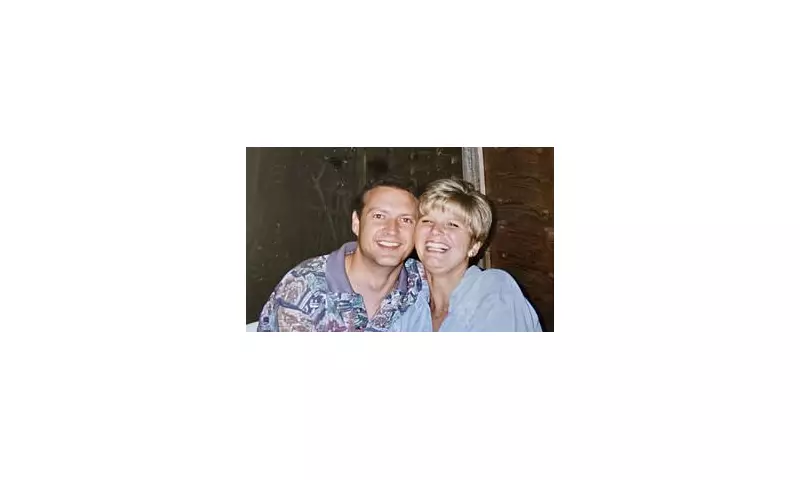
While undertaking a routine clear-out of cupboards in her Solihull home, Emma Ruscoe unearthed an old notebook from 2017 that contained profoundly unsettling entries. Its pages were filled with meticulous notes detailing the increasingly unusual behaviours and memory lapses exhibited by her husband, Simon, the father of their two sons. This simple domestic discovery brought back painful memories of the early, confusing stages of what would later be diagnosed as young-onset Alzheimer's disease.
A Sharp Mind Begins to Falter
For over two decades after meeting through mutual friends in 1992, Simon Ruscoe was known for his sharp intellect, diligent work ethic, and a notably devilish wit. However, towards the end of 2015, his wife Emma, now 57, began observing subtle but disconcerting changes in her long-term partner. The first major red flag emerged during a family holiday to the Greek island of Kefalonia.
'We had been joking about what our teenage boys, Alex and Ollie, would have for lunch that day,' Emma recalls. 'Not ten seconds after finishing that conversation, Simon turned to me and asked, "What do you think the boys will have for lunch?"' This immediate repetition, followed by Simon's refusal to acknowledge they had just discussed the topic, sparked a heated argument. Looking back nearly six years after his official diagnosis, Emma recognises this moment as a chilling foreshadowing of the difficult journey ahead.

The Battle for a Diagnosis
Initially, Emma attributed Simon's strained demeanour and forgetfulness to stress from his IT career. The extended time together during the family holiday, however, revealed the true extent of his memory issues. What followed was a protracted and isolating battle for answers, during which Emma's concerns were repeatedly dismissed.
'They kept saying it was me. They kept saying it was the menopause,' Emma explains. 'So I went and had a check for dementia because I thought I was losing the plot. I did start to think, "Maybe it is me. Maybe I'm going mad".' Medical professionals and loved ones alike suggested her observations were imaginary or symptoms of perimenopause, leaving her to doubt her own sanity while Simon's condition progressed undiagnosed.
Documenting the Decline
As more instances of Simon's faltering memory accumulated, Emma began diligently recording them in her notebook. This served as a crucial written record against the persistent disbelief she faced. One particularly distressing incident involved a car journey with their teenage son Ollie, where Simon, normally a confident driver, repeatedly forgot directions, terrifying his passenger.
Despite a referral to a memory clinic in 2018, over two years after her initial concerns, Emma felt they were 'fobbed off.' 'There were no tests, we spoke to a psychologist, and she told us that Simon was stressed,' she states. They received a letter stating categorically that he did not have dementia. Emma herself began hormone replacement therapy, yet continued to advocate for her husband.
A Devastating Validation
Finally, at the beginning of 2020, nearly four years after the holiday in Greece, Simon was diagnosed with young-onset Alzheimer's at the age of 55. While devastating, the diagnosis also brought Emma a profound sense of relief after her lengthy struggle to be heard. She notes that the average time to get a diagnosis for young-onset dementia in the UK is approximately three years, a statistic she finds 'disgusting.'
The subsequent Covid-19 lockdowns, though challenging, allowed the family to spend more intensive time caring for Simon at home. Emma is adamant that placing him in a care home is 'not in our plans,' emphasising her commitment to home care.
Life as a Carer
Emma's role has fundamentally transformed from wife to full-time carer. She now works from home to be constantly available for Simon, whose needs have increased significantly. He has lost the ability to perform basic tasks for himself and has become largely non-verbal.

'I keep incontinence pads in every room of the house now,' she shares. 'The other day I gave him his dinner and popped out of the room but because I hadn't put the cutlery in his hand, I came back in to see him eating with just his knife. Absolutely everything has to be routine.'
The family has accessed valuable support, including dementia nurses and Alzheimer's Society support workers. Simon attends a day centre four days a week for respite care, which Emma says gives him a sense of independence. Their adult sons, Alex and Ollie, help where they can as they build their own lives, but Emma admits caring for a spouse with advanced Alzheimer's can be a 'lonely' experience.
Glimmers of the Man Within
Despite the immense difficulties, including Simon's unstable moods and moments of frustration, Emma occasionally glimpses his former brilliant humour. 'I look at him and he still looks the same. I still fancy him, but I just look at him and think, where have you gone?' she reflects.
She even finds a strange comfort in their arguments, which now stem from his confusion. 'Even though it's horrible at the time, afterwards I think - he's still in there.' Emma's story is a powerful testament to the challenges of securing an early dementia diagnosis, the relentless dedication of family carers, and the enduring love that persists through profound illness.