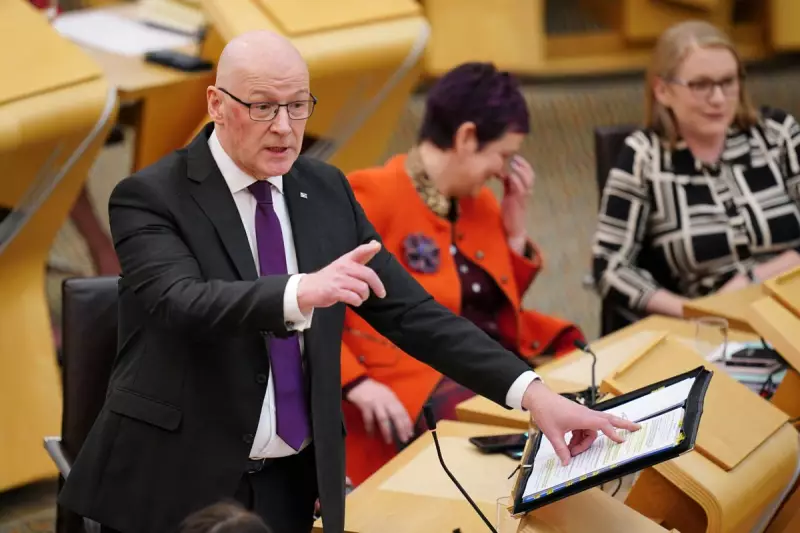
First Minister John Swinney has categorically denied that the Scottish Government exerted any pressure on health officials to open Glasgow's flagship Queen Elizabeth University Hospital on schedule, despite admissions from the NHS board that the facility was not ready.
Firm Denial at First Minister's Questions
Speaking during a tense session of First Minister's Questions at Holyrood, Mr Swinney repeatedly rejected accusations from opposition leaders that ministers had pushed for the hospital's opening in 2015. When directly questioned by Scottish Conservative leader Russell Findlay about whether governmental pressure had been applied, the First Minister gave a straightforward response: "The direct answer to that question is no."
Scottish Labour leader Anas Sarwar pressed the issue multiple times, highlighting his years of campaigning alongside affected families, but Mr Swinney maintained his position that no ministerial pressure had been placed on NHS Greater Glasgow and Clyde.

Commitment to Transparency and Document Release
In response to growing calls for greater transparency, the First Minister made a significant commitment regarding documentation related to the hospital's troubled opening. "The Government has shared all relevant evidence that addresses the terms of reference of the inquiry," Mr Swinney stated. "Nonetheless, if there is anything further related to the business of Government, whether that's cabinet minutes or ministerial correspondence not submitted to the inquiry, then I'm happy to release this, subject to any appropriate redactions."
This pledge extends to potentially sensitive materials, with the caveat that personal information and legally privileged communications would be protected through redaction processes.
Board Admissions and Family Outrage
The political exchanges follow startling admissions from NHS Greater Glasgow and Clyde this week. The health board acknowledged that pressure had indeed been applied to open the Queen Elizabeth University Hospital on time, despite the facility not being ready. More disturbingly, the board conceded that environmental conditions at the hospital likely contributed to infections that resulted in patient deaths.
Ahead of closing statements at the ongoing public inquiry, families of those affected released a scathing statement through Thompsons Solicitors Scotland. They asserted that ventilation and water issues at the hospital "killed and poisoned our loved ones" and accused NHS Greater Glasgow and Clyde of systematic deception. "We were all lied to by GGCH. We were all disbelieved by GGCH. We were all demeaned and smeared by GGCH," their statement declared, demanding accountability from both health board leadership and political figures.
Opposition Challenges and Historical Context
Mr Sarwar challenged the credibility of the First Minister's denials, pointing to an internal report circulated before the hospital's opening that warned of "a high risk of infections and therefore a high risk to life for immunocompromised patients." The Labour leader argued this warning was ignored, pressure was applied, and the hospital opened regardless, with "devastating consequences."
Mr Swinney countered that the Scottish Government was not advised about water contamination issues until 2018 – three years after the hospital began operations. He emphasised the importance of allowing inquiry chairman Lord Brodie to complete his work, stating: "Lord Brodie must have the opportunity to consider and to reflect on the evidence and to set out his conclusions."
Calls for Accountability and Future Actions
Russell Findlay urged the First Minister to dismiss NHS Greater Glasgow and Clyde officials accused of mistreating families affected by the infections scandal. Mr Swinney responded that the government would "take seriously all recommendations from Lord Brodie" once the inquiry concludes, but stressed the importance of awaiting the formal findings before taking action.

Addressing the affected families directly, the First Minister expressed sympathy for their losses and traumatic experiences. "The Government set up the inquiry to get to the truth," he affirmed, "and it's absolutely vital that is the case, so the families can understand and have confidence in what has happened and that we can learn lessons from all of that."
The controversy continues to cast a shadow over one of Scotland's most significant healthcare projects, with political leaders, health officials, and grieving families all awaiting the final conclusions of Lord Brodie's investigation into what went wrong at the Queen Elizabeth University Hospital.