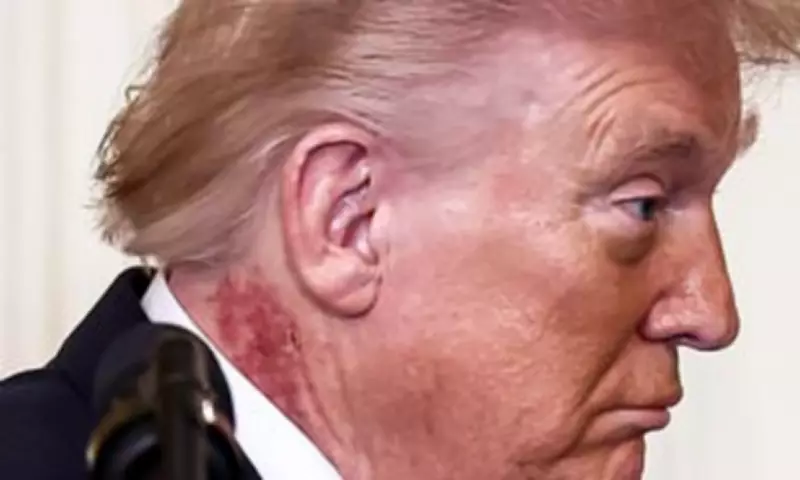
Trump's Neck Rash Ignites Health Speculation Amid White House Briefing
Speculation has intensified since President Trump appeared at the White House this week with a prominent red rash on the right side of his neck. The irritation was clearly visible as he delivered an update on the conflict with Iran, sparking widespread online debate about his health and potential medical treatments.
Official Statement and Medical Theories
In response to the growing attention, the 79-year-old president's physician, Dr Sean Barbabella, issued a formal statement. 'President Trump is using a very common cream on the right side of his neck, which is a preventative treatment, prescribed by the White House Doctor,' the statement clarified. 'The President is using this treatment for one week and the redness is expected to last for a few weeks.'
While no official diagnosis has been confirmed, social media commentators have proposed several possibilities:

- Contact dermatitis potentially caused by dry cleaning chemicals in his suits
- Rosacea, a skin condition Trump has previously been confirmed to suffer from
- Shingles, a painful blistering rash caused by the chickenpox virus
Expert Analysis Points to Sun Damage
However, leading skin specialists believe the most likely explanation is actinic keratosis, a common sun-related skin condition that can, in some cases, develop into cancer. Dr Paul Farrant, a consultant dermatologist and director at Experts in Skin and Hair, provided detailed analysis.
'This kind of red, very angry rash on the right side of his neck could definitely be caused by the treatment for actinic keratosis, a precancerous skin condition caused by sun damage,' Dr Farrant explained. 'When these creams are applied we would definitely expect long lasting redness and irritation, which looks like what's going on underneath Trump's collar.'
Understanding Actinic Keratosis
Actinic keratoses, also known as solar keratoses, are dry, scaly patches of skin caused by years of sun exposure. They typically appear on areas frequently exposed to sunlight, including:
- The face and scalp
- Ears and neck
- Backs of the hands and forearms
The condition affects approximately a quarter of people aged 60 and older, making it incredibly common. Patches usually measure between half an inch and an inch in size, appearing skin-coloured, pink, red or brown depending on skin tone, often feeling rough or gritty to the touch.
Treatment Options and Medical Implications
According to NHS guidelines, actinic keratosis is not usually serious, though there is a small risk that patches can develop into squamous cell carcinoma, a type of skin cancer. Treatment options include:
- Prescription creams and gels
- Cryotherapy (freezing the lesion)
- Minor surgical removal
Clinical immunologist Dr Zachary Rubin has speculated that President Trump may be using 5-fluorouracil cream, a topical chemotherapy treatment commonly prescribed for widespread sun damage. 'One of the potential treatments that can be used is a topical cream called 5-F.U which can cause the skin to look very irritated and red, potentially like what we see here,' he noted in a social media video.
However, Dr Farrant suggested it is more likely to be Tirbanibulin, a similar treatment typically used for just five days, which would 'tally with the statement issued by the White House.' This cream works by destroying abnormal, sun-damaged cells while largely sparing healthy skin.
Treatment Response and Recovery Process
During treatment, the skin typically becomes red, inflamed and sore – a reaction that indicates the medication is working effectively. Dr Rowland-Payne emphasized: 'The more inflammatory the response to treatment, the more beneficial the result to the patient. When cream is applied, we would expect some redness - and that's not necessarily a bad thing.'
The NHS notes that depending on skin type, this inflammatory response can take up to 28 days to fully develop. The skin may ooze, crust and scab before gradually healing over several weeks, with temporary skin discolouration that usually fades with time.

Cancer Risk and Prevention Measures
While only around five to ten percent of actinic keratoses progress to cancer, the majority of squamous cell carcinomas begin as these sun-damaged patches. Risk increases with the number of lesions present and for people taking immunosuppressive medication.
Warning signs that a lesion may be turning cancerous include:
- Rapid growth or thickening into a lump
- Bleeding or increasing tenderness
More than 25,000 people in the UK are diagnosed with squamous cell carcinoma annually, with the figure exceeding one million in the United States. When detected early, this cancer is highly treatable, though advanced cases can spread to other parts of the body.
Sun Protection and Prevention Strategies
The most effective prevention against actinic keratoses involves consistent sun protection measures:
- Daily use of sunscreen with SPF of at least 30
- Reapplication during prolonged sun exposure
- Avoiding sunbeds completely
- Limiting outdoor time between 11am and 3pm when UV radiation peaks
The NHS also advises regular skin checks for new or changing patches. Emerging evidence suggests vitamin B3 (nicotinamide) may reduce the risk of developing actinic keratoses and some skin cancers in high-risk individuals.
Conclusion: Health Reassurance and Public Awareness
President Trump has repeatedly declared himself in 'perfect health,' attributing this to 'good genetics.' His doctor's statement offers reassurance that the visible redness represents a temporary reaction to treatment rather than a serious health concern.
Nevertheless, this episode has highlighted a common condition affecting millions worldwide and serves as a powerful reminder of the long-term consequences of sun exposure. The public discussion has raised awareness about skin health, preventive measures, and the importance of regular dermatological check-ups, particularly for individuals with significant sun exposure history.