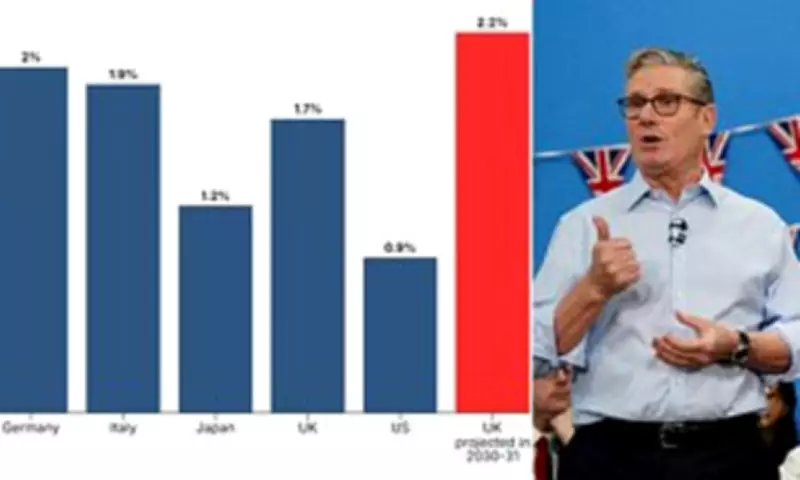
Concerns are mounting that the United Kingdom is projected to allocate a greater proportion of its economic output to health and disability benefits than any other major developed nation within the next decade. This potential shift would mark a significant departure from the country's historical position among its international peers.
A Changing International Landscape
Historically, Britain has occupied a middle-ranking position among G7 countries regarding expenditure on health and disability benefits as a percentage of Gross Domestic Product. The most recent comparative data from the Organisation for Economic Co-operation and Development, dating from 2021, placed UK spending at 1.7 per cent of GDP.
At that time, this figure was notably lower than the 2 per cent recorded in Germany, 1.9 per cent in Italy, and 1.8 per cent in France. It remained, however, substantially higher than the 0.9 per cent in the United States and 0.7 per cent in Canada.

Forecasts Point to a Dramatic Rise
The fiscal landscape is now set for a dramatic transformation according to projections from the Office for Budget Responsibility, the Treasury's independent watchdog. The OBR forecasts that spending on health and disability benefits will surge to account for 2.2 per cent of UK GDP by the 2030-31 financial year.
This projected increase would potentially elevate the United Kingdom to the top of the G7 spending table for this category of welfare, assuming other nations do not experience a comparable escalation in their own benefit costs. While international comparisons are inherently complex due to differing welfare systems and data collection methods, these figures represent the most reliable estimates available for cross-country analysis.
Political Challenges and Policy Reversals
The rising trajectory of benefit expenditure has sparked fresh alarm about the long-term fiscal sustainability of the UK's welfare state. The political difficulty in managing this growing burden was highlighted last year when the Labour leadership, including Prime Minister Keir Starmer and Chancellor Rachel Reeves, abandoned plans to curtail approximately £5 billion from the spiralling costs.
This decision followed a significant backbench revolt by Labour MPs, and no new legislation aimed at containing welfare spending is anticipated in the upcoming King's Speech in May. Furthermore, Chancellor Reeves has scrapped the controversial two-child benefit cap, a policy move that is expected to add further pressure to overall welfare expenditure.
An Isolated British Trend?
Analysis from the Institute for Fiscal Studies, a respected economic think-tank, suggests that the sharp increase forecast for the UK may not be mirrored elsewhere in the G7. The IFS, which has produced similar estimates in the past, indicated to The Telegraph that there is little evidence of equivalent trends developing in other major economies.
Researcher Eduin Latimer commented: 'We've seen this big rise in health-related inactivity in the UK. I've not seen much evidence of those similar trends happening elsewhere.' This observation raises questions about whether specific domestic factors are driving the UK's unique position.
Government Response and Reform Efforts
In response to these concerns, a government spokesman defended the administration's approach, stating: 'We're fixing the broken welfare system we inherited, including through a package of measures to tackle the backlog of people waiting for a work capability assessment and save nearly £2 billion by the end of the decade.'
The spokesman added: 'This is on top of changes to Universal Credit to narrow the gap between what people receive for being unemployed compared to long-term sickness.' These reforms are presented as part of a broader strategy to create a more sustainable and effective welfare framework while managing fiscal pressures.
The coming years will be critical in determining whether these measures can successfully alter the UK's trajectory and prevent it from becoming the G7's highest spender on health and disability support.