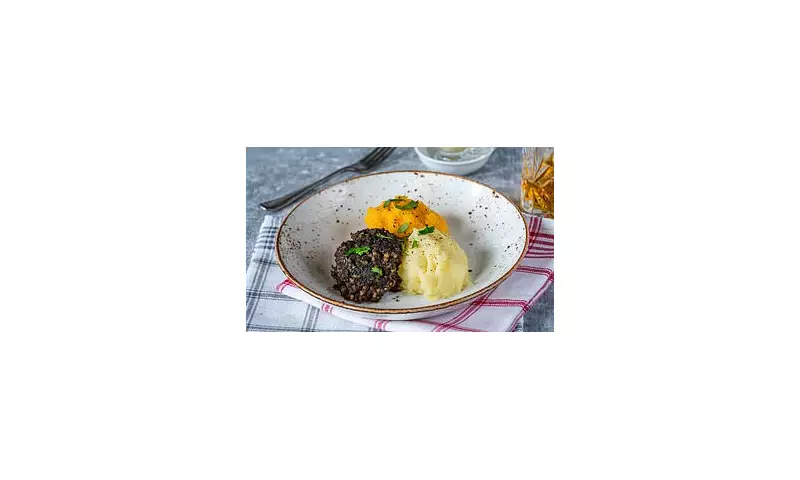
As Burns Night celebrations commence globally, Scots and enthusiasts worldwide are preparing to indulge in the traditional hearty feast of haggis, neeps, and tatties. This iconic meal, featuring a savoury offal pudding accompanied by mashed potatoes, boiled turnips, and a rich whisky cream sauce, might appear wholesome at first glance. However, a recent nutritional analysis has uncovered some surprising facts about the calorie content of this classic Scottish supper.
The Calorie Revelation
The Daily Mail has conducted detailed calculations revealing that a standard serving of Burns Supper packs a substantial caloric punch. According to their findings, a plate comprising 200g of haggis, 200g of mashed potatoes (tatties), 200g of turnips (neeps), and 100ml of whisky cream sauce totals a remarkable 944 calories. This figure notably surpasses the calorie count of a large McDonald's cheeseburger meal, which registers at 896 calories.
Breaking Down the Numbers
The meal's components contribute individually to this high total. Macsween data indicates that 200g of traditional haggis contains 570 calories, while the vegetarian alternative, made from vegetables, oatmeal, and pulses, is slightly lower at 546 calories. Mashed potatoes, depending on butter and cream content, add approximately 176 calories per 200g serving. Neeps, or turnips, are the lightest element, contributing just 88 calories for the same weight. The whisky cream sauce rounds off the meal with about 110 calories per 100ml.

Nutritionist Dr Laura Wyness commented on her website, acknowledging that "Burns Supper has many nutritional benefits," but cautioned diners to "be mindful of the portion size of haggis due to the high fat, saturated fat and salt content." She elaborated that haggis, primarily made from liver, provides valuable nutrients including vitamin A, vitamin B12, and folate. Additionally, ingredients like heart and lungs offer iron, zinc, and selenium, while the oats contribute to dietary fibre intake.
Fast Food Comparison
To contextualise these figures, the Daily Mail compared the Burns Supper to a McDonald's double cheeseburger meal. A double cheeseburger alone contains 452 calories, and when paired with a large portion of fries at 444 calories, the combined total reaches 896 calories. This is 48 calories fewer than the traditional Scottish meal, leaving just enough room for a 25ml BBQ dip, which adds 49 calories.
Health and Environmental Considerations
This calorie revelation follows recent calls from experts for Scots to moderate their haggis consumption in favour of increased portions of neeps and tatties. Researchers from the University of Edinburgh have highlighted that reducing beef, lamb, and pork intake could significantly aid climate change mitigation efforts. If individuals adhered to the dietary recommendation of no more than 70g of meat daily, Scotland could decrease its total red meat consumption by 16 per cent.
Professor Lindsay Jaacks, Personal Chair of Global Health and Nutrition at the University of Edinburgh, stated: "There is no question that we need to change our diets to reduce our impact on the planet."
Who Was Robert Burns?
Robert Burns, born 25 January 1759 and died 21 July 1796, is widely celebrated as Scotland's national poet. A farmer's son and high-ranking Freemason, his work resonated with common people, often using simple subjects to convey profound ideas, positioning him as a pioneer of the Romantic movement. His poem 'Auld Lang Syne' remains a New Year's staple, and his birthday is honoured annually with Burns Suppers.
However, Burns's legacy is not without controversy. Poet Liz Lochhead has described him as a "sex pest," referencing a 1788 letter where Burns boasted about aggressive sexual encounters with his pregnant girlfriend, Jean Armour. Lochhead likened his behaviour to modern-day scandals, calling it "very Weinsteinian." Academic Daniel Cook notes that Burns's unpublished works contain bawdy songs and themes of violence against women, suggesting they offer insight into historical attitudes towards sexuality and misconduct.

Despite these controversies, Burns Night remains a cherished cultural event, blending culinary tradition with poetic homage. As revelers enjoy their suppers this year, they might consider both the nutritional impact of their meal and the complex legacy of the poet it honours.