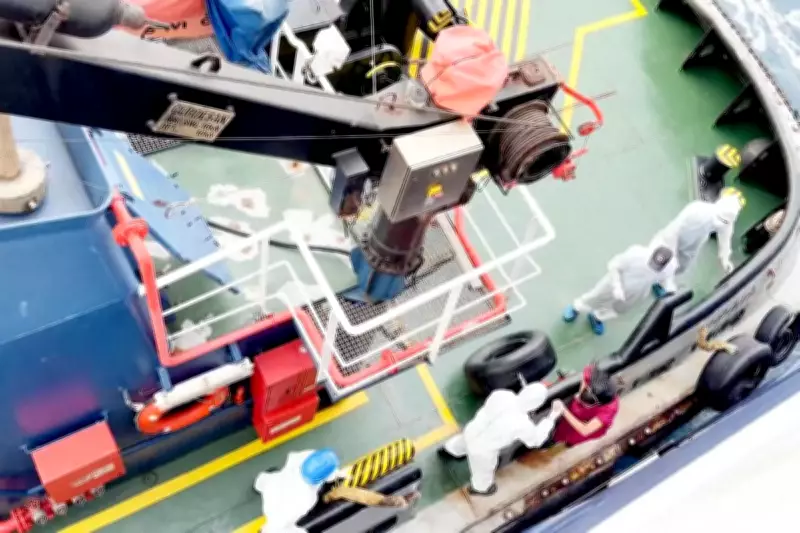
The nearly 150 individuals aboard a cruise ship stationed off the coast of Cape Verde have been largely confined to their cabins, as revealed by footage obtained by The Associated Press. This follows the deaths of three passengers and illness in at least four others amid a suspected hantavirus outbreak.
Ship's Situation and Response
The MV Hondius, a Dutch vessel on an extended polar cruise from Argentina to Antarctica and several remote South Atlantic islands, has been awaiting assistance after Cape Verde authorities refused to let passengers disembark due to public health concerns. Footage depicts the ship's decks mostly empty, with only a few people wearing medical masks moving about. Common areas are deserted as passengers remain isolated in their cabins. At least five individuals in full protective gear—white overalls, boots, and face masks—were seen leaving the ship on a smaller boat.
The World Health Organization stated on Monday that passengers were instructed to stay in their cabins to “limit their risk while disinfection and other measures are being taken.” Evacuation plans remain uncertain. Cape Verde authorities dispatched teams of doctors, surgeons, nurses, and laboratory specialists to provide medical support.

Officials in Praia, Cape Verde’s capital, have enhanced safety protocols, especially near the port, as a precaution against the rodent-borne illness. The WHO notes that human-to-human transmission is rare but possible.
Evacuation and Next Steps
It is still unclear when the sick individuals will be evacuated. The WHO reported late Monday that they would soon be transported to the Netherlands for medical care. The ship’s operator, Oceanwide Expeditions, based in the Netherlands, stated it might move the vessel to Tenerife or Las Palmas in the Canary Islands if evacuation to Cape Verde is not possible.
Dr. Maria Van Kerkhove, WHO’s director of epidemic and pandemic preparedness, told reporters on Tuesday that the current plan is for the ship “to continue on to the Canary Islands.” She added, “We’re working with Spanish authorities, who will welcome the ship.” She emphasized that no other passengers have symptoms and that “once the two sick individuals on board are medically evacuated, then the ship can move.” Earlier, Cape Verde authorities reported three individuals with mild symptoms.
However, the Spanish health ministry stated on Tuesday that it is “conducting close monitoring, together with the World Health Organization and other involved countries, of the situation on the ship … (and) the most appropriate port of call will be decided. Until then, the Ministry of Health will not adopt any decision, as we have informed the World Health Organization.”
Onboard Atmosphere and Background
Oceanwide Expeditions said in a statement late Monday that the atmosphere onboard “remains calm, with passengers generally composed” and that the response plan is at the highest level (3), including isolation, hygiene protocols, and medical monitoring. The ship departed Ushuaia, Argentina, on April 1. Health officials in Ushuaia confirmed no passengers had hantavirus symptoms at departure, but symptoms can appear up to eight weeks after exposure, according to Juan Facundo Petrina, director of epidemiology for Tierra del Fuego province.
The WHO stated Monday night that no new cases have emerged, but the situation is being “carefully monitored.” The organization noted, “The outbreak is being managed through coordinated international response, and includes in-depth investigations, case isolation and care, medical evacuation and laboratory investigations.”
Cape Verde’s National Director of Health, Angela Gomes, told state-run Radiotelevisao Caboverdiana radio that authorities are focused on ensuring “the maximum level of safety” for the local population. She said, “All assistance is being provided with personal protective equipment, with maximum protection, both to our medical team, but also to the entire team that assists the medical team in transporting it to the vessel.”