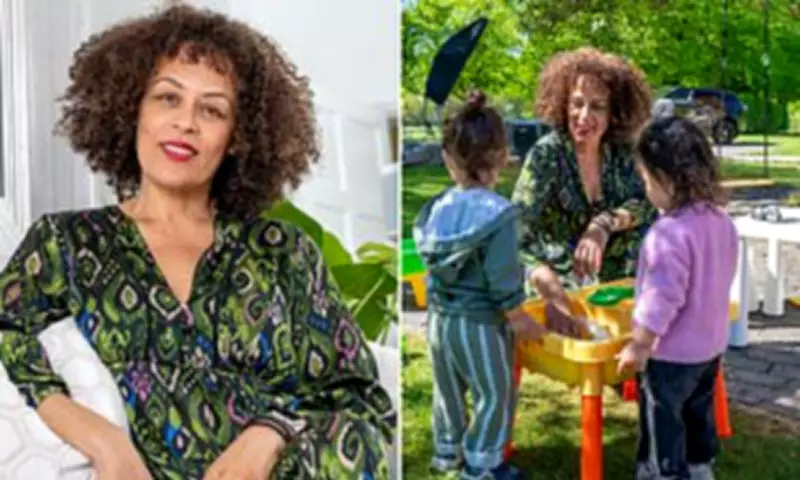
Most women in their fifties are grappling with menopause, but Caroline Morgan is getting to grips with first-time motherhood too. Now aged 53, she delivered much-longed-for twins when she was 51, following years of fertility struggles, pregnancy losses, and multiple rounds of IVF, with her devoted husband Richard always by her side.
A Journey of Hope and Heartache
Ms Morgan, from Derby, said: 'I met Richard when I was 44. After a couple of years we weren't actively trying but we weren't not trying, we were just getting on with life. We went to the doctors to get checked and they said they can't see anything wrong but said look, "it's your age probably and you need to go down the road of IVF."' It was a hard pill for Ms Morgan to swallow, as she had 'always dreamed of being a mum'. But, like many women, the conditions and timings to embark upon motherhood were never quite right, especially as she spent years working as a cruise ship entertainer.
She said: 'I was an auntie quite young – I was nine and in primary school and my sister is a lot older than me. At that point I thought, "I love babies and I'm going to be a mummy one day." I travelled quite a lot for work, singing on cruise ships, so becoming a mum for me never really felt like the right time.'

The IVF Rollercoaster
Ms Morgan first met Richard on dating app Match.com and shared her dreams of motherhood straight away. After being together for two years and failing to get pregnant, they were advised to try IVF. They travelled to Palma, Mallorca for the treatment and discovered that Ms Morgan had undiagnosed endometriosis, a condition where cells similar to the womb lining are present in other areas of the body, causing inflammation, scarring, and preventing pregnancy if not treated.
After their first round failed, Richard suggested a second cycle of IVF, but they were met with another failed attempt, followed by two chemical pregnancies. A chemical pregnancy is a very early miscarriage, usually occurring shortly after an embryo implants in the womb but before the pregnancy can be seen on a scan. It can cause a positive pregnancy test because the body has started producing pregnancy hormone, hCG, but the pregnancy stops developing very early. Ms Morgan fell pregnant on the couple's fifth IVF round, but she miscarried the pregnancy at six weeks.
A Final Attempt Brings Joy
With so much heartache behind them, and her milestone birthday fast approaching, Ms Morgan told her husband that she was ready to give up her dream of starting a family. She said: 'At that point I said to Richard "I've got my 50th coming up in a few weeks and after that I'm not going to do this anymore, I can't do this to my body." So he said "why don't we try again?" We had two embryos left. I ended up being pregnant. We did an early viable scan at six weeks and found out it was twins and we were absolutely flabbergasted. I was terrified – absolutely terrified because it was such an emotional rollercoaster last time.'
At the age of 51, after seven years of IVF and £22,000 later, she gave birth to a 4.5lb baby boy closely followed by a 4lb baby girl at Royal Derby Hospital.
Motherhood in Middle Age: Challenges and Rewards
Becoming a mother in middle-age has proved to be a double-edged sword; Ms Morgan says her temperament makes her a good parent, but menopause is also taking its toll. 'Personally I've had patience and love being an older mum – I can give them more financially, I'm more settled, more wise and more worldly,' she said. 'I don't look my age but I'm 53 and people say I look 35, so people don't really know and when I tell them I'm 53 they're absolutely gobsmacked. When I tell them my story they are shocked and couldn't fathom having a child at this age because they'd be so exhausted.'
She added: 'The body image for me was very hard after having babies my body changed a lot in the perimenopause and after that in post-partum. I had hot flushes and rage, not towards my kids but anger to myself at not feeling good enough and "why is my body not the same anymore?"'

Building a Support Network
The babies are now two and thriving, and Ms Morgan hosts her own podcast, Motherhood in Stereo, where she chats to other mums and experts about being a twin mum, covering topics like birth trauma, early menopause, IVF, adoption, and more. She was inspired to start it because she felt 'lost' after her husband went back to work and she noticed voids in her social life due to her friends being at totally different life stages.
Despite being 'over the moon' to have her children, Ms Morgan admits she didn't feel the 'bubble of love' she expected after giving birth. 'I didn't have a village, my family live over two hours away in a different part of the country,' she said. 'After two weeks my husband went back to work and I was like "I don't know how I'm going to do this." My friends are all empty nesters in their fifties or grandparents in different stages of their life. The only people who helped me were my neighbours who were a retired nurse and midwife – they would bring me food every day to the house.'
A Message of Hope
Ms Morgan hopes that her podcast can bring comfort, support, and encouragement to other women who have had a less than linear route to parenthood. She said: 'The key message for me is this – there's no timeline to motherhood. Lots of women have lots of different complications through life. It's a personal decision, what feels right for one woman won't feel right for another. I was told by a clinician as long as you have a healthy womb you can have a child whichever way that is – women go through surrogacy, IVF, adoption, different routes. I want to tell people there is hope and don't give up.'
How Does IVF Work?
In-vitro fertilisation, known as IVF, is a medical procedure in which a woman has an already-fertilised egg inserted into her womb to become pregnant. It is used when couples are unable to conceive naturally, and a sperm and egg are removed from their bodies and combined in a laboratory before the embryo is inserted into the woman. Once the embryo is in the womb, the pregnancy should continue as normal. The procedure can be done using eggs and sperm from a couple or those from donors.
Guidelines from the National Institute for Health and Care Excellence (NICE) recommend that IVF should be offered on the NHS to women under 43 who have been trying to conceive through regular unprotected sex for two years. People can also pay for IVF privately, which costs an average of £3,348 for a single cycle, according to figures published in January 2018, and there is no guarantee of success. The NHS says success rates for women under 35 are about 29 per cent, with the chance of a successful cycle reducing as they age. Around eight million babies are thought to have been born due to IVF since the first ever case, British woman Louise Brown, was born in 1978.
Chances of Success
The success rate of IVF depends on the age of the woman undergoing treatment, as well as the cause of the infertility (if it's known). Younger women are more likely to have a successful pregnancy. IVF isn't usually recommended for women over the age of 42 because the chances of a successful pregnancy are thought to be too low. Between 2014 and 2016 the percentage of IVF treatments that resulted in a live birth was: 29 per cent for women under 35, 23 per cent for women aged 35 to 37, 15 per cent for women aged 38 to 39, 9 per cent for women aged 40 to 42, 3 per cent for women aged 43 to 44, and 2 per cent for women aged over 44.