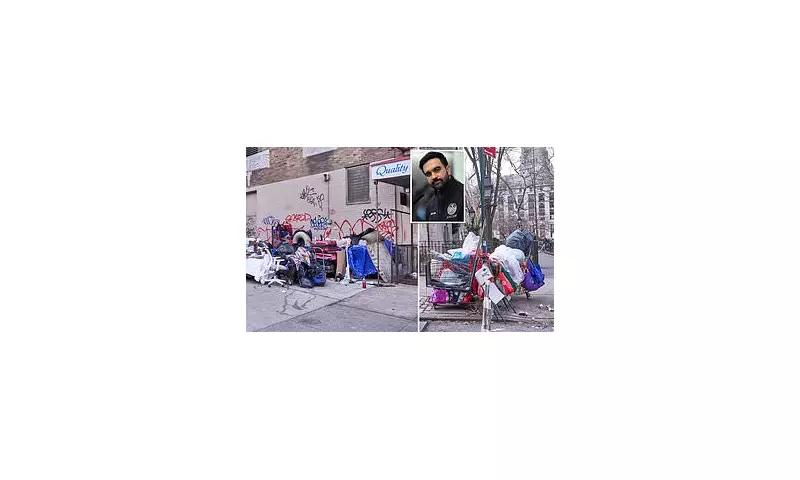
Within weeks of Zohran Mamdani's inauguration as Mayor of New York City, homeless encampments have resurfaced prominently across Manhattan. This development follows his campaign promise to cease the clearance of these outdoor living spaces, a policy that defined his predecessor Eric Adams' tenure.
A Shift in Policy Sparks Immediate Change
The democratic socialist mayor, who assumed office on January 1st, declared in December that he would end the destruction of homeless encampments throughout the city. Mamdani argued that the previous administration's approach merely displaced vulnerable individuals without offering real solutions.
'They are simply pushing New Yorkers who are living in the cold to another place where they will live in the cold,' Mamdani stated during his December announcement, criticising what he viewed as an ineffective strategy.

Encampments Emerge Across Manhattan
In the 23 days since Mamdani took office, multiple encampments have appeared in Manhattan neighbourhoods including:
- The Upper West Side
- Hell's Kitchen
- Areas near the United Nations headquarters
- East Village
- Chinatown
An East Village site displayed an extensive collection of personal belongings including suitcases, office chairs, trash bags, and tarps arranged along a graffitied wall. Meanwhile, a Chinatown encampment near Columbus Park featured two stolen shopping carts filled with reusable bags and additional trash bags.
Contrasting Approaches to Homelessness
The visible return of street encampments marks a stark departure from the Adams administration's approach. In 2022, Mayor Adams initiated a policy that began with sweeping approximately 200 encampments across the city.
Adams later announced a substantial $650 million, five-year initiative in 2025 aimed at combating street homelessness and mental health issues. This comprehensive plan included expanding 'safe haven' beds as alternatives to traditional shelters and implementing outreach programmes to connect homeless individuals with shelter services.
Criticism of Previous Strategies
Mayor Mamdani has been vocal in his criticism of these previous efforts, describing them as fundamentally ineffective. 'The previous administration's approach to homeless encampments has been one where only three New Yorkers were connected with supportive housing over the entirety of a year,' he revealed during a recent press conference.
The new mayor contends that Adams' strategy essentially forced unhoused New Yorkers to relocate from one outdoor location to another without addressing the root causes of homelessness.
Developing a New Strategy
While Mamdani has acknowledged deficiencies in New York City's shelter system, his administration has not yet unveiled its comprehensive homelessness policy. He has indicated that developing more effective outcomes represents a primary focus for his team, including discussions with Councilwoman Gale Brewer.
The timing of this policy transition coincides with significant weather challenges, as Winter Storm Fern approaches with predictions of up to 12 inches of snow and wind chills potentially dropping below zero.
Emergency Response Activation
In preparation for the severe weather, Mayor Mamdani's office has activated a Code Blue emergency protocol. This measure directs outreach workers to intensify efforts to connect homeless individuals with safe shelter options during the storm.
'Outreach workers will ramp up efforts to connect unhoused New Yorkers to safe shelter,' Mamdani confirmed via social media on Thursday.
The approaching storm system, expected to affect regions from Oklahoma through Washington DC, New York, and Boston, poses particular risks to New York City's estimated 102,000 homeless residents. In response, Governor Kathy Hochul has declared a state of emergency across New York.
As encampments continue to appear with increasing frequency across Manhattan and Brooklyn—a phenomenon rarely witnessed during the previous administration—the Mamdani administration faces mounting pressure to articulate and implement its alternative approach to addressing New York City's persistent homelessness crisis.