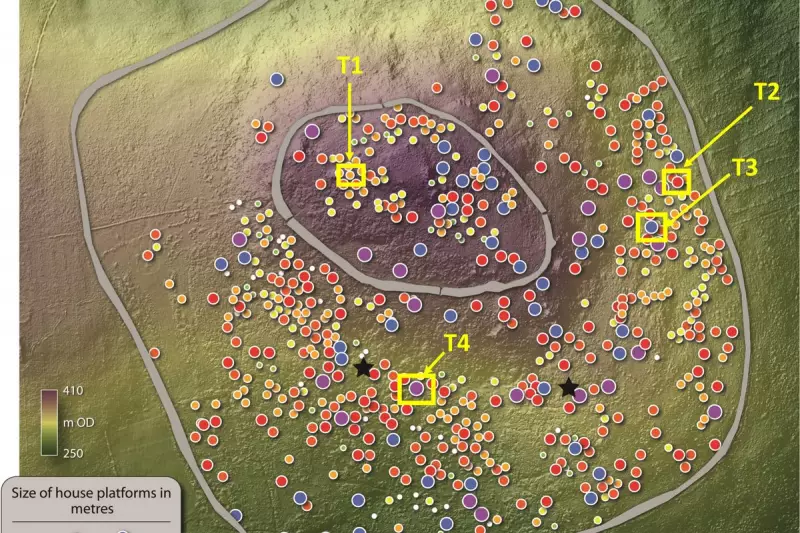
A dramatic archaeological discovery in the Wicklow Mountains has fundamentally reshaped our understanding of prehistoric life in Ireland and Britain. A hillfort complex known as Brusselstown Ring has been identified as the largest nucleated settlement from prehistoric times across both islands, and is now recognised as Ireland's earliest proto-town.
Unearthing a Prehistoric Metropolis
Led by researchers from Queen's University Belfast, a major study combined existing archaeological data with new excavations at the site, located just south of Dublin near Baltinglass. The findings are staggering. While terrestrial surveys in the last decade had hinted at 288 potential hut sites, aerial surveys in 2017 and 2022 revealed over 600 topographical anomalies consistent with prehistoric house platforms.
Through new ground excavations, the team has confidently located 98 potential roundhouse footprints within the inner enclosure, with a possible further 509 structures between the inner and outer defensive elements. This vast cluster of up to 13 hilltop forts forms a 'necklace' of occupation spanning from the early Neolithic to the late Bronze Age, approximately 3700–800 BC.

Dating and Significance of the Discovery
Radiocarbon dating has pinpointed significant occupation at Brusselstown Ring during the Late Bronze Age, between roughly 1210 and 780 BC. Evidence suggests some house platforms continued in use or were re-used into the Early Iron Age (c. 750–400 BC). This timeline makes the settlement two millennia older than the Viking towns previously thought to be Ireland's first urban centres.
Dr Dirk Brandherm from Queen's University Belfast emphasised the scale, stating that even if not every anomaly is a house, the site is still the largest nucleated prehistoric settlement in the region "by some distance." He noted that only a handful of other sites have more than a few dozen roundhouse footprints, and not all are enclosed like Brusselstown.
Redefining Prehistoric Society
The research, which won the Prehistoric Society's 2025 James Dyer prize, challenges previous conceptions of prehistoric community organisation. It reveals a level of social complexity and cohesion not fully recognised before. The team also uncovered evidence of a possible water cistern, consistent with Bronze and Iron Age technology from elsewhere in Europe.
Dr Brandherm described Brusselstown Ring as a "site of major national and international heritage importance" that enriches our knowledge of how people lived, organised themselves, and used the landscape. He expressed hope that the new findings will aid in its preservation and open avenues for further research into prehistoric societal development.
Fieldwork at the site remains ongoing, promising more insights into this remarkable window into Ireland's deep past. The study was funded by UK Research and Innovation, the Natural Environment Research Council, and the Prehistoric Society, and has been published by Cambridge University Press.