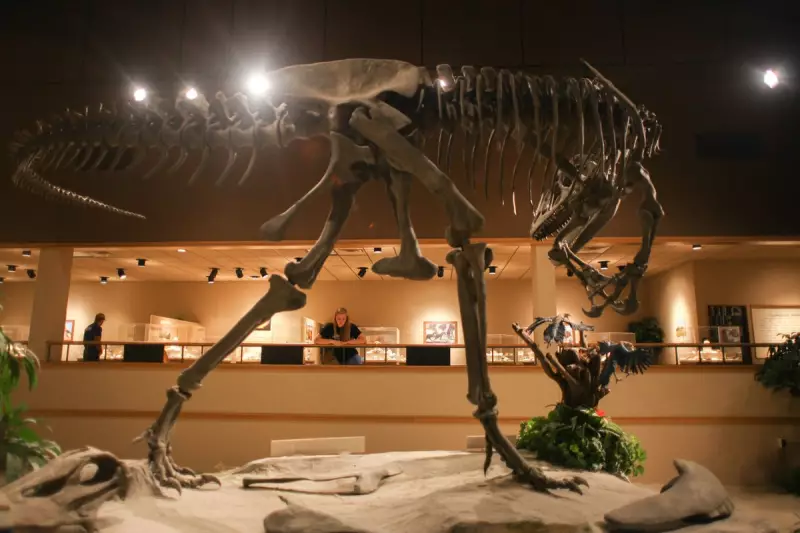
The year 2025 has proven to be a landmark period for dinosaur science, with public fascination reaching new heights. This was driven by major television revivals, blockbuster films, and record-breaking museum attendance, particularly at London's Natural History Museum which drew 6.3 million visitors in the 2024-2025 period. Underpinning this cultural moment is a genuine boom in scientific discovery, with 44 new dinosaur species identified so far this year—a rate of nearly one per week.
Spectacular Finds from Across the Globe
While hotspots like Argentina, China, and the U.S. continue to yield treasures, remarkable fossils emerged from unexpected locations, including Serbia and the stormy coasts of north-west Scotland. The sheer volume of finds makes it a challenge for even seasoned researchers to keep pace. Here is a curated look at some of the most significant and startling dinosaur discoveries that defined 2025.
1. The Punk Rock Dinosaur: Spicomellus afer
First named in 2021 from a bizarre, spiny rib found in Morocco, Spicomellus afer was fully revealed in 2025. A team led by researcher Susie Maidment described a much more complete skeleton, showcasing one of the strangest dinosaurs ever found. This four-metre-long, heavily armoured ankylosaur, described as resembling a "walking coffee table," was covered in long spines. A bony neck collar featured spines the length of golf clubs, earning it the "punk rock dinosaur" moniker from the BBC. Crucially, Spicomellus is now identified as the oldest known ankylosaur, reshaping understanding of the group's evolution and highlighting Morocco's critical fossil record.

2. Ending a 35-Year Debate: Nanotyrannus lethaeus
One of palaeontology's fiercest debates—whether Nanotyrannus was a distinct species or merely a juvenile T. rex—was finally settled in 2025. Palaeontologists Lindsay Zanno and James Napoli published a study of a new specimen, part of the famed "Duelling Dinosaurs" fossil alongside a Triceratops. Their work, combined with a subsequent study on the original Nanotyrannus, proved both individuals were fully grown. The research confirms Nanotyrannus as a slender, agile pursuit predator, built for speed and distinct from its giant cousin, closing a 35-year-long controversy.
3. A Sauropod Ancestor from the Dawn of Dinosaurs
The quest to understand the origins of gigantic sauropods like Brachiosaurus gained crucial insight with the discovery of Huayracursor jaguensis. Found in 228-million-year-old rocks in the Argentine Andes, this two-metre-long dinosaur is one of the oldest known sauropod ancestors. Its notably longer neck, compared to other species from the dawn of the dinosaur era, reveals the earliest stages of the extreme neck elongation that would later define the largest animals to ever walk the Earth.
4. The Gasp-Inducing Zavacephale rinpoche
Some discoveries are so stunning they draw audible reactions from experts. Such was the case with Zavacephale rinpoche, a one-metre-long plant-eater from the Gobi Desert of Mongolia. Described by palaeontologist Tsogtbaatar Chinzorig, it is the oldest known pachycephalosaur, the group famous for their domed, head-butting skulls. This exceptionally preserved skeleton provides critical clues to understanding the early evolution of one of dinosaur science's most enigmatic families.
5. A Sailed Herbivore from the Isle of Wight
Even in well-explored regions like the Isle of Wight, new secrets await. Retired doctor and dinosaur expert Jeremy Lockwood named his latest discovery, the six-metre-long Istiorachis macarthurae. This herbivorous ornithopod, related to Iguanodon, sported a striking sail-like structure along its back. This 128-million-year-old feature was likely used for display, helping to attract mates and deter predators by making the animal appear larger.

A Golden Era of Discovery Continues
The year also saw other significant finds, including a 'Jurassic Highway' of sauropod trackways in an Oxfordshire quarry. With around 1,400 dinosaur species now known globally, the accelerating pace of discovery shows no sign of slowing. 2025 has been a remarkable year that has solved long-standing mysteries and unveiled breathtakingly bizarre creatures. As the golden era of dinosaur science marches on, the global community eagerly anticipates what surprises 2026 will unearth from the ancient past.