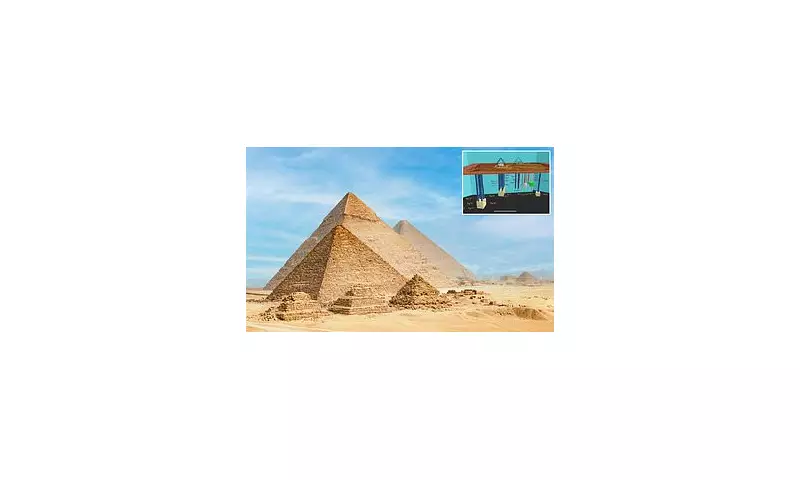
In a groundbreaking revelation on the Joe Rogan Experience podcast, Italian scientist Filippo Biondi has presented controversial synthetic aperture radar scans that suggest an enormous underground megastructure exists beneath the Giza plateau in Egypt. The findings, if verified, could fundamentally rewrite our understanding of ancient history and the purpose of the iconic pyramids.
Revolutionary Satellite Technology Uncovers Hidden World
The research team, operating under the Khafre Project, conducted more than 200 scans using advanced satellite imaging technology from multiple sources including Italy's Cosmo-SkyMed and US-based Capella Space systems. Biondi explained that the synthetic aperture radar works by bouncing radio waves off the ground to map subsurface features without physical penetration.
The consistency across different satellite systems provided compelling evidence for the team, with Biondi noting they initially held the results for six months due to skepticism about potential processing artifacts. "My opinion was that it was not real. I was thinking that maybe it was noise or some artifacts due to our processing procedures," he admitted during the podcast interview.

Massive Underground Chambers and Shafts Revealed
The scans indicate the presence of what Biondi described as "huge chambers" measuring approximately 260 feet in length and width, located beneath all three pyramids and the Sphinx. These cubic chambers appear to be connected by an intricate network of vertical shafts and horizontal corridors.
According to the data presented:
- Enormous pillars approximately 65 feet in diameter wrapped in spirals plunge nearly 4,000 feet deep
- Vertical shafts descend about 2,000 feet before intersecting with horizontal corridors roughly 9-10 feet tall
- The structures appear to form a complex underground system connecting the pyramid sites
Radical Implications for Ancient History
Biondi dated the underground structures to between 18,000 and 20,000 years ago, potentially linking them to Zep Tepi - the mythic "First Time" in Egyptian mythology when gods first ruled and civilization began. This dating challenges conventional archaeological understanding that places the pyramids' construction at approximately 4,500 years ago.
The researcher pointed to salt residues from ancient seawater flooding as evidence supporting theories of a great flood event, potentially indicating a far older civilization existed beneath what we now know as the Giza complex. This has led to speculation that the pyramids may not have been tombs at all, but rather served as ancient power plants or vibration devices for out-of-body experiences.
Scientific Controversy and Mainstream Skepticism
The findings have faced fierce opposition from mainstream archaeologists, most notably Dr Zahi Hawass, former Egyptian Minister of Antiquities, who dismissed the scans as "bulls***" in comments to Daily Mail. Hawass argued that tomographic radar technology cannot penetrate beyond about 60 feet, making claims of thousand-foot-deep structures impossible.
Biondi countered these criticisms by explaining that his method doesn't involve penetrating the ground with radar beams but instead analyzes mechanical vibrations naturally present on Earth's surface. "We are not penetrating anything," he clarified. "We are just grabbing the entropy that is on the surface of the earth."
Validation Through Established Applications
The technology's credibility receives support from its successful application in other contexts. Biondi developed the method through "top secret projects for the Italian military" and has applied it to sites including the Mosul Dam and Italy's Grand Sasso laboratory - a particle physics facility buried approximately 4,600 feet inside a mountain.
Joe Rogan emphasized this validation during the podcast, stating: "We know it's accurate, we know it works," while characterizing resistance to the findings as "confirmation bias" within the archaeological establishment.

Proposed Verification and Future Exploration
Rather than advocating for extensive new excavations, Biondi has proposed a more targeted approach to verify the findings. He suggests clearing debris from existing shafts between the pyramids and deploying robotic drones to explore the underground system, estimating the cost at approximately $20 million.
"We want to use machines, not humans," Biondi explained, noting that physical excavation might not even be necessary to confirm the underground structures. He remains open to scrutiny and replication by other research groups, stating: "I am happy if somebody can replicate things. If other research groups can replicate the things that I'm showing, I'm happy."
Transformative Potential for Historical Understanding
The implications of these findings, if substantiated, would be profound. Rogan captured the scale of potential revision when he remarked: "Those immense structures that have baffled mankind forever are just the tip of the iceberg." He added that if the data proves accurate, "the pyramids may be 'just the tip of the iceberg.'"
Biondi stressed that his team's measurements currently represent the only subsurface data available for the Giza Plateau, making them particularly significant despite the controversy. The scans remain suspended between radical possibility and entrenched skepticism, unverified by direct exploration but supported by multiple satellite datasets.
As Rogan concluded during the discussion, ignoring such data outright would be premature: "If you're skeptical, we should probably explore it. And if it's wrong, okay. But if it's right, it's a crime not to investigate." The debate continues as the scientific community grapples with evidence that could potentially rewrite chapters of human history.