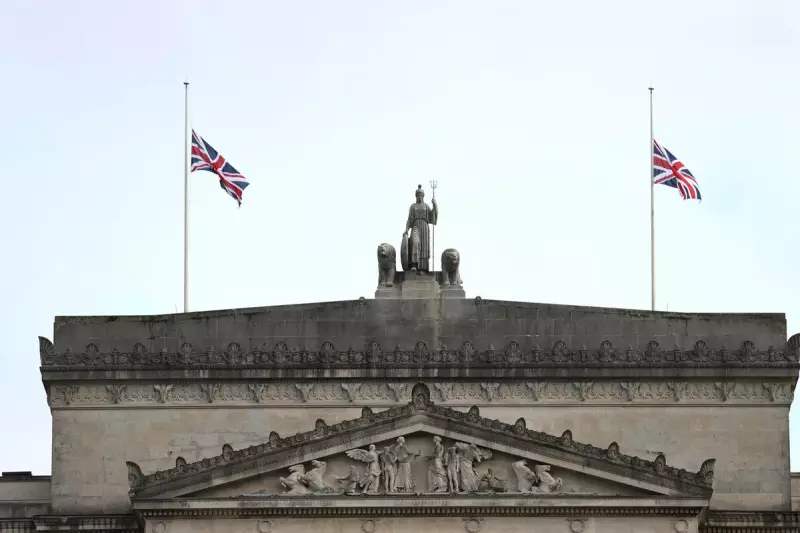
Freshly declassified government papers have revealed that ministers in Northern Ireland's first devolved executive received explicit legal counsel in the year 2000 stating they could not be commanded by the late Queen to fly the Union flag from official buildings.
The Legal Advice on Ministerial Discretion
The crucial advice, given to the newly formed power-sharing executive in early 2000, is contained within briefing papers for a ministerial meeting held on 1 February 2000. The documents, now made public, show the executive secretariat had sought legal opinion following discussions at a prior meeting on 11 January about the protocol for flying the flag.
This internal debate was triggered by guidance issued from the Department of Culture, Media and Sport (DCMS) in Westminster, which outlined specific days the national flag should be flown on government buildings across the UK.

The legal advice, provided by Denis McCartney from the departmental solicitors' office, was clear. He stated he could find "no statutory provision relating to the flying of the Union flag". His research indicated the matter had historically been seen as a "prerogative matter", but he concluded that for Northern Ireland, it was a transferred matter under devolution.
A Clash of Constitutional Authority
The lawyer expressed significant doubts over whether the authority to fly the flag derived from royal prerogative powers exercisable by Northern Ireland departments. He argued that "any person may fly any flag, including the Union flag, on their property", and a department's decision to do so was likely a matter of lawful administration.
"It is clear that this, as a transferred matter, is for decision of Ministers, rather than a legal imperative by direction of Her Majesty," McCartney advised. He concluded that, subject to executive agreement, "the issue of the flying of the Union flag from government buildings is for individual Ministerial discretion."
In follow-up advice on 25 January, McCartney addressed whether a "residual power" existed for the Crown to command departments in Northern Ireland. While he acknowledged the DCMS regulations were "issued in the language of command of Her Majesty" and intended UK-wide, he stated they "disregard the constitutional arrangements for Northern Ireland".
He firmly asserted that the royal prerogative was constrained by the Northern Ireland Act 1998. After informal discussions with Home Office lawyers, he confirmed they agreed the command "is without legal authority in Northern Ireland".
Political Tensions and Suspension
The released file also includes a forceful letter from the then Department for Social Development minister, Nigel Dodds, sent the day before the executive meeting. He registered his "strongest possible" opposition to any minister refusing to follow the DCMS schedule, insisting there must be a "consistent policy across all Departments".
The executive meeting on 1 February was attended by First Minister David Trimble and Deputy First Minister Seamus Mallon. Minutes reveal the contentious discussion on flying flags was simply "deferred".
This internal dispute occurred just weeks before the fledgling powersharing executive faced a greater crisis. Later in February 2000, the entire executive was suspended by the then Northern Ireland Secretary, Peter Mandelson, due to a lack of progress on IRA decommissioning, highlighting the fragile political environment of the time.