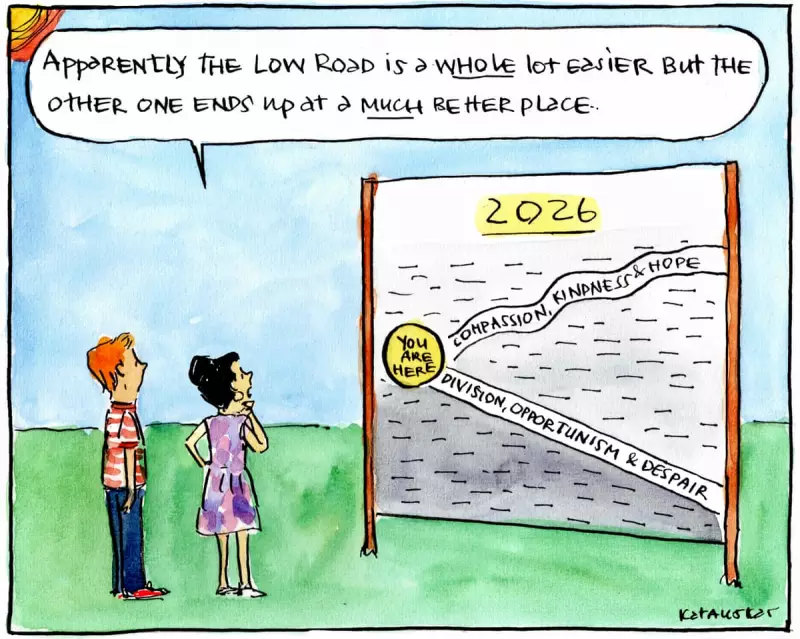
As the new year dawns, the United Kingdom stands at a series of profound junctures. The path forward through 2026 is fraught with complex decisions that will shape the nation's future for decades to come. A compelling visual guide, published by The Guardian on the first day of the year, maps out these critical crossroads, offering citizens a clear-eyed view of the choices ahead.
The Fork in the Road: Key Policy Divisions
The visual guide presents a stark illustration of the divergent routes available to policymakers and the public. It moves beyond simple partisan politics to frame the year's biggest questions as a series of literal pathways. Each branch represents a fundamental choice on issues central to national life. The guide underscores that 2026 is not merely another year in politics but a potential inflection point for the country's direction.
Central to the analysis is the ongoing debate surrounding the UK's constitutional framework. One path leads towards deeper devolution and potential federal restructuring, responding to long-standing tensions within the union. The alternative route suggests a recentralisation of powers, aiming for a more uniform application of policy across England, Scotland, Wales, and Northern Ireland. The choice here will significantly impact the very integrity of the United Kingdom.

Economic and Environmental Trajectories
Parallel to the constitutional debate, the guide highlights the economic and environmental crossroads. On one hand, a pathway advocates for aggressive investment in green technology and renewable energy, positioning the UK as a leader in the post-carbon economy. This route is linked with ambitious retraining schemes and industrial strategy. The competing path prioritises short-term economic stability and deregulation to spur growth, with a more gradual approach to net-zero commitments.
The visual narrative powerfully connects these policy decisions to tangible outcomes for everyday life. It suggests that the route taken on climate policy will directly influence energy bills, job creation in new sectors, and the UK's international standing on the world stage. Similarly, the economic direction chosen will affect inflation, public service funding, and regional inequality.
Implications for Public Engagement and Democracy
Perhaps the most crucial aspect of the guide is its implicit call for an engaged citizenry. By distilling complex, often opaque political debates into an accessible visual format, it empowers readers to understand the stakes. The guide reframes the political discourse of 2026 not as a series of isolated news cycles, but as a connected set of decisions leading to vastly different national futures.
The publication date of 1 January 2026 is symbolic, setting the tone for a year of consequential choice. It serves as a New Year's reflection on national destiny rather than personal resolution. The guide does not advocate for one specific path but insists on the importance of recognising that these forks in the road exist and require deliberate, informed navigation.
In conclusion, The Guardian's visual guide is more than an editorial graphic; it is a tool for democratic clarity. As the UK progresses through 2026, the choices mapped out will move from theoretical pathways to lived reality. The guide's lasting message is that the direction taken will depend not just on those in power, but on the awareness and pressure applied by a public that understands the map laid before them.