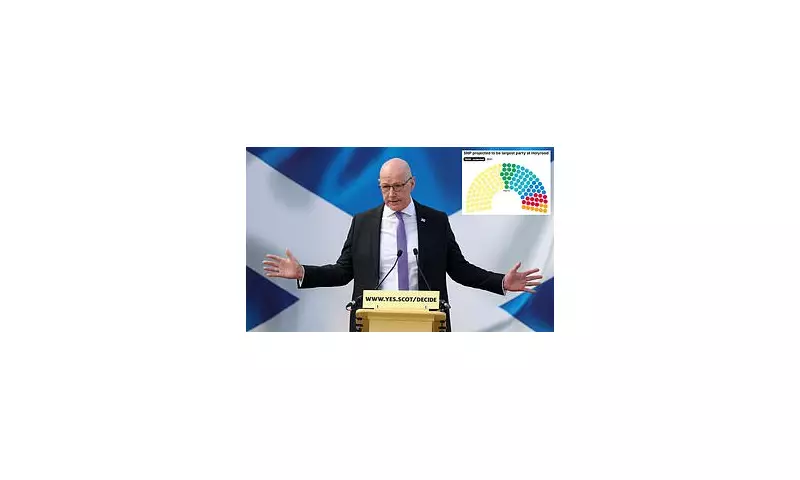
Scottish First Minister John Swinney has declared that securing a majority for the Scottish National Party in the upcoming Holyrood elections would act as a direct trigger for a second independence referendum. In a bold intervention, he also predicted such a result would lead to the ousting of Sir Keir Starmer as Prime Minister.
A Democratic Mandate for Independence
Speaking on Sky News's Sunday Morning with Trevor Phillips, Mr Swinney was unequivocal about his party's intentions. When asked if an SNP majority in May would be taken as a green light to demand another vote on Scotland's future, he replied "yes". He grounded his argument in precedent and democratic principle.
"I'm being straightforward with people in Scotland," Swinney stated. "If people in Scotland want Scotland to become independent, the SNP has got to do really well in this forthcoming election and it's got to achieve a majority in the Scottish Parliament." He pointed to the 2011 Holyrood election, where an SNP majority under Alex Salmond led directly to the 2014 independence referendum.

Challenged on what would happen if a Prime Minister Starmer refused a referendum request, Swinney was defiant. He asserted that Scotland has a "democratic right to decide our own future" within the "partnership of equals" that is the United Kingdom. He then added his stark political prediction: "if I win a majority in the Scottish Parliament elections in May of this year, I don't think Keir Starmer will be the Prime Minister."
Fuel to the Fire for Labour's Troubles
These comments are set to intensify the internal pressures already mounting on Sir Keir Starmer after Labour's chaotic first 18 months in power at Westminster. There is a growing expectation within political circles that a poor showing for Labour in the May elections across Scotland, England, and Wales could prompt a serious attempt to remove him as leader.
The situation appears particularly acute in Scotland. Some Labour MPs representing Scottish constituencies have reportedly warned Starmer they might lead a move to topple him before May, fearing an electoral "slaughter" in the Holyrood contests. Current polling suggests Labour's popularity in Scotland has slumped since the 2024 general election, where they won 37 seats.
The Uphill Battle for an SNP Majority
Despite his confident rhetoric, Mr Swinney faces a significant challenge in achieving his stated goal. The SNP, currently the largest party with 60 out of 129 MSPs, has set a target of winning at least 65 seats to secure a working majority. However, recent polling indicates this ambition may fall short.
A Find Out Now survey for The National newspaper, conducted between 11 and 19 December, projects the SNP would win 59 seats—six short of a majority. The poll, analysed by Professor Sir John Curtice, also showed a surge for Reform UK in Scotland, who are projected to win 25 seats. Labour and the Conservatives were tied in fourth place with 12 seats each, behind the Scottish Greens on 13.
Mr Swinney has previously argued that "significant generational change" since the 2014 vote—where Scotland backed remaining in the UK by 55.3% to 44.7%—justifies a fresh ballot. He notes that around one million new voters will be eligible by 2030. While the UK Government remains firmly opposed to another referendum, the First Minister has hinted at a "variety of tactics" if given an emphatic mandate, though he refuses to disclose them ahead of the campaign.
"I am simply saying to people in Scotland," Swinney concluded, "if they want Scotland to be an independent country then the safest, most reliable way of delivering that outcome is to vote for the SNP." The May elections are now set to be a high-stakes battle not only for control of Holyrood, but potentially for the future of the Union and the premiership of Keir Starmer.