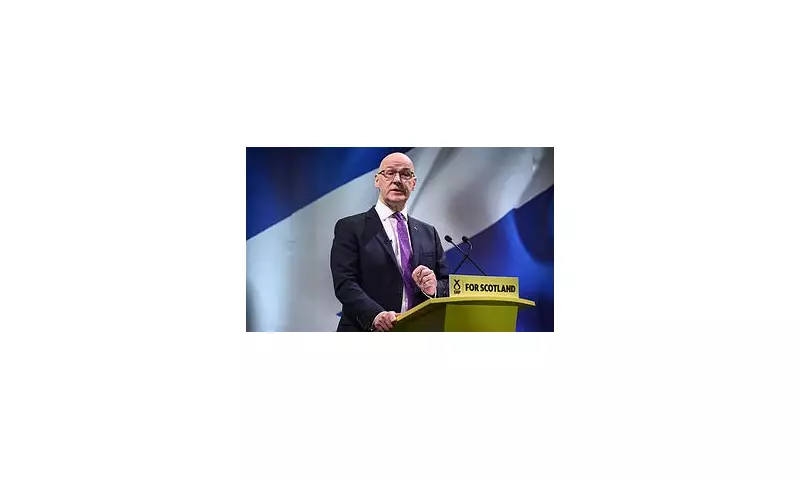
Scottish First Minister John Swinney has been widely ridiculed after launching the SNP's election campaign with a pledge to make independence its 'cornerstone', while simultaneously refusing to tell voters how he intends to achieve it.
The 'Precedent' Argument and a Secret Plan
Setting out his pitch for a historic fifth term for the SNP at Holyrood, Swinney was forced to deny that his strategy for securing another independence referendum was a half-baked 'muddle'. He insisted that if his party wins a majority in the Scottish Parliament elections on May 7, 2026, 'precedent' would demand a new vote on the Union.
Pointing to the 2011 SNP landslide under Alex Salmond, Swinney argued: 'It worked in 2011 - and it will work in 2026.' However, when pressed by the media on what happens if Westminster again refuses to grant a Section 30 order, the First Minister changed tack, admitting precedent 'should be enough' while revealing he had 'various tactics' in reserve.

He refused to elaborate on these tactics, calling them a 'secret plan'. When it was put to him that this sounded confused, he snapped: 'No it doesn't. No it doesn't. What it means is that the UK should respect the democratic wishes of the people of Scotland.'
Legal and Political Reality Check
Swinney's strategy faces immense legal and political hurdles. The UK Supreme Court ruled unanimously in 2022 that only Westminster can authorise a constitutional referendum. Successive UK governments have ruled one out, citing the decisive 'No' vote in the 2014 independence referendum.
Chancellor Rachel Reeves stated unequivocally in November that another SNP majority would not change this, telling the BBC: 'I'm going to be very clear, there won't be another referendum.'
Legal scholars have also trashed the 'precedent' argument, noting the UK Government cannot be compelled to grant a vote as it is ultimately a political decision. Former SNP MP Joanna Cherry KC dismissed it as 'back of the envelope nonsense'.
Opposition Fury and Domestic Record Defended
The opposition reacted with fury to Swinney's campaign launch in Glasgow. Scottish Conservative deputy leader Rachael Hamilton accused the First Minister of 'obsessing over independence' instead of focusing on public priorities like the NHS and schools.
'He has made it clear that every vote for the SNP in May’s election will be used for another push to break up the United Kingdom,' she said. Alastair Cameron of Scotland in Union added that appetite for a 'bitterly divisive' new vote had dropped since 2014.
During his speech, Swinney defended the SNP's 19-year record, claiming child poverty was falling and the NHS had 'turned a corner'. The latter claim was denounced as 'rubbish' by former SNP health secretary Alex Neil, who cited a case of a 33-hour A&E trolley wait.
Despite the criticism, Swinney told party activists that securing an independence vote would 'flow' from an SNP majority, aiming to win the 65 seats needed for an overall majority in May.