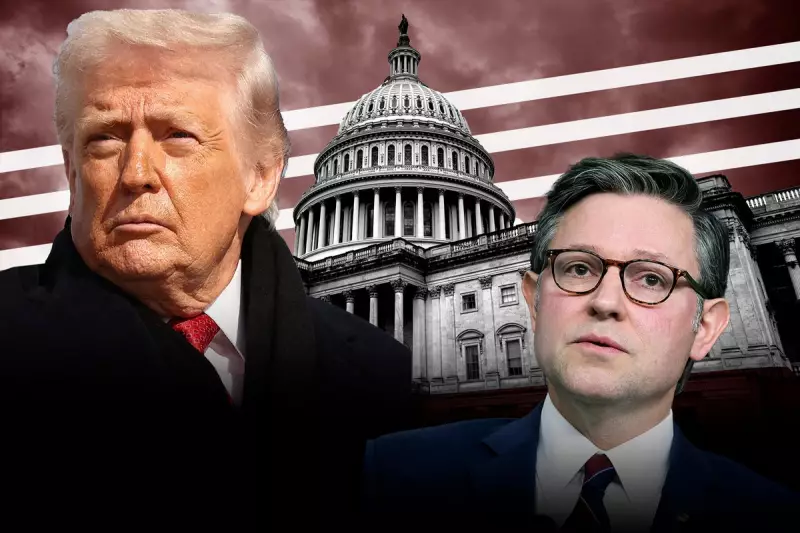
In just one year since his return to the White House, former President Donald Trump has profoundly reshaped the relationship between the executive and legislative branches, with Republicans in Congress demonstrating a marked reluctance to challenge his authority. This dynamic has raised significant questions about the practical state of the separation of powers in the United States.
A Pattern of Acquiescence in the Republican Ranks
The recent reversal by two Republican senators, Todd Young of Indiana and Josh Hawley of Missouri, on a War Powers Act resolution concerning Venezuela, serves as a potent symbol of this shift. The senators changed their votes after Trump publicly denounced the five Republicans who initially sided with Democrats, declaring they “should never be elected to office again.” This incident underscores how even once-fervent allies like Hawley, who famously led objections to the 2020 election certification, are not immune to presidential pressure.
Many anticipated a more fractious legislative process during Trump's second term, given the narrow Republican majorities. The GOP holds 53 seats in the Senate, short of the 60 needed to bypass filibusters, and a mere 220 seats in the House, just two above the majority threshold. Initial infighting, which saw Speaker Kevin McCarthy ousted and replaced by Mike Johnson, suggested a rocky path ahead. Yet, the reality has been starkly different, with Congress largely yielding to the president's agenda.

Representative Thomas Massie, a rare Republican critic from Kentucky, voiced his disillusionment to The Independent. “I thought I'd have some other people occasionally when he deviated from his promises,” Massie said. “My colleagues here are increasingly being forced to choose between President Trump and President Trump's promises, and so far, they've chose President Trump.”
Confirmations and Legislation: A Rubber-Stamp Congress?
This compliance is evident in key confirmations. Despite initial controversy, nearly all of Trump's major Cabinet nominees were approved. Senator Joni Ernst, an Army Reserve veteran, voted to confirm Pete Hegseth as Defence Secretary, despite his past comments opposing women in combat roles. Similarly, Senator Bill Cassidy, who had voted to convict Trump for his actions on January 6, supported the confirmation of anti-vaccine figure Robert F. Kennedy Jr. as Health and Human Services Secretary.
This represents a clear departure from Trump's first term, when figures like the late John McCain, Mitt Romney, and Liz Cheney provided notable opposition. The passage of the sprawling “One Big, Beautiful Bill” Act further illustrated the trend. While Senator Lisa Murkowski expressed objections, she voted for it hoping for amendments in the House. The House Freedom Caucus, historically a rebel faction, also fell into line.
During the debate, Representative Ralph Norman of South Carolina claimed the caucus had leverage because “they know we'll vote 'no.'” Ultimately, he and his colleagues voted ‘yes’ for both the rule and the final bill. Massie criticised conservatives on the Rules Committee, including Norman and Chip Roy of Texas, for capitulating.
The Cost of Defiance and the Centralisation of Power
Those who have dared to oppose the president have faced severe consequences. When then-Representative Marjorie Taylor Greene, a major Trump supporter, joined a bipartisan discharge petition to force a vote on releasing files related to Jeffrey Epstein, Trump lashed out, prompting her eventual resignation from Congress. Massie, who co-proposed the petition with Democrat Ro Khanna, now faces a primary challenge.
Executive power was further asserted when Trump vetoed a unanimously passed bill for clean drinking water rights in tribal areas, sponsored by Representative Lauren Boebert. Republicans in Congress refused to override the veto. Furthermore, Speaker Mike Johnson's decision to keep the House closed for six weeks, blocking votes on issues like tariffs and swearing in a newly elected Democrat, led to accusations that the legislative branch was ceding its authority.

While some, like Senator Thom Tillis of North Carolina, argue that Republicans have shown more independence than Democrats did under Presidents Obama and Biden, his voting record tells a different story. Despite occasional disagreements, such as on invading Greenland, Tillis voted to confirm Hegseth and helped shepherd the confirmation of Kash Patel as FBI director.
The cumulative effect of these events paints a picture of a constitutional balance under strain. As the first year of Trump's second term concludes, the traditional mechanisms of congressional oversight and intra-party dissent appear significantly weakened, rendering the principle of separated powers increasingly theoretical in the face of consolidated political will.