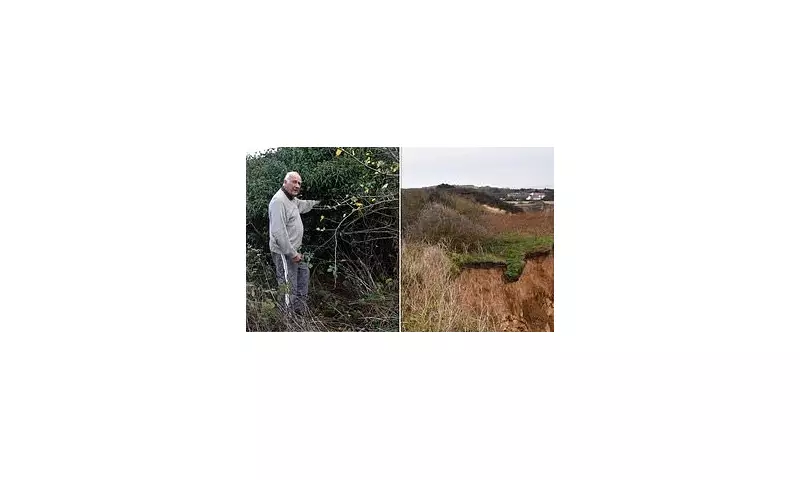
Villagers in a picturesque Norfolk coastal community have expressed disbelief and ridicule after their local council formally registered a 650-foot public byway that runs through an impassable thicket before terminating at a dangerous, crumbling cliff face.
A Four-Year Process for a 'Road to Nowhere'
After a lengthy four-year administrative process, Norfolk County Council declared the route in Sidestrand 'open to all traffic', a designation that legally permits cars, pedestrians, horse riders, and cyclists to use it. The decision was communicated to residents living at the inland end of the path via official letters, with signs erected to announce the new public right of way.
However, locals have branded the move absurd. Sidestrand parish councillor Ivor Watkins stated: 'It is as if they are inviting you to drive up to the cliff edge. If they had come and had a proper look, I’m sure they would have realised "What are we doing here?"' Another resident objected in writing, noting: 'I cannot see any reason to adopt this as a byway, it goes nowhere except over a cliff. The danger to public transport is huge.'

Historical Rights vs. Present Danger
The council's action was taken under a modification order, the formal process for recording routes on the definitive map of local rights of way. The Open Spaces Society (OSS), a group campaigning to preserve historic public paths, provided evidence including old maps indicating the route had existed for centuries and possessed vehicular rights.
A spokeswoman for the OSS explained their motivation, highlighting a looming deadline: 'Research revealed that this route has always been a public byway. We were motivated to claim this route because on January 1, 2031, it will no longer be possible to apply to record historic highways.' She added that government promises to repeal this cut-off have not yet been legislated.
Council officer Ben Nutall confirmed the byway was once part of the old A148 Coast Road, moved inland due to coastal erosion. 'It goes right up to the cliff edge. Furthermore, even though the last 50m or so of the route is largely inaccessible due to thick vegetation, the surface still has highway rights over it,' he said.
Erosion Accelerates and Money is 'Wasted'
Cllr Watkins, who has lived in the area since 1991, warned that coastal erosion has accelerated alarmingly. 'In that time we had one major collapse,' he said. 'But this [past] year we had three or four. It is getting worse.' He also called the lengthy registration process a 'waste of public money'.
Previously, Watkins had installed unofficial signs reading 'Only residents’ cars beyond this point' to prevent holidaymakers from driving down the track expecting beach access, only to find a dead end and have to reverse out. He suspects these restrictions prompted the OSS to pressure the council to assert the route's legal status.
While some online commentators defended the council and OSS for 'asserting ownership', the prevailing local mood is one of bafflement. A regular dog walker named Simon summed it up: 'It is a road to nowhere. I don’t think anyone will actually use the byway. It seems a strange thing to do.'