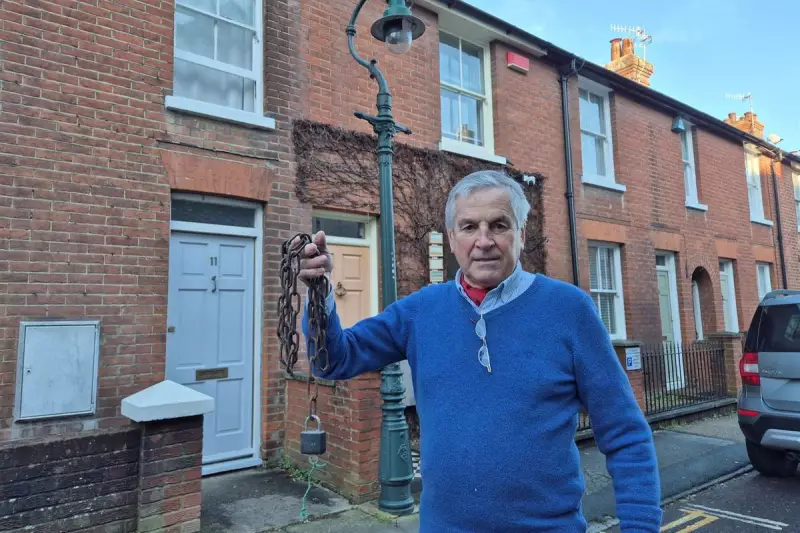
A defiant 78-year-old pensioner has pledged to chain himself to a historic Victorian lamppost outside his Canterbury home if council contractors attempt to tear it down.
A Stand for Heritage
Richard Parkinson, a former city councillor and ex-Sheriff of Canterbury, says the ornate cast-iron structures are "precious" features that must be "preserved at all costs." The picture restorer, who now holds the honorary title of city alderman, has personally cleaned and repainted the lamppost opposite his home in St Peter’s Lane.
"I’m not throwing out just an idle threat," Mr Parkinson stated. "I really mean it. If they come along with a digger to remove it, I’ll be out there to chain myself to the lamppost." His stand is part of a wider controversy that hit national headlines after Kent County Council (KCC) announced plans to potentially replace up to 240 historic lampposts deemed unsafe.

The Heart of the Controversy
The dispute was first ignited when KCC's highways department identified nine lampposts on Cossington Road as requiring removal due to corrosion. The posts are unique survivors from the HM Biggleston & Sons Foundry in Canterbury, which operated from the mid-19th century until 1963.
Engineers recommended steel replicas, estimating restoration costs could reach £5,000 per post. With 242 Biggleston posts potentially needing work, the total bill could approach £1 million. In contrast, modern replicas cost about £800 each, offering significant savings for the cash-strapped, Reform-run county council.
Leading the resistance are the Alliance of Canterbury Residents Association (ACRA) and The Canterbury Society. Their president, Ptolemy Dean—a conservation architect and surveyor of the fabric at Westminster Abbey—called the proposed replacements "grotesque-looking things."
David Kemsley, ACRA's business secretary, argued: "To replace them with mass-produced steel poles is cultural vandalism." The groups have launched a 'Save Canterbury’s Streetlights' campaign, urging the city council to use planning laws to protect lighting in Conservation Areas.
Council Response and Ongoing Talks
Facing overwhelming opposition, county council bosses have defended their approach. Cllr Peter Osborne, KCC’s cabinet member for highways and transport, stated on the authority’s Facebook page that the issue solely concerns the nine unsafe columns on Cossington Road.
"Painting them doesn’t fix internal corrosion or underground damage," he explained. "The original manufacturer is long gone, and full refurbishment would be impractical and very expensive for taxpayers." He emphasised that public safety is the priority and that KCC is not legally required to install heritage-style lighting but chooses to do so.
Cllr Osborne confirmed that no historic posts will be replaced while talks with Canterbury City Council to find a better solution are ongoing. He has invited The Canterbury Society for discussions and stated that KCC is working on "even better designs," with ornate lanterns being reused.
Separately, Canterbury City Council is using Levelling Up government funding to recreate the cast-iron lampposts it is responsible for in the Dane John Gardens.