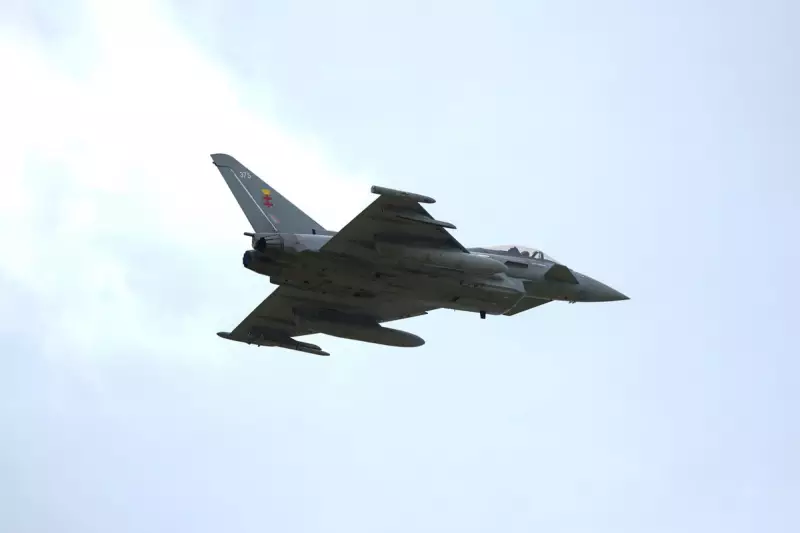
Defence Secretary John Healey is poised to unveil a major £453 million investment to equip the Royal Air Force's Typhoon fighter jets with next-generation radar technology, a move set to secure approximately 1,300 skilled positions across the United Kingdom.
Securing High-Skilled Employment Nationwide
During a visit to Leonardo UK's facility in Edinburgh on Thursday morning, Mr Healey will formally announce the award of this significant contract. The project involves a collaboration between three prominent UK defence firms: BAE Systems, Leonardo UK, and Parker Meggitt. Their collective task will be to install state-of-the-art radar systems onto the Typhoon fleet over the coming years.
This initiative is a substantial boost for the domestic workforce. It will directly safeguard 300 highly skilled engineering and technical roles at Leonardo's site in Edinburgh. Furthermore, the contract will secure an additional 120 jobs in Lancashire and over 100 positions in Luton, underscoring the project's wide-reaching economic benefits across different regions.

A Pillar of National and NATO Defence
In a statement, Defence Secretary John Healey emphasised the strategic importance of the Typhoon platform. "Our Typhoon fleet is the backbone of UK and NATO air defence," he stated. "Operated across Europe by the Royal Air Force and our allies, it is fundamental to protecting our skies and collective security."
Healey linked the upgrade directly to contemporary geopolitical challenges. "As the threats we face increase, and with Russian drones continuing to strike Ukraine and violate NATO airspace, this cutting-edge radar capability will keep Britain secure at home and strong abroad for many years to come," he added.
The announcement arrives during a period of heightened focus on NATO's capabilities and cohesion, partly influenced by international political developments.
Technological Leap with the ECRS Mk2 Radar
The core of this investment is the integration of 40 advanced European Common Radar System (ECRS) Mk2 units. This includes 38 entirely new systems and modifications to two existing test platforms. The ECRS Mk2 represents a significant technological advancement, offering capabilities far beyond traditional radar.
According to the Government, this new system will enable the RAF Typhoons to simultaneously detect, identify, and track multiple targets in the air and on the ground. Crucially, it provides a high-powered electronic jamming capability, allowing the aircraft to engage threats from beyond the enemy's effective range. This ensures the RAF maintains a decisive operational advantage in contested and highly defended airspace.
An Engine for Growth and Security
This contract is part of a broader pattern of defence investment announced this week, totalling over £650 million. Earlier, a £205 million contract was awarded to QinetiQ for long-term specialist engineering support for the Typhoon fleet. The Government has framed this combined spending as evidence that defence is a powerful "engine for growth," capable of creating skilled employment while simultaneously strengthening national security.
"Our Government has backed their high-skilled work with more than £650 million of investment this week alone," Mr Healey remarked. "This secures British jobs and makes defence an engine for growth in Scotland and beyond."
He also highlighted the long-term sustainability of the workforce, noting it will be supported for years due to a recent £8 billion fighter jet export deal secured with Türkiye in October, described as the biggest of its kind in a generation.
Scottish Expertise at the Forefront
Scottish Secretary Douglas Alexander welcomed the news, stressing the critical role of Scottish industry. "This £453 million contract award shows just how vital Scottish expertise is to the UK’s national security, and why Scotland is globally recognised as a centre of defence excellence," he said.
Alexander described the upgrade as "the latest in an impressive line of defence dividend wins for Scotland," reinforcing the UK Government's commitment to transforming the defence sector into a catalyst for economic growth and community prosperity.

Industry Perspective on Enhanced Capability
Mark Stead, Senior Vice-President of Radar and Advanced Targeting at Leonardo UK, provided insight into the radar's advanced features. "ECRS Mk2 isn’t just an exceptional radar – it’s equipped with advanced electronic surveillance and electronic attack capabilities which will make the RAF’s Typhoons more potent against their adversaries, adapting to new and unpredictable threats," he explained.
Stead confirmed the job security for 300 roles in Edinburgh and 100 in Luton, and noted that the project supports over 71 UK-based suppliers. He also expressed hope that the advanced capabilities of the ECRS Mk2 would lead to wider adoption by other international operators of the Typhoon aircraft.
A Long-Term Commitment to Air Power
This investment fulfils a commitment made in the UK's strategic defence review to continuously upgrade the RAF's Typhoon fleet. The aircraft are scheduled to remain in service, protecting British and allied airspace, until at least the 2040s. The full Typhoon programme is a cornerstone of UK aerospace, supporting an estimated 20,000 jobs across a network of 330 companies nationwide, illustrating its profound and sustained impact on the UK's industrial and defence landscape.