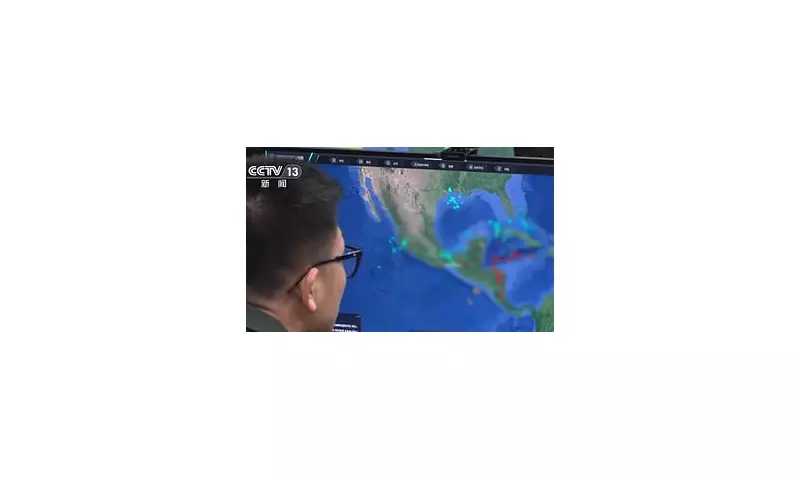
China's military has conducted extensive wargames simulating potential battles in strategically sensitive locations close to the United States, including the waters near Cuba and the Gulf of Mexico. This move is being interpreted as a significant signal of Beijing's expanding global military ambitions and its preparedness for potential conflict far beyond its immediate region.
Simulating Conflict in America's Backyard
According to reports from local media in China, the People's Liberation Army (PLA) held a wargaming event in Xuchang, within Henan province, which was attended by 20 military units. The simulations depicted hypothetical battles in several key global hotspots.
Broadcasts from the event showed screens with opposing units, traditionally colour-coded with red for Chinese forces and blue for enemy forces. One screen displayed these units converging near the coasts of Cuba and Mexico. Multiple blue units were positioned near Houston, Texas, advancing into the Gulf of Mexico, while red units were stationed in the Caribbean Sea.

Another screen focused on the North Pacific, showing red units near Russia's far eastern coast and blue units over Hokkaido, Japan, and the disputed Kuril Islands. A third screen prominently featured Taiwan at the centre of its map, underscoring the ongoing regional tension.
A New Era of Naval Power Projection
While the PLA regularly exercises around Taiwan and has conducted joint drills with Russia in the Sea of Okhotsk and the Sea of Japan, this public revelation of preparations for possible military actions in the Americas marks a notable escalation in rhetoric and displayed capability. It points to a strategic pivot towards global power projection.
This display of growing military boldness from China coincides with a major announcement from former US President Donald Trump regarding the modernisation of American naval forces. Trump revealed plans for a new class of vessel, which he has personally dubbed the 'Trump-class' battleship.
Trump's Counter: The 'Trump-Class' Battleship
Criticising the current US fleet as "old, tired, and obsolete," Trump vowed a dramatic overhaul. He approved immediate construction of the first two vessels, claiming they will be the largest and most powerful battleships in human history. The lead ship will be named the 'USS Defiant.'
Trump explained that these new warships, weighing between 30,000 to 40,000 tons, are designed to be a hundred times more powerful than the legendary Iowa-class battleships of WWII. The initial plan is for two ships, with an intent to rapidly expand to a fleet of ten and an ultimate goal of 20 to 25 such vessels.
Designed as high-tech fortresses, the Trump-class will reportedly feature:
- State-of-the-art electric rail guns.
- Hypersonic weapons and high-powered lasers.
- Nuclear-armed capabilities and AI integration.
- Massive guns offering lethal force at a "tiny fraction of the cost" of missiles.
Emphasising domestic industry revival, Trump stated these ships will be built in American navy yards, creating thousands of jobs. "I'm a very aesthetic person," he added, claiming these cutting-edge vessels will be "the most lethal Surface Warfare ships... the most ever built."
The concurrent developments—China's wargames near American shores and the US proposal for a new generation of super-battleships—highlight a rapidly intensifying great power competition, with military preparedness and technological dominance at its core. The public nature of these announcements suggests both nations are engaged in a form of strategic signalling, underscoring a volatile shift in global defence postures.